Jump to main content (press Enter)Jump to the footer (press Enter)

Breadcrumbs

  1. Home
  2. Emscherkunstweg

Emscherkunstweg

The Emscherkunstweg is a public art collection along the Emscher. The cooperation project is implemented by Urbane Künste Ruhr (until 30.9.2025), the Emschergenossenschaft and the Regionalverband Ruhr and is under the patronage of Ina Brandes, Minister for Culture and Science of the State of North Rhine-Westphalia. The public art collection emerged from the temporary exhibition format Emscherkunst, which has accompanied the Emscher conversion by the Emschergenossenschaft since 2010. Emscherkunst was initiated on the occasion of the RUHR.2010 Capital of Culture and subsequently continued as a triennial. Since 2019, the Emscherkunstweg has been a permanent sculpture trail and thus a sustainable exhibition format for the region. Five new works of art were added to the existing works. The extension was designed by Britta Peters, artistic director of Urbane Künste Ruhr, together with curator Marijke Lukowicz.

Open "Neustadt"
Artists Marta Dyachenko and Julius von Bismarck, together with artistic director Britta Peters, sit in front of Neustadt, a miniature city composed of models of demolished buildings from the Ruhr region.

© Daniel Sadrowski

Neustadt

Duisburg

A total of 23 sculptures form a fictitious city, on a scale of 1:25, made up of various real buildings that have been demolished in the Ruhr area since the turn of the millennium.

Open "Königsgrube"

© Henning Rogge

Königsgrube

Herne

A former pumping station of a disused colliery on the Emscherkunstweg becomes an installation, the name remains and sounds promising: Königsgrube.

Open "Pool Lines"
The sculpture Pool Lines by Sofía Táboas consists of two large triangular structures covered in shimmering green mosaic tiles, blending into the surrounding landscape.

© Henning Rogge

Pool Lines

Dortmund

Two large triangles together constitute a third triangular form. Their waist-high walls are about one metre thick; they both taper and flatten towards the ground.

Open "Emscher Folly"
Emscher Folly, a bicycle sculpture by Nicole Wermers, consists of over 50 bicycles arranged in a triangular shape, symbolizing mobility and urban transformation in the Ruhr area.

© Henning Rogge

Emscher Folly

Duisburg

For the Emscherkunstweg, artist Nicole Wermers has created a sculpture from over 50 bicycles and a triangular bicycle stand she designed.

Open "Public Hybrid"
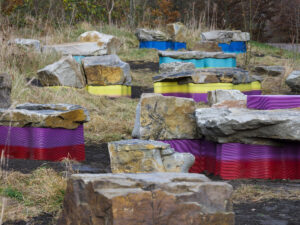
The installation Public Hybrid by David Jablonowski features multiple sandstone and plastic sculptures, their vibrant colors and irregular shapes appearing like artificial rock formations.

© Heinrich Holtgreve

Public Hybrid

Dortmund

David Jablonowski’s hybrid sculpture is located directly next to the Emscher-Weg bike path in the Schüren district of Dortmund.

Worte an den Ohren, an der Haut, an der Zelle

Havîn Al-Sîndy

© Amina Falah

© Amina Falah

© Amina Falah

© Amina Falah

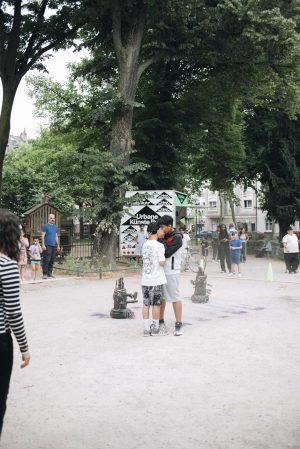
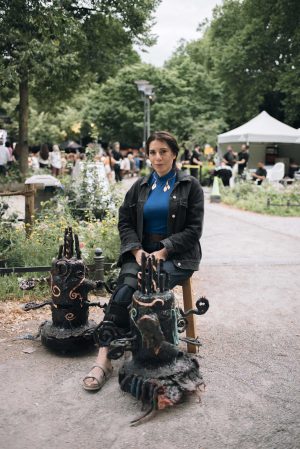
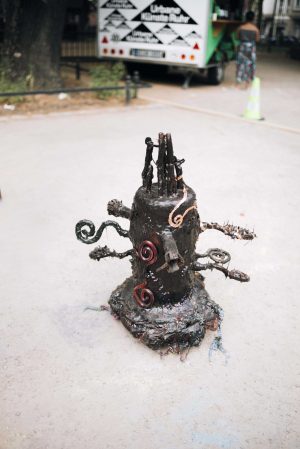
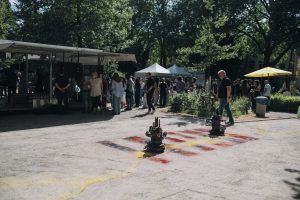
Auf dem Dortmunder Nordmarkt setzten sich zwei Skulpturen aus silikonartiger Textur und rätselhafter Silhouette das erste Mal in Bewegung – aufrecht, körperhaft und mit Mikrofonen versehen. Die über Sensoren gesteuerten Roboter haben mittels KI eines gelernt: das Lästern. Auch in Zukunft sollen Besucher*innen sich um sie versammeln, ihnen zuhören oder etwas zuflüstern können. So wird eine beiläufige, neugierige Öffentlichkeit allmählich in Gespräche verwickelt, die sie nicht vollständig kontrollieren kann. 

Die Roboter hat die Künstlerin Havîn Al-Sîndy in Kooperation mit Schüler*innen der Dortmunder Anne-Frank-Gesamtschule entwickelt. So ist Worte an den Ohren, an der Haut, an der Zelle Output eines Gestaltungsprozesses mit Jugendlichen, die ihre Stimmen, ihren Gossip, ihr Flüstern als Codes der Maschine geliehen haben. Zur Installation gehören auch eine sich durch Bewegung verändernde Bodenzeichnung und ein Film, der zwei aus Gips geformte Vögel in der Natur zeigt. 

Al-Sîndys Praxis kreist um immaterielle Archive – Erinnerungen, Körperwissen, kollektive Gedächtnisse – als fragile, widersprüchliche, doch wirkmächtige Formen von Wissen, und die Frage, wie sie weitergegeben, überschrieben oder verdrängt werden. Das Lästern ist dabei weit mehr als Klatsch: Es ist eine der ältesten Formen der informellen Sprachübertragung, eine des Widerstands für jene, denen offizielle Sprache verwehrt bleibt, eine Form der Oral History, die auf Marktplätzen und Hinterhöfen überlebt. Aber es ist auch ein Instrument der Mächtigen und der Manipulation: Sogar Amtsträger*innen verspotten heute öffentlich, das politische Gebaren scheint irrationaler zu werden. 

Die Frage, die Al-Sîndys Skulpturen stellen, ist also keine technische, sondern eine politische: Was geht verloren, wenn Sprache übersetzt, archiviert, codiert und automatisiert wird – und wessen Sprache war es überhaupt? 

Artist

Open Artsit

Havîn Al-Sîndy

Havîn Al-Sîndy works in Kurdistan and Germany. Her artistic practice moves between performance, sculpture, painting, and moving images.  

View