Jump to main content (press Enter)Jump to the footer (press Enter)

Breadcrumbs

  1. Home
  2. Emscherkunstweg
  3. Königsgrube

Königsgrube

© Henning Rogge

© Henning Rogge

© Henning Rogge

Address

Hofstraße 24
44651 Herne

Open in Maps

A former pumping station of a disused colliery becomes an installation, the name remains and sounds promising: Königsgrube. Markus Jeschaunig's work, in which he transforms fragments of the demolished building into a hybrid landscape, is characterised by past and future.

From 1860 to 1967, coal mining at the Königsgrube colliery in Herne-Röhlinghausen was extremely productive, then the black gold was extracted, leaving the earth depleted and perforated with subsidence of up to ten metres. The pumping station had the task of channeling the waste water from the neighbouring communities into the Hüller Bach and from there into the Emscher. With the end of coal mining, underground disposal became possible and the pumping station was decommissioned.

The pumping station is now being demolished. Artist Markus Jeschaunig is creating an installation on the partially backfilled foundations that sculpturally integrates various elements of the building: Part of a staircase will be preserved, three pipes will form a solar-powered fountain from which drops of water and sounds can be heard. A quarry forest is being created, a biotope made up of six black alder trees that like it wet and are reminiscent of the floodplain landscapes along the Emscher in pre-industrial times. On the paved forecourt, rainwater can be collected in a cistern via gutters and, together with a photovoltaic pergola, enables completely self-sufficient operation.

As an artistically remodelled ruin, Jeschaunig's work points to both the great technologies and the enormous ecological destruction that mining brought with it, and at the same time shows a way in which new life and climate-positive places can be created in the city.

Artist

Open Artsit

©Daniel Sadrowski

Markus Jeschaunig

Markus Jeschaunig works as an artist and architect, his projects combine art, natural sciences, ecology and activism.

View

Dates

  • Open Event
    Group of cyclists on a tour along the Emscherkunstweg. The cyclists ride on a paved path next to a river, passing under a highway bridge, surrounded by green scenery.

    © Daniel Sadrowski

    So., 30.3.25, 12:30–15 hView

    Bike Tour to the Opening of Königsgrube

  • Open Event
    The former pumping station Königsgrube by Markus Jeschaunig is captured in a winter setting, highlighting its green industrial structures and historical significance.

    © Daniel Sadrowski

    So., 30.3.25, 15 hView

    Opening Königsgrube

Worte an den Ohren, an der Haut, an der Zelle

Havîn Al-Sîndy

© Amina Falah

© Amina Falah

© Amina Falah

© Amina Falah

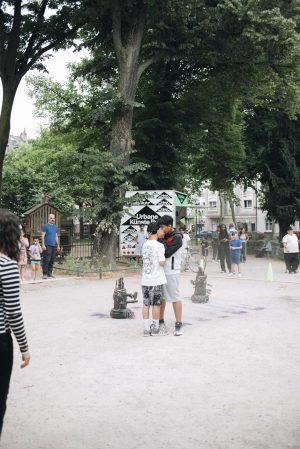
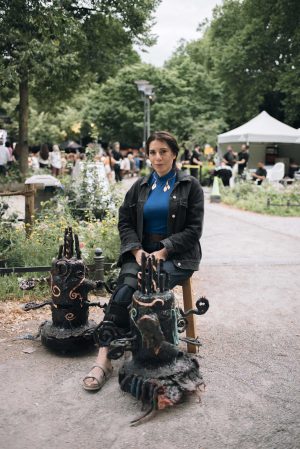
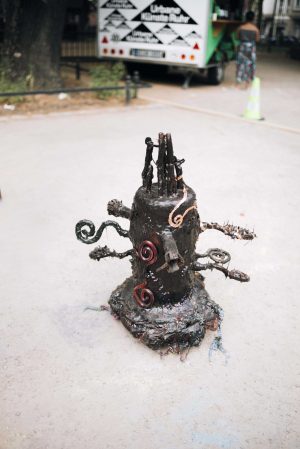
Auf dem Dortmunder Nordmarkt setzten sich zwei Skulpturen aus silikonartiger Textur und rätselhafter Silhouette das erste Mal in Bewegung – aufrecht, körperhaft und mit Mikrofonen versehen. Die über Sensoren gesteuerten Roboter haben mittels KI eines gelernt: das Lästern. Auch in Zukunft sollen Besucher*innen sich um sie versammeln, ihnen zuhören oder etwas zuflüstern können. So wird eine beiläufige, neugierige Öffentlichkeit allmählich in Gespräche verwickelt, die sie nicht vollständig kontrollieren kann. 

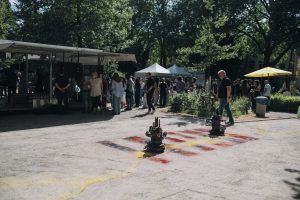
Die Roboter hat die Künstlerin Havîn Al-Sîndy in Kooperation mit Schüler*innen der Dortmunder Anne-Frank-Gesamtschule entwickelt. So ist Worte an den Ohren, an der Haut, an der Zelle Output eines Gestaltungsprozesses mit Jugendlichen, die ihre Stimmen, ihren Gossip, ihr Flüstern als Codes der Maschine geliehen haben. Zur Installation gehören auch eine sich durch Bewegung verändernde Bodenzeichnung und ein Film, der zwei aus Gips geformte Vögel in der Natur zeigt. 

Al-Sîndys Praxis kreist um immaterielle Archive – Erinnerungen, Körperwissen, kollektive Gedächtnisse – als fragile, widersprüchliche, doch wirkmächtige Formen von Wissen, und die Frage, wie sie weitergegeben, überschrieben oder verdrängt werden. Das Lästern ist dabei weit mehr als Klatsch: Es ist eine der ältesten Formen der informellen Sprachübertragung, eine des Widerstands für jene, denen offizielle Sprache verwehrt bleibt, eine Form der Oral History, die auf Marktplätzen und Hinterhöfen überlebt. Aber es ist auch ein Instrument der Mächtigen und der Manipulation: Sogar Amtsträger*innen verspotten heute öffentlich, das politische Gebaren scheint irrationaler zu werden. 

Die Frage, die Al-Sîndys Skulpturen stellen, ist also keine technische, sondern eine politische: Was geht verloren, wenn Sprache übersetzt, archiviert, codiert und automatisiert wird – und wessen Sprache war es überhaupt? 

Artist

Open Artsit

Havîn Al-Sîndy

Havîn Al-Sîndy works in Kurdistan and Germany. Her artistic practice moves between performance, sculpture, painting, and moving images.  

View