Jump to main content (press Enter)Jump to the footer (press Enter)

Breadcrumbs

  1. Home
  2. Emscherkunstweg
  3. Emscher Folly

Emscher Folly

Emscher Folly, a bicycle sculpture by Nicole Wermers, consists of over 50 bicycles arranged in a triangular shape, symbolizing mobility and urban transformation in the Ruhr area.

© Henning Rogge

Address

Kläranlage Duisburg-Alte Emscher
Alsumer Straße 215 
47166 Duisburg

Open in Maps

The artist Nicole Wermers has created a sculpture out of over 50 bicycles and a triangular bicycle stand she designed. 

She thus shifts an image familiar from urban space to a place marked by industrial work, abandoned and seemingly inhospitable, metaphorically speaking: in the engine room of everyday life between sewage plant and steelworks, the bicycles seem mysteriously out of place. Freed from their use, their design emerges all the more clearly. Close to the former mouth of the River Emscher, Emscher Folly also refers to the artificiality of a landscape as strongly shaped by man as the Emscher region.

Nicole Wermers lives and works in London and Emsdetten. She has been a professor at the Academy of Fine Arts in Munich since 2017. She was a fellow of the German Academy Villa Massimo in Rome in 2012 and was nominated for the Turner Prize in 2015. In her sculptures, photographs and collages, the artist combines formal questions with investigations of urban space and its social, economic and psychological inscriptions.

Artist

Open Artsit

Nicole Wermers

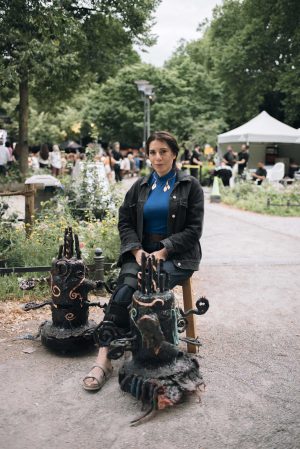
Nicole Wermers uses sculptures and collages to depict urban space, social structures and the recomposition of everyday objects.
View

Worte an den Ohren, an der Haut, an der Zelle

Havîn Al-Sîndy

© Amina Falah

© Amina Falah

© Amina Falah

© Amina Falah

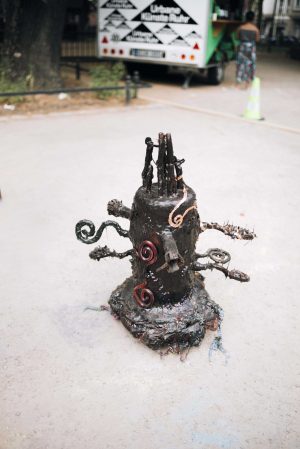
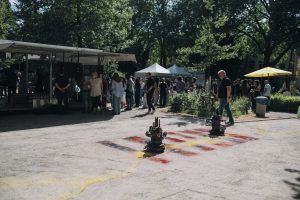
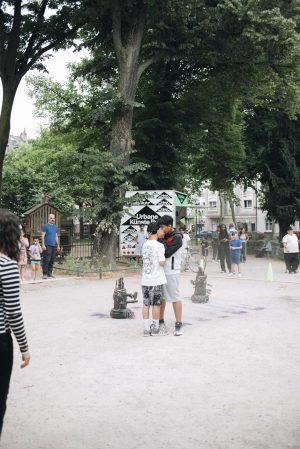
Auf dem Dortmunder Nordmarkt setzten sich zwei Skulpturen aus silikonartiger Textur und rätselhafter Silhouette das erste Mal in Bewegung – aufrecht, körperhaft und mit Mikrofonen versehen. Die über Sensoren gesteuerten Roboter haben mittels KI eines gelernt: das Lästern. Auch in Zukunft sollen Besucher*innen sich um sie versammeln, ihnen zuhören oder etwas zuflüstern können. So wird eine beiläufige, neugierige Öffentlichkeit allmählich in Gespräche verwickelt, die sie nicht vollständig kontrollieren kann. 

Die Roboter hat die Künstlerin Havîn Al-Sîndy in Kooperation mit Schüler*innen der Dortmunder Anne-Frank-Gesamtschule entwickelt. So ist Worte an den Ohren, an der Haut, an der Zelle Output eines Gestaltungsprozesses mit Jugendlichen, die ihre Stimmen, ihren Gossip, ihr Flüstern als Codes der Maschine geliehen haben. Zur Installation gehören auch eine sich durch Bewegung verändernde Bodenzeichnung und ein Film, der zwei aus Gips geformte Vögel in der Natur zeigt. 

Al-Sîndys Praxis kreist um immaterielle Archive – Erinnerungen, Körperwissen, kollektive Gedächtnisse – als fragile, widersprüchliche, doch wirkmächtige Formen von Wissen, und die Frage, wie sie weitergegeben, überschrieben oder verdrängt werden. Das Lästern ist dabei weit mehr als Klatsch: Es ist eine der ältesten Formen der informellen Sprachübertragung, eine des Widerstands für jene, denen offizielle Sprache verwehrt bleibt, eine Form der Oral History, die auf Marktplätzen und Hinterhöfen überlebt. Aber es ist auch ein Instrument der Mächtigen und der Manipulation: Sogar Amtsträger*innen verspotten heute öffentlich, das politische Gebaren scheint irrationaler zu werden. 

Die Frage, die Al-Sîndys Skulpturen stellen, ist also keine technische, sondern eine politische: Was geht verloren, wenn Sprache übersetzt, archiviert, codiert und automatisiert wird – und wessen Sprache war es überhaupt? 

Artist

Open Artsit

Havîn Al-Sîndy

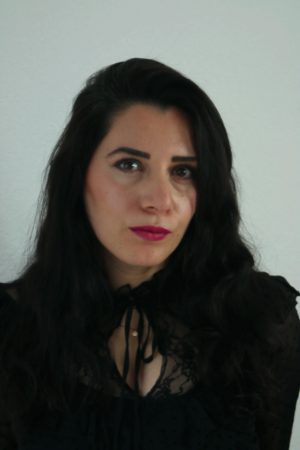
Havîn Al-Sîndy works in Kurdistan and Germany. Her artistic practice moves between performance, sculpture, painting, and moving images.  

View