Breadcrumbs
The Troubadour by Ari Benjamin Meyers in Coproduction with the Manifesta 16 Ruhr3.7.2026
The Troubadour is a one-month durational performance taking place from the 10th of August to the 10th of September 2026 at various locations across the Ruhr Area. In addition, as part of the event Electronic Shifts by Urbane Künste Ruhr, there will be an epilogue on the 19th of September at Ev. Stadtkirche Sankt Petri in Dortmund.
The project The Troubadour is a co-production by Urbane Künste Ruhr and Manifesta 16 Ruhr. It is part of the exhibition Uncanny Shifts (from the 22nd of August until the 4th of October 2026), which Urbane Künste Ruhr is presenting for this year’s Ruhrtriennale.
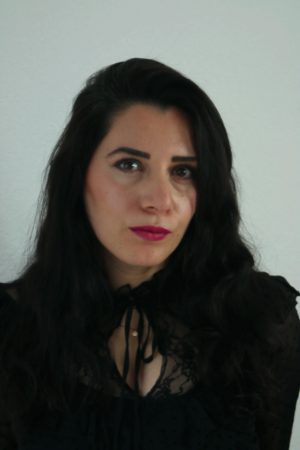
The Troubadour, performed by British-Romani singer-songwriter and actor Riah Knight, will travel through the Ruhr Area for one month – from Bochum to Dortmund, from Duisburg to Essen. Accompanied by an assistant, the Juggler, the Troubadour figure will meet people, exchange stories, wander around and find her way using public transport while searching for places to stay and spend time.
She will play music as she goes, in concert halls and clubs as well as town squares and parks. Her performances will combine songs composed for the project by Ari Benjamin Meyers with new material she will write during her travels.
Inspired by the travelling balladeers of the Middle Ages, this one-month project is both a durational performance and a social experiment. Conversations, hospitality and shared experiences will give rise to an everexpanding repertoire of songs and tales. How will this ‘unknown traveller’ be treated in each town she visits? What kind of music will her journey through the region produce?
The Troubadour by Ari Benjamin Meyers is a co-production by Urbane Künste Ruhr and Manifesta 16 Ruhr as part of the exhibition Uncanny Shifts. Uncanny Shifts is an exhibition by Urbane Künste Ruhr for the Ruhrtriennale 2026.
Save the Dates:
The Troubadour’s Welcome
Date: Wednesday, 12.8.2026
Time: 19-21 h
Meeting point: Hans-Schalla-Platz at Schauspielhaus Bochum, 44789 Bochum
Organiser: Manifesta 16 Ruhr
Meet the Troubadour
Date: Sunday, 23.8.2026
Time: 16:30-18:30 h
Meeting point: Dietrich-Keuning-Haus, Leopoldstr. 50-58, 44147 Dortmund
Organiser: Urbane Künste Ruhr
The Troubadour’s Farewell
Date: Thursday, 10.9.2026
Time: 19-21 h
Meeting point: Christ-König-Kirche, Steinring 32, 44789 Bochum
Organiser: Manifesta 16 Ruhr
Troubadour, The Epilogue
Date: Saturday, 19.9.2026
Time: 19-21 h
Meeting point: Ev. Stadtkirche Sankt Petri, Westenhellweg/ Petrikirchhof 1, 44137 Dortmund, as part of DEW21 Museumsnacht
Organiser: Urbane Künste Ruhr and Ev. Stadtkirche Sankt Petri
Performance The Troubadour: Riah Knight
Assistenz / The Juggler: Christian Löffel
Curated by Britta Peters (Urbane Künste Ruhr) together with Michael Kurtz (Manifesta 16 Ruhr)