Breadcrumbs
Uncanny Shifts
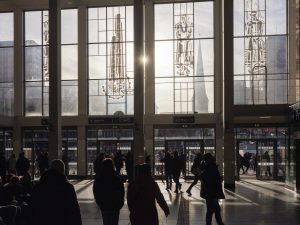
© Heinrich Holtgreve
Address
Ev. Stadtkirche Sankt Petri und others
Westenhellweg / Petrikirchhof 1
44137 Dortmund
Accessibility
An exhibition close to Dortmund main station
With Works by Ellinor Aurora Aasgaard & Zayne Armstrong, Anushka Chkheidze, Aleksandra Domanović, Kein schöner Archiv (Michael Annoff & Nuray Demir), Katrin Mayer, Hans Ostapenko with MNPL, Ziran Sha Pei, Joanna Piotrowska, Neda Saeedi, sakasaka, Silke Schönfeld, Transsolar, UH HUH HER, Driant Zeneli and The Troubadour by Ari Benjamin Meyers in co-production with Manifesta 16 Ruhr
Familiar environments are changing, fundamental orders are shifting, and threatening events are repeating themselves: the uncanny could be considered a state that describes the prevailing mood of the present. While committed scientists are trying to find ways out of the global crises, feelings of fear and uncertainty are mixed with polemics, denial and rejection in the discourse fueled by authoritarian voices.
The exhibition Uncanny Shifts uses artistic means to address some ecological, social, and political interactions of our time. At various locations around Dortmund's main railway station, sculptural, installation and performative works interact with their surroundings. They encounter a complex present with new inventions, curiosity, prudence, beauty and melancholic analyses.
Some projects were developed as part of the programme Zu Gast bei Urbane Künste Ruhr.
An exhibition by Urbane Künste Ruhr for the Ruhrtriennale 2026
Your visit
The exhibition takes place at different locations which are within walking distance from the main station. The locations are accessible for wheelchair users (with exceptions). If you have any questions, our team will be happy to help you at several locations and at the information stand in the pedestrian zone at Westenhellweg/Petrikirchplatz. Information material is also available on site for your orientation.
Download map (PDF)
View locations via Google Maps
English audio tour: Listen here
By public transport
Dortmund main station or metro lines U 41, U 45, U 47, U 49 to Kampstraße stop
By car
DOPARK Underground car park Westentor
Navigation: Schmiedingstr. 10, 44137 Dortmund
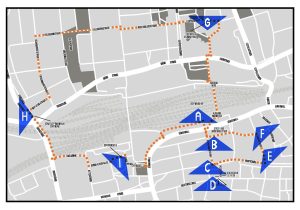
A Aleksandra Domanović: Dortmunder Hauptbahnhof, Königswall 15, 44137 Dortmund
B Neda Saeedi: Max-Von-Der-Grün-Platz 5, 44137 Dortmund
C Hans Ostapenko mit MNPL: Fußgängerzone zwischen Café Bernstein & Sparkasse Dortmund
D Kein Schöner Archiv, Transsolar, Anushka Chkheidze, Joanna Piotrowska, Ziran Sha Pei: Ev. Stadtkirche Sankt Petri: Westenhellweg/ Petrikirchhof 1, 44137 Dortmund
E Ellinor Aurora Aasgaard & Zayne Armstrong, Silke Schönfeld, Driant Zeneli, sakasaka: Ehemaliges Optikergeschäft, Hansastraße 26-28, 44137 Dortmund
F Katrin Mayer: HANS C: Hansastraße 6-12, 44137 Dortmund
G Kein schöner Archiv (Michael Annoff & Nuray Demir): Dietrich-Keuning-Haus: Leopoldstraße 50-58, 44147 Dortmund
H Tingling Earth – Schauer unter der Haut der Erde🔥: Künstler*innenhaus Dortmund: Sunderweg 1, 44147 Dortmund
I UH HUH HER: Lautsprecher in Dortmunder U Etage 4, Leonie-Reygers-Terrasse, 44137 Dortmund
- Artistic Director:
Britta Peters
- Curators:
Alisha Raissa Danscher und Britta Peters
Booklet
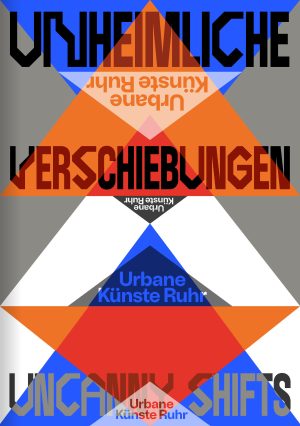
Exhibition booklet
The exhibition Uncanny Shifts uses artistic means to address some ecological, social, and political interactions of our time. At various locations around Dortmund's main railway station, sculptural, installation and performative works interact with their surroundings. They encounter a complex present with new inventions, curiosity, prudence, beauty and melancholic analyses.
Programme
- Open Event
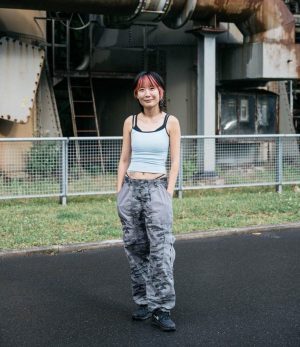 Do., 3.9.26, 18 hView
Die Geschichte der ruhigen Wolke (WIP)
- Open EventFr., 4.9.26, 18 hView
Die Geschichte der ruhigen Wolke (WIP)
- Open Event
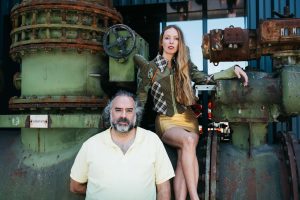
© Daniel Sadrowksi
Mo., 10.8. – Do., 10.9.26ViewThe Troubadour