Jump to main content (press Enter)Jump to the footer (press Enter)

Breadcrumbs

  1. Home
  2. Emscherkunstweg
  3. Public Hybrid

Public Hybrid

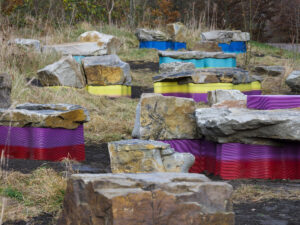
The installation Public Hybrid by David Jablonowski features multiple sandstone and plastic sculptures, their vibrant colors and irregular shapes appearing like artificial rock formations.

© Heinrich Holtgreve

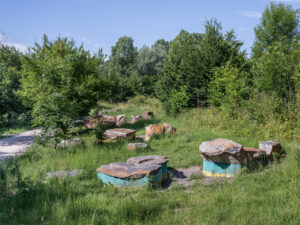
The sculpture Public Hybrid by David Jablonowski stands along the Emscherkunstweg, where layered Ruhr sandstone and 3D-printed plastic elements merge into an abstract landscape.

© Henning Rogge

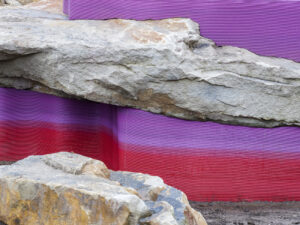
A detailed view of Public Hybrid by David Jablonowski showcases the layered combination of natural sandstone and vividly colored 3D-printed plastic, symbolizing the intersection of nature and technology.

© Heinrich Holtgreve

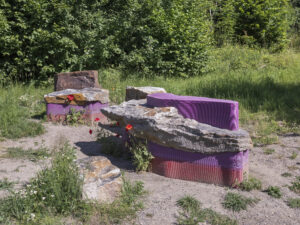
A close-up of Public Hybrid by David Jablonowski shows the colorful, 3D-printed plastic elements blending with natural sandstone, creating a striking contrast.

© Henning Rogge

Address

Emscher-Weg 
Adelenstraße 
44269 Dortmund

Open in Maps

David Jablonowski’s hybrid sculpture is located directly next to the Emscher-Weg bike path in the Schüren district of Dortmund.

In it, the artist, who grew up in Bochum, explores the history and future not only of this particular place, but of the entire Ruhr area as well. At the same time, he has created a contemporary monument that resembles a natural landmark and can be regarded as referring to the ecological improvements that have been made to Emscher River system.

In this multipart installation titled »Public Hybrid«, the artist combines the contrasting materials of sandstone and plastic. 3D printed elements made of recycled plastic and broken sandstone from the Ruhr region are stacked on top of each other like sediments. The resulting amorphous, artificial formations protrude out of the ground in a seemingly random fashion.  

The sandstone comes from the nearby town of Sprockhövel. It was formed about 320 million years ago and is one of the most resistant types of sandstone in Germany. Unlike this raw material that has been used by humans for millennia, the use of recycled plastic elements produced by 3D printing provides a glimpse into a digital, green vision of the future. 3D printing, or additive manufacturing technology, is in principle based on data for computer-aided physical translation. Through 3D printing, Jablonowski implicitly refers to invisible infrastructures that are created by the digital data traffic of public communication. He also juxtaposes waste, which is a material that needs the help of digital technology to become a resource, with geological materials that are quarried in a traditional way. This innovation through the combination of new technologies, nature, and artistic interventions also reflects the project of a generation of restoring the Emscher River.

Artist

Open Artsit

©Frey

David Jablonowski

In his sculptures, David Jablonowski shows the changes in communication and media content, influenced by industrial materials and technologies.
View

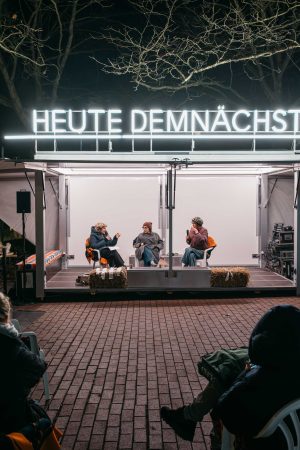
HEUTE DEMNÄCHST ENDE

Anna Viebrock

© Daniel Sadrowski

© Daniel Sadrowski

© Daniel Sadrowski

© Daniel Sadrowski

© Daniel Sadrowski

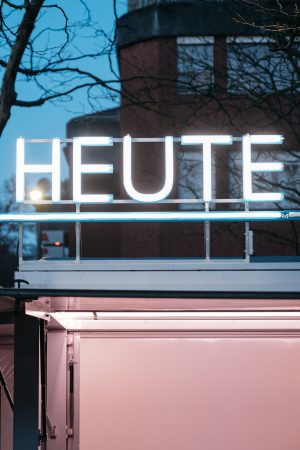
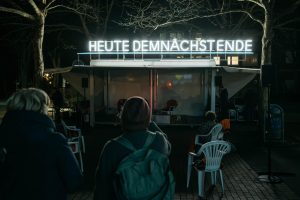
Drei Wörter leuchten in den Himmel: HEUTE DEMNÄCHST ENDE. Es könnte wie die Ankündigung eines Kinoprogramms klingen, beim wiederholten Lesen aber vervielfältigen sich die drei Worte auf dem Schriftzug von Anna Viebrock zu mehr – einer Prophezeiung, Warnung, einem lakonischen Gedicht. 

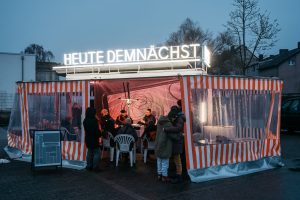
Seit den späten 1980er-Jahren hat die Bühnenbildnerin, Regisseurin und Künstlerin einen Fundus aus ihren eigenen Bühnenbildern angesammelt, den sie für die Entstehung neuer Arbeiten nutzt. Sie verwendet Elemente ihrer detailreichen und Geschichten-überbordenden Innenräume erneut und lädt sie mit zusätzlicher Bedeutung auf. Auch das 2021 für Christoph Marthalers Inszenierung der Operette Giuditta von Franz Lehár entworfene Szenario, dem der Schriftzug HEUTE DEMNÄCHST ENDE entstammt, hat seither ein Eigenleben entwickelt: 2024 schuf Viebrock aus dem recycelten Giuditta-Bühnenbild eine Gesamtinstallation für ihre Ausstellung in der Skulpturenhalle Neuss, die das Zitat aus der Operette als Titel verwendete. Seit 2026 zieht der Schriftzug nun in wetterfester Ausführung auf dem Trailer der Grand Snail Tour durchs Ruhrgebiet. Mit jedem Stopp und in jedem Kontext kann der Text neue Bedeutungen gewinnen. 

Die Buchstaben leuchten auch sinnbildlich für das gesamte Konzept der dreijährigen Tour, die als Hybrid zwischen mobilem Ausstellungsort und Veranstaltungsformat alle 53 Ruhrgebietsstädte miteinander verbindet. HEUTE DEMNÄCHST ENDE beschreibt damit nicht nur eine abstrakte Zeitlichkeit, sondern die konkrete Dramaturgie eines im September 2024 begonnenen und bis Oktober 2027 geplanten Projekts, das seine eigene Endlichkeit kennt. 

Artist

Open Artsit

© Lisa Rastl

Anna Viebrock

Anna Viebrock studied stage design at the Düsseldorf Art Academy. Her collaboration with Christoph Marthaler took her to numerous theatres and opera houses.

View