Jump to main content (press Enter)Jump to the footer (press Enter)

Breadcrumbs

  1. Home
  2. Emscherkunstweg

Emscherkunstweg

The Emscherkunstweg is a public art collection along the Emscher. The cooperation project is implemented by Urbane Künste Ruhr (until 30.9.2025), the Emschergenossenschaft and the Regionalverband Ruhr and is under the patronage of Ina Brandes, Minister for Culture and Science of the State of North Rhine-Westphalia. The public art collection emerged from the temporary exhibition format Emscherkunst, which has accompanied the Emscher conversion by the Emschergenossenschaft since 2010. Emscherkunst was initiated on the occasion of the RUHR.2010 Capital of Culture and subsequently continued as a triennial. Since 2019, the Emscherkunstweg has been a permanent sculpture trail and thus a sustainable exhibition format for the region. Five new works of art were added to the existing works. The extension was designed by Britta Peters, artistic director of Urbane Künste Ruhr, together with curator Marijke Lukowicz.

Open "Neustadt"
Artists Marta Dyachenko and Julius von Bismarck, together with artistic director Britta Peters, sit in front of Neustadt, a miniature city composed of models of demolished buildings from the Ruhr region.

© Daniel Sadrowski

Neustadt

Duisburg

A total of 23 sculptures form a fictitious city, on a scale of 1:25, made up of various real buildings that have been demolished in the Ruhr area since the turn of the millennium.

Open "Königsgrube"

© Henning Rogge

Königsgrube

Herne

A former pumping station of a disused colliery on the Emscherkunstweg becomes an installation, the name remains and sounds promising: Königsgrube.

Open "Pool Lines"
The sculpture Pool Lines by Sofía Táboas consists of two large triangular structures covered in shimmering green mosaic tiles, blending into the surrounding landscape.

© Henning Rogge

Pool Lines

Dortmund

Two large triangles together constitute a third triangular form. Their waist-high walls are about one metre thick; they both taper and flatten towards the ground.

Open "Emscher Folly"
Emscher Folly, a bicycle sculpture by Nicole Wermers, consists of over 50 bicycles arranged in a triangular shape, symbolizing mobility and urban transformation in the Ruhr area.

© Henning Rogge

Emscher Folly

Duisburg

For the Emscherkunstweg, artist Nicole Wermers has created a sculpture from over 50 bicycles and a triangular bicycle stand she designed.

Open "Public Hybrid"
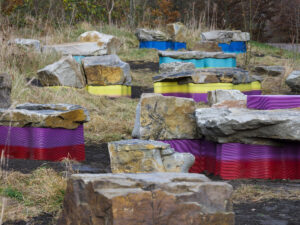
The installation Public Hybrid by David Jablonowski features multiple sandstone and plastic sculptures, their vibrant colors and irregular shapes appearing like artificial rock formations.

© Heinrich Holtgreve

Public Hybrid

Dortmund

David Jablonowski’s hybrid sculpture is located directly next to the Emscher-Weg bike path in the Schüren district of Dortmund.

HEUTE DEMNÄCHST ENDE

Anna Viebrock

© Daniel Sadrowski

© Daniel Sadrowski

© Daniel Sadrowski

© Daniel Sadrowski

© Daniel Sadrowski

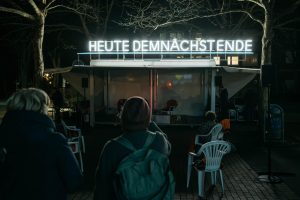
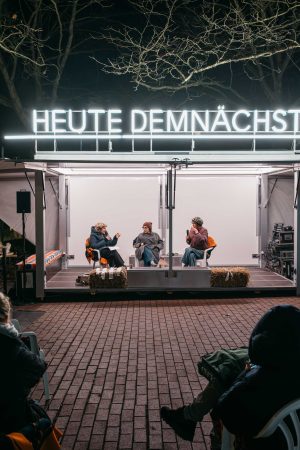
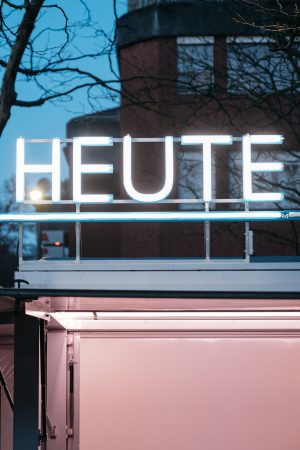
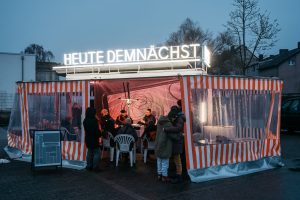
Drei Wörter leuchten in den Himmel: HEUTE DEMNÄCHST ENDE. Es könnte wie die Ankündigung eines Kinoprogramms klingen, beim wiederholten Lesen aber vervielfältigen sich die drei Worte auf dem Schriftzug von Anna Viebrock zu mehr – einer Prophezeiung, Warnung, einem lakonischen Gedicht. 

Seit den späten 1980er-Jahren hat die Bühnenbildnerin, Regisseurin und Künstlerin einen Fundus aus ihren eigenen Bühnenbildern angesammelt, den sie für die Entstehung neuer Arbeiten nutzt. Sie verwendet Elemente ihrer detailreichen und Geschichten-überbordenden Innenräume erneut und lädt sie mit zusätzlicher Bedeutung auf. Auch das 2021 für Christoph Marthalers Inszenierung der Operette Giuditta von Franz Lehár entworfene Szenario, dem der Schriftzug HEUTE DEMNÄCHST ENDE entstammt, hat seither ein Eigenleben entwickelt: 2024 schuf Viebrock aus dem recycelten Giuditta-Bühnenbild eine Gesamtinstallation für ihre Ausstellung in der Skulpturenhalle Neuss, die das Zitat aus der Operette als Titel verwendete. Seit 2026 zieht der Schriftzug nun in wetterfester Ausführung auf dem Trailer der Grand Snail Tour durchs Ruhrgebiet. Mit jedem Stopp und in jedem Kontext kann der Text neue Bedeutungen gewinnen. 

Die Buchstaben leuchten auch sinnbildlich für das gesamte Konzept der dreijährigen Tour, die als Hybrid zwischen mobilem Ausstellungsort und Veranstaltungsformat alle 53 Ruhrgebietsstädte miteinander verbindet. HEUTE DEMNÄCHST ENDE beschreibt damit nicht nur eine abstrakte Zeitlichkeit, sondern die konkrete Dramaturgie eines im September 2024 begonnenen und bis Oktober 2027 geplanten Projekts, das seine eigene Endlichkeit kennt. 

Artist

Open Artsit

© Lisa Rastl

Anna Viebrock

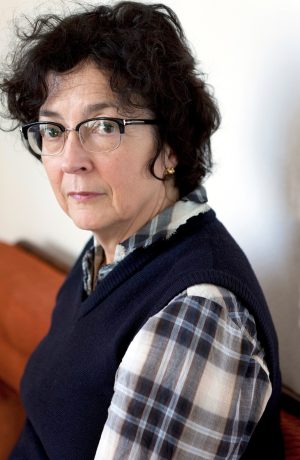
Anna Viebrock studied stage design at the Düsseldorf Art Academy. Her collaboration with Christoph Marthaler took her to numerous theatres and opera houses.

View