Jump to main content (press Enter)Jump to the footer (press Enter)

Breadcrumbs

  1. Home
  2. Emscherkunstweg

Emscherkunstweg

The Emscherkunstweg is a public art collection along the Emscher. The cooperation project is implemented by Urbane Künste Ruhr (until 30.9.2025), the Emschergenossenschaft and the Regionalverband Ruhr and is under the patronage of Ina Brandes, Minister for Culture and Science of the State of North Rhine-Westphalia. The public art collection emerged from the temporary exhibition format Emscherkunst, which has accompanied the Emscher conversion by the Emschergenossenschaft since 2010. Emscherkunst was initiated on the occasion of the RUHR.2010 Capital of Culture and subsequently continued as a triennial. Since 2019, the Emscherkunstweg has been a permanent sculpture trail and thus a sustainable exhibition format for the region. Five new works of art were added to the existing works. The extension was designed by Britta Peters, artistic director of Urbane Künste Ruhr, together with curator Marijke Lukowicz.

Open "Neustadt"
Artists Marta Dyachenko and Julius von Bismarck, together with artistic director Britta Peters, sit in front of Neustadt, a miniature city composed of models of demolished buildings from the Ruhr region.

© Daniel Sadrowski

Neustadt

Duisburg

A total of 23 sculptures form a fictitious city, on a scale of 1:25, made up of various real buildings that have been demolished in the Ruhr area since the turn of the millennium.

Open "Königsgrube"

© Henning Rogge

Königsgrube

Herne

A former pumping station of a disused colliery on the Emscherkunstweg becomes an installation, the name remains and sounds promising: Königsgrube.

Open "Pool Lines"
The sculpture Pool Lines by Sofía Táboas consists of two large triangular structures covered in shimmering green mosaic tiles, blending into the surrounding landscape.

© Henning Rogge

Pool Lines

Dortmund

Two large triangles together constitute a third triangular form. Their waist-high walls are about one metre thick; they both taper and flatten towards the ground.

Open "Emscher Folly"
Emscher Folly, a bicycle sculpture by Nicole Wermers, consists of over 50 bicycles arranged in a triangular shape, symbolizing mobility and urban transformation in the Ruhr area.

© Henning Rogge

Emscher Folly

Duisburg

For the Emscherkunstweg, artist Nicole Wermers has created a sculpture from over 50 bicycles and a triangular bicycle stand she designed.

Open "Public Hybrid"
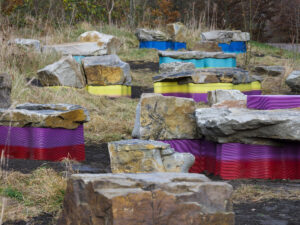
The installation Public Hybrid by David Jablonowski features multiple sandstone and plastic sculptures, their vibrant colors and irregular shapes appearing like artificial rock formations.

© Heinrich Holtgreve

Public Hybrid

Dortmund

David Jablonowski’s hybrid sculpture is located directly next to the Emscher-Weg bike path in the Schüren district of Dortmund.

Tablescapes

Nils Norman

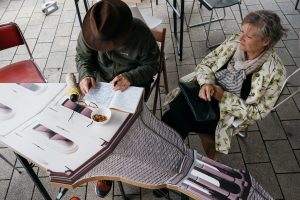
Two people sit at a table with a printed surface featuring an architectural motif. One person wears a brown hat and writes in a notebook, while the other, in a floral coat, sits holding a black bag.

© Daniel Sadrowski

© Daniel Sadrowski

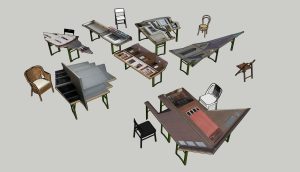
Neutral und funktional sollten mobile Tische sein. Doch die von Nils Norman irritieren diese Selbstverständlichkeit: Ihre Oberflächen zeigen ausgefräste Elemente unterschiedlicher Architekturen aus dem Ruhrgebiet – Kirchtürme, Fassaden aus der Gründerzeit, Platten- oder Gewerbebauten. Was als schlichte Arbeitsunterlage dient, wird zur opulenten Modelllandschaft. 

Norman arbeitet seit vielen Jahren interdisziplinär an der Schnittstelle von Skulptur, Natur, Architektur, Stadtplanung, Möbeldesign und Pädagogik, stets zur Frage: Wem gehört der öffentliche Raum und wer darf ihn gestalten? Er entwickelte Fußgängerbrücken, Theatervorhänge, Spielplätze, Gärten und Wegeleitsysteme, wobei er mit viel Humor seine Kritik an gängigen Vorstellungen von Stadtentwicklung, Lokalpolitik und ökonomischen Systemen formuliert. In seinem Archiv Urbanomics sammelt er seit 1997 Sicherheitsarchitekturen, wobei ihn die Frage nach der Gestaltung von Kontrolle interessiert und wie die Nutzung eines Raumes durch dessen Design beeinflusst wird. Mit dem umgebauten Reisebus mit Gewächshaus und Lesesaal Geocruiser (2002) schuf er eine mobile Bildungs- und Begegnungsinfrastruktur. 2005 ließ er mit einer 80m langen Brücke inklusive See und Insel einen neu gebauten Stadtteil im dänischen Roskilde mit seinen Nachbarschaften verbinden. 

Normans Tische für die Grand Snail Tour erfüllen eine Funktion und unterlaufen sie zugleich. Die klappbaren Gestelle verbinden Flexibilität und Mobilität mit barocker Ausgestaltung – Oberflächen, die mehr erzählen als nötig. Als Teil der Sammlung reisen sie von Beginn an mit, werden aufgestellt, verwendet und wieder eingeklappt. An jedem Stopp treffen die Tisch-Landschaften auf neue Stadträume und erzeugen stets eine produktive Reibung zwischen dem abgebildeten und tatsächlichen Ort. 

Artist

Open Artsit

Nils Norman

Nils Norman is an artist living in Amsterdam and Munich. He works across the disciplines of public art, architecture and urban planning.

View