Jump to main content (press Enter)Jump to the footer (press Enter)

Breadcrumbs

  1. Home
  2. Emscherkunstweg
  3. Königsgrube

Königsgrube

© Henning Rogge

© Henning Rogge

© Henning Rogge

Address

Hofstraße 24
44651 Herne

Open in Maps

A former pumping station of a disused colliery becomes an installation, the name remains and sounds promising: Königsgrube. Markus Jeschaunig's work, in which he transforms fragments of the demolished building into a hybrid landscape, is characterised by past and future.

From 1860 to 1967, coal mining at the Königsgrube colliery in Herne-Röhlinghausen was extremely productive, then the black gold was extracted, leaving the earth depleted and perforated with subsidence of up to ten metres. The pumping station had the task of channeling the waste water from the neighbouring communities into the Hüller Bach and from there into the Emscher. With the end of coal mining, underground disposal became possible and the pumping station was decommissioned.

The pumping station is now being demolished. Artist Markus Jeschaunig is creating an installation on the partially backfilled foundations that sculpturally integrates various elements of the building: Part of a staircase will be preserved, three pipes will form a solar-powered fountain from which drops of water and sounds can be heard. A quarry forest is being created, a biotope made up of six black alder trees that like it wet and are reminiscent of the floodplain landscapes along the Emscher in pre-industrial times. On the paved forecourt, rainwater can be collected in a cistern via gutters and, together with a photovoltaic pergola, enables completely self-sufficient operation.

As an artistically remodelled ruin, Jeschaunig's work points to both the great technologies and the enormous ecological destruction that mining brought with it, and at the same time shows a way in which new life and climate-positive places can be created in the city.

Artist

Open Artsit

©Daniel Sadrowski

Markus Jeschaunig

Markus Jeschaunig works as an artist and architect, his projects combine art, natural sciences, ecology and activism.

View

Dates

  • Open Event
    Group of cyclists on a tour along the Emscherkunstweg. The cyclists ride on a paved path next to a river, passing under a highway bridge, surrounded by green scenery.

    © Daniel Sadrowski

    So., 30.3.25, 12:30–15 hView

    Bike Tour to the Opening of Königsgrube

  • Open Event
    The former pumping station Königsgrube by Markus Jeschaunig is captured in a winter setting, highlighting its green industrial structures and historical significance.

    © Daniel Sadrowski

    So., 30.3.25, 15 hView

    Opening Königsgrube

Tablescapes

Nils Norman

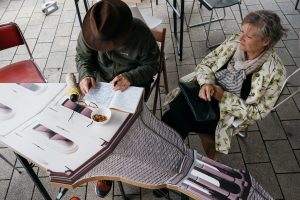
Two people sit at a table with a printed surface featuring an architectural motif. One person wears a brown hat and writes in a notebook, while the other, in a floral coat, sits holding a black bag.

© Daniel Sadrowski

© Daniel Sadrowski

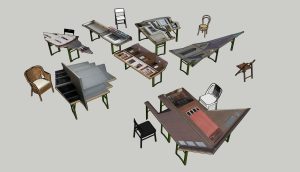
Neutral und funktional sollten mobile Tische sein. Doch die von Nils Norman irritieren diese Selbstverständlichkeit: Ihre Oberflächen zeigen ausgefräste Elemente unterschiedlicher Architekturen aus dem Ruhrgebiet – Kirchtürme, Fassaden aus der Gründerzeit, Platten- oder Gewerbebauten. Was als schlichte Arbeitsunterlage dient, wird zur opulenten Modelllandschaft. 

Norman arbeitet seit vielen Jahren interdisziplinär an der Schnittstelle von Skulptur, Natur, Architektur, Stadtplanung, Möbeldesign und Pädagogik, stets zur Frage: Wem gehört der öffentliche Raum und wer darf ihn gestalten? Er entwickelte Fußgängerbrücken, Theatervorhänge, Spielplätze, Gärten und Wegeleitsysteme, wobei er mit viel Humor seine Kritik an gängigen Vorstellungen von Stadtentwicklung, Lokalpolitik und ökonomischen Systemen formuliert. In seinem Archiv Urbanomics sammelt er seit 1997 Sicherheitsarchitekturen, wobei ihn die Frage nach der Gestaltung von Kontrolle interessiert und wie die Nutzung eines Raumes durch dessen Design beeinflusst wird. Mit dem umgebauten Reisebus mit Gewächshaus und Lesesaal Geocruiser (2002) schuf er eine mobile Bildungs- und Begegnungsinfrastruktur. 2005 ließ er mit einer 80m langen Brücke inklusive See und Insel einen neu gebauten Stadtteil im dänischen Roskilde mit seinen Nachbarschaften verbinden. 

Normans Tische für die Grand Snail Tour erfüllen eine Funktion und unterlaufen sie zugleich. Die klappbaren Gestelle verbinden Flexibilität und Mobilität mit barocker Ausgestaltung – Oberflächen, die mehr erzählen als nötig. Als Teil der Sammlung reisen sie von Beginn an mit, werden aufgestellt, verwendet und wieder eingeklappt. An jedem Stopp treffen die Tisch-Landschaften auf neue Stadträume und erzeugen stets eine produktive Reibung zwischen dem abgebildeten und tatsächlichen Ort. 

Artist

Open Artsit

Nils Norman

Nils Norman is an artist living in Amsterdam and Munich. He works across the disciplines of public art, architecture and urban planning.

View