Jump to main content (press Enter)Jump to the footer (press Enter)

Breadcrumbs

  1. Home
  2. Emscherkunstweg
  3. Public Hybrid

Public Hybrid

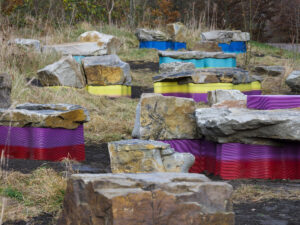
The installation Public Hybrid by David Jablonowski features multiple sandstone and plastic sculptures, their vibrant colors and irregular shapes appearing like artificial rock formations.

© Heinrich Holtgreve

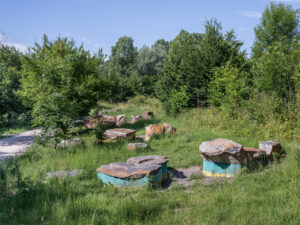
The sculpture Public Hybrid by David Jablonowski stands along the Emscherkunstweg, where layered Ruhr sandstone and 3D-printed plastic elements merge into an abstract landscape.

© Henning Rogge

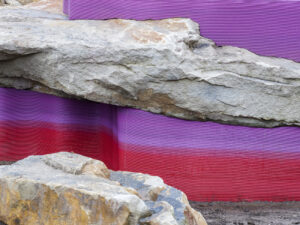
A detailed view of Public Hybrid by David Jablonowski showcases the layered combination of natural sandstone and vividly colored 3D-printed plastic, symbolizing the intersection of nature and technology.

© Heinrich Holtgreve

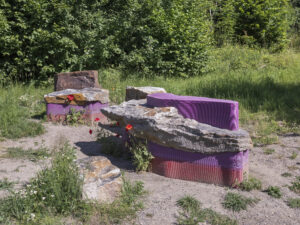
A close-up of Public Hybrid by David Jablonowski shows the colorful, 3D-printed plastic elements blending with natural sandstone, creating a striking contrast.

© Henning Rogge

Address

Emscher-Weg 
Adelenstraße 
44269 Dortmund

Open in Maps

David Jablonowski’s hybrid sculpture is located directly next to the Emscher-Weg bike path in the Schüren district of Dortmund.

In it, the artist, who grew up in Bochum, explores the history and future not only of this particular place, but of the entire Ruhr area as well. At the same time, he has created a contemporary monument that resembles a natural landmark and can be regarded as referring to the ecological improvements that have been made to Emscher River system.

In this multipart installation titled »Public Hybrid«, the artist combines the contrasting materials of sandstone and plastic. 3D printed elements made of recycled plastic and broken sandstone from the Ruhr region are stacked on top of each other like sediments. The resulting amorphous, artificial formations protrude out of the ground in a seemingly random fashion.  

The sandstone comes from the nearby town of Sprockhövel. It was formed about 320 million years ago and is one of the most resistant types of sandstone in Germany. Unlike this raw material that has been used by humans for millennia, the use of recycled plastic elements produced by 3D printing provides a glimpse into a digital, green vision of the future. 3D printing, or additive manufacturing technology, is in principle based on data for computer-aided physical translation. Through 3D printing, Jablonowski implicitly refers to invisible infrastructures that are created by the digital data traffic of public communication. He also juxtaposes waste, which is a material that needs the help of digital technology to become a resource, with geological materials that are quarried in a traditional way. This innovation through the combination of new technologies, nature, and artistic interventions also reflects the project of a generation of restoring the Emscher River.

Artist

Open Artsit

©Frey

David Jablonowski

In his sculptures, David Jablonowski shows the changes in communication and media content, influenced by industrial materials and technologies.
View

Tablescapes

Nils Norman

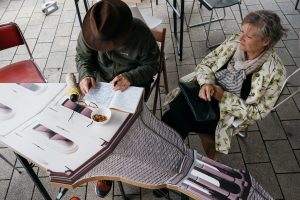
Two people sit at a table with a printed surface featuring an architectural motif. One person wears a brown hat and writes in a notebook, while the other, in a floral coat, sits holding a black bag.

© Daniel Sadrowski

© Daniel Sadrowski

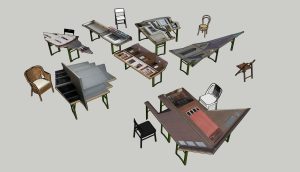
Neutral und funktional sollten mobile Tische sein. Doch die von Nils Norman irritieren diese Selbstverständlichkeit: Ihre Oberflächen zeigen ausgefräste Elemente unterschiedlicher Architekturen aus dem Ruhrgebiet – Kirchtürme, Fassaden aus der Gründerzeit, Platten- oder Gewerbebauten. Was als schlichte Arbeitsunterlage dient, wird zur opulenten Modelllandschaft. 

Norman arbeitet seit vielen Jahren interdisziplinär an der Schnittstelle von Skulptur, Natur, Architektur, Stadtplanung, Möbeldesign und Pädagogik, stets zur Frage: Wem gehört der öffentliche Raum und wer darf ihn gestalten? Er entwickelte Fußgängerbrücken, Theatervorhänge, Spielplätze, Gärten und Wegeleitsysteme, wobei er mit viel Humor seine Kritik an gängigen Vorstellungen von Stadtentwicklung, Lokalpolitik und ökonomischen Systemen formuliert. In seinem Archiv Urbanomics sammelt er seit 1997 Sicherheitsarchitekturen, wobei ihn die Frage nach der Gestaltung von Kontrolle interessiert und wie die Nutzung eines Raumes durch dessen Design beeinflusst wird. Mit dem umgebauten Reisebus mit Gewächshaus und Lesesaal Geocruiser (2002) schuf er eine mobile Bildungs- und Begegnungsinfrastruktur. 2005 ließ er mit einer 80m langen Brücke inklusive See und Insel einen neu gebauten Stadtteil im dänischen Roskilde mit seinen Nachbarschaften verbinden. 

Normans Tische für die Grand Snail Tour erfüllen eine Funktion und unterlaufen sie zugleich. Die klappbaren Gestelle verbinden Flexibilität und Mobilität mit barocker Ausgestaltung – Oberflächen, die mehr erzählen als nötig. Als Teil der Sammlung reisen sie von Beginn an mit, werden aufgestellt, verwendet und wieder eingeklappt. An jedem Stopp treffen die Tisch-Landschaften auf neue Stadträume und erzeugen stets eine produktive Reibung zwischen dem abgebildeten und tatsächlichen Ort. 

Artist

Open Artsit

Nils Norman

Nils Norman is an artist living in Amsterdam and Munich. He works across the disciplines of public art, architecture and urban planning.

View