Jump to main content (press Enter)Jump to the footer (press Enter)

Breadcrumbs

  1. Home
  2. Emscherkunstweg
  3. Königsgrube

Königsgrube

© Henning Rogge

© Henning Rogge

© Henning Rogge

Address

Hofstraße 24
44651 Herne

Open in Maps

A former pumping station of a disused colliery becomes an installation, the name remains and sounds promising: Königsgrube. Markus Jeschaunig's work, in which he transforms fragments of the demolished building into a hybrid landscape, is characterised by past and future.

From 1860 to 1967, coal mining at the Königsgrube colliery in Herne-Röhlinghausen was extremely productive, then the black gold was extracted, leaving the earth depleted and perforated with subsidence of up to ten metres. The pumping station had the task of channeling the waste water from the neighbouring communities into the Hüller Bach and from there into the Emscher. With the end of coal mining, underground disposal became possible and the pumping station was decommissioned.

The pumping station is now being demolished. Artist Markus Jeschaunig is creating an installation on the partially backfilled foundations that sculpturally integrates various elements of the building: Part of a staircase will be preserved, three pipes will form a solar-powered fountain from which drops of water and sounds can be heard. A quarry forest is being created, a biotope made up of six black alder trees that like it wet and are reminiscent of the floodplain landscapes along the Emscher in pre-industrial times. On the paved forecourt, rainwater can be collected in a cistern via gutters and, together with a photovoltaic pergola, enables completely self-sufficient operation.

As an artistically remodelled ruin, Jeschaunig's work points to both the great technologies and the enormous ecological destruction that mining brought with it, and at the same time shows a way in which new life and climate-positive places can be created in the city.

Artist

Open Artsit

©Daniel Sadrowski

Markus Jeschaunig

Markus Jeschaunig works as an artist and architect, his projects combine art, natural sciences, ecology and activism.

View

Dates

  • Open Event
    Group of cyclists on a tour along the Emscherkunstweg. The cyclists ride on a paved path next to a river, passing under a highway bridge, surrounded by green scenery.

    © Daniel Sadrowski

    So., 30.3.25, 12:30–15 hView

    Bike Tour to the Opening of Königsgrube

  • Open Event
    The former pumping station Königsgrube by Markus Jeschaunig is captured in a winter setting, highlighting its green industrial structures and historical significance.

    © Daniel Sadrowski

    So., 30.3.25, 15 hView

    Opening Königsgrube

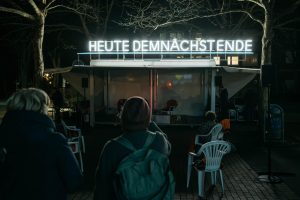
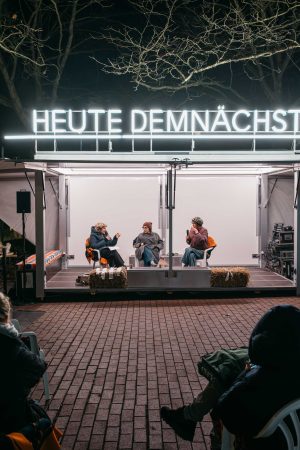
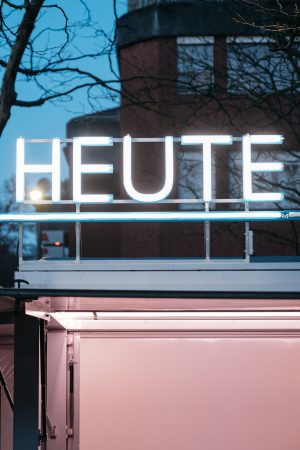
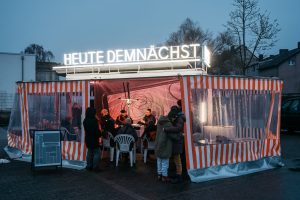
HEUTE DEMNÄCHST ENDE

Anna Viebrock

© Daniel Sadrowski

© Daniel Sadrowski

© Daniel Sadrowski

© Daniel Sadrowski

© Daniel Sadrowski

Drei Wörter leuchten in den Himmel: HEUTE DEMNÄCHST ENDE. Es könnte wie die Ankündigung eines Kinoprogramms klingen, beim wiederholten Lesen aber vervielfältigen sich die drei Worte auf dem Schriftzug von Anna Viebrock zu mehr – einer Prophezeiung, Warnung, einem lakonischen Gedicht. 

Seit den späten 1980er-Jahren hat die Bühnenbildnerin, Regisseurin und Künstlerin einen Fundus aus ihren eigenen Bühnenbildern angesammelt, den sie für die Entstehung neuer Arbeiten nutzt. Sie verwendet Elemente ihrer detailreichen und Geschichten-überbordenden Innenräume erneut und lädt sie mit zusätzlicher Bedeutung auf. Auch das 2021 für Christoph Marthalers Inszenierung der Operette Giuditta von Franz Lehár entworfene Szenario, dem der Schriftzug HEUTE DEMNÄCHST ENDE entstammt, hat seither ein Eigenleben entwickelt: 2024 schuf Viebrock aus dem recycelten Giuditta-Bühnenbild eine Gesamtinstallation für ihre Ausstellung in der Skulpturenhalle Neuss, die das Zitat aus der Operette als Titel verwendete. Seit 2026 zieht der Schriftzug nun in wetterfester Ausführung auf dem Trailer der Grand Snail Tour durchs Ruhrgebiet. Mit jedem Stopp und in jedem Kontext kann der Text neue Bedeutungen gewinnen. 

Die Buchstaben leuchten auch sinnbildlich für das gesamte Konzept der dreijährigen Tour, die als Hybrid zwischen mobilem Ausstellungsort und Veranstaltungsformat alle 53 Ruhrgebietsstädte miteinander verbindet. HEUTE DEMNÄCHST ENDE beschreibt damit nicht nur eine abstrakte Zeitlichkeit, sondern die konkrete Dramaturgie eines im September 2024 begonnenen und bis Oktober 2027 geplanten Projekts, das seine eigene Endlichkeit kennt. 

Artist

Open Artsit

© Lisa Rastl

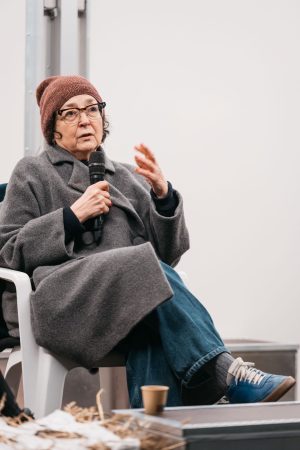
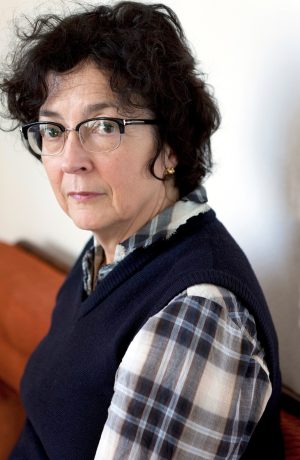
Anna Viebrock

Anna Viebrock studied stage design at the Düsseldorf Art Academy. Her collaboration with Christoph Marthaler took her to numerous theatres and opera houses.

View