Jump to main content (press Enter)Jump to the footer (press Enter)

Breadcrumbs

  1. Home
  2. Zu Gast
  3. Zu Gast Jahrgang 2024

Zu Gast Jahrgang 2024

© Daniel Sadrowski

For 2024, Urbane Künste Ruhr is awarding six research stays for guest artists for three months each in Dortmund, Duisburg and Bochum.

During their stay, they will develop a context-specific project that will be presented to the public in an exhibition in 2025. The guest artist programme is aimed at artists and collectives who are interested in working in the Ruhr area and in a contemporary perspective on the region and its themes.

The programme was implemented together with the regional cooperation partners Stiftung Geschichte des Ruhrgebiets and Stiftung Industriedenkmalpflege und Geschichtskultur and with different focal points.

Artists and collectives were able to submit their context-specific project via an open call until 31 March. A total of six positions (two per focus) were selected from the submissions by an expert jury.

Artists

Open Artsit

©Daniel Sadrowski

Ramona Schacht & Luca Bublik

Ramona Schacht studied photography in Heidi Specker's class at the HGB Leipzig until 2020, Luca Bublik completed his doctorate at the Bauhaus University in Weimar. Both live in Leipzig.

View
Open Artsit

©Daniel Sadrowski

Paula Pedraza

In her artistic practice, Paula Pedraza is concerned with decolonial and feminist theories, surveillance architecture and is interested in experimental design and hybrid spatial constructions.

View
Open Artsit

©Daniel Sadrowski

Marlin de Haan

In her artistic practice, Marlin de Haan deals with the tensions between bodies and objects in space as well as the possibilities and limits of action areas, performance and narrative formats.

View
Open Artsit

©Daniel Sadrowski

Jonas Leifert & Franziska Pierwoss

Jonas Leifert's work addresses social issues from the perspective of the Ruhr area, Franziska Pierwoss develops site-specific installations that question personal and political relationships.

View
Open Artsit

©Daniel Sadrowski

Arhun Aksakal

Arhun Aksakal is interested in human perception, urban psychology and geographical infrastructures and investigates phenomena of civilizational activity and geological time.

View
Open Artsit

©Daniel Sadrowski

Anna R. Winder

Anna R. Winder (*1995 in Aarhus) is part of the b_books collective, which runs a bookshop and a publishing house and is a co-editor of wormhole newspaper.
View

Worte an den Ohren, an der Haut, an der Zelle

Havîn Al-Sîndy

© Amina Falah

© Amina Falah

© Amina Falah

© Amina Falah

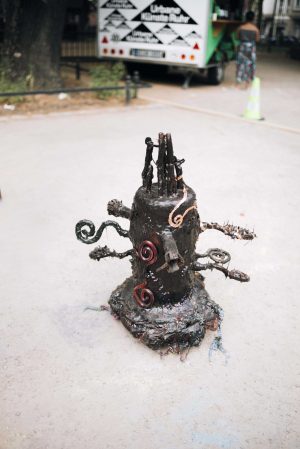
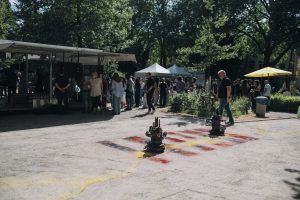
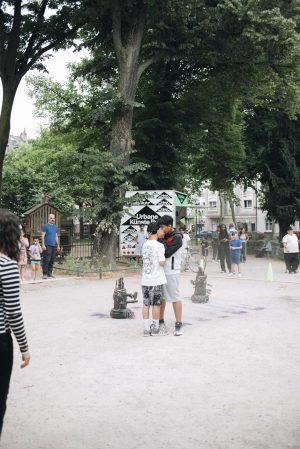
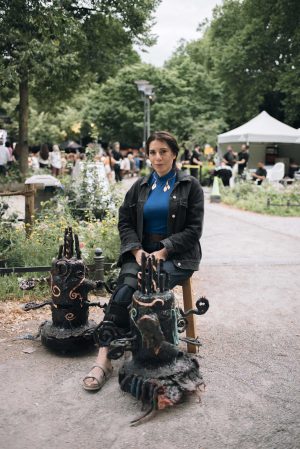
Auf dem Dortmunder Nordmarkt setzten sich zwei Skulpturen aus silikonartiger Textur und rätselhafter Silhouette das erste Mal in Bewegung – aufrecht, körperhaft und mit Mikrofonen versehen. Die über Sensoren gesteuerten Roboter haben mittels KI eines gelernt: das Lästern. Auch in Zukunft sollen Besucher*innen sich um sie versammeln, ihnen zuhören oder etwas zuflüstern können. So wird eine beiläufige, neugierige Öffentlichkeit allmählich in Gespräche verwickelt, die sie nicht vollständig kontrollieren kann. 

Die Roboter hat die Künstlerin Havîn Al-Sîndy in Kooperation mit Schüler*innen der Dortmunder Anne-Frank-Gesamtschule entwickelt. So ist Worte an den Ohren, an der Haut, an der Zelle Output eines Gestaltungsprozesses mit Jugendlichen, die ihre Stimmen, ihren Gossip, ihr Flüstern als Codes der Maschine geliehen haben. Zur Installation gehören auch eine sich durch Bewegung verändernde Bodenzeichnung und ein Film, der zwei aus Gips geformte Vögel in der Natur zeigt. 

Al-Sîndys Praxis kreist um immaterielle Archive – Erinnerungen, Körperwissen, kollektive Gedächtnisse – als fragile, widersprüchliche, doch wirkmächtige Formen von Wissen, und die Frage, wie sie weitergegeben, überschrieben oder verdrängt werden. Das Lästern ist dabei weit mehr als Klatsch: Es ist eine der ältesten Formen der informellen Sprachübertragung, eine des Widerstands für jene, denen offizielle Sprache verwehrt bleibt, eine Form der Oral History, die auf Marktplätzen und Hinterhöfen überlebt. Aber es ist auch ein Instrument der Mächtigen und der Manipulation: Sogar Amtsträger*innen verspotten heute öffentlich, das politische Gebaren scheint irrationaler zu werden. 

Die Frage, die Al-Sîndys Skulpturen stellen, ist also keine technische, sondern eine politische: Was geht verloren, wenn Sprache übersetzt, archiviert, codiert und automatisiert wird – und wessen Sprache war es überhaupt? 

Artist

Open Artsit

Havîn Al-Sîndy

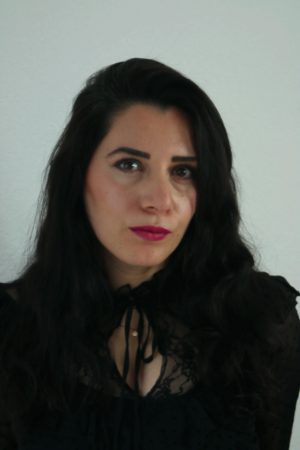
Havîn Al-Sîndy works in Kurdistan and Germany. Her artistic practice moves between performance, sculpture, painting, and moving images.  

View