Jump to main content (press Enter)Jump to the footer (press Enter)

Breadcrumbs

  1. Home
  2. Exhibitions
  3. Exhibition

Die Spielstraße
nchen 1972

23.8. – 1.11.20

In 1972, Werner Ruhnau was invited by the Olympic Organizing Committee to realize the Spielstraße as a supporting program for the Olympic Games in Munich. 

In accordance with the principles of the modern Olympic Games, which were intended to contribute to international understanding and tolerance among nations, the project invited people of all backgrounds to come together at the Spielstraße and enter into communication with one another. The contributions on site included various artistic media, from performing games and video works to objects and performances from the field of visual arts. The focus was on the critical examination of current events from the stadiums, the possibility of participation, and the timeless Olympic ideals. Due to the attack on the Israeli team on September 5th, 1972, the Spielstraße was demolished early on and was hardly received in the aftermath.

The architect Werner Ruhnau lived in Essen until the end of his life and became famous above all for his innovative theater buildings such as the Musiktheater im Revier in Gelsenkirchen. Anita Ruhnau took over the project management of the visual arts division during the realization of the Spielstraße. The exhibition at the Skulpturenmuseum Glaskasten in Marl, curated by Georg Elben, Britta Peters and Jana Kerima Stolzer, approaches the Spielstrasse from a contemporary perspective and for the first time shows film material from the archives of Werner and Anita Ruhnau, as well as original objects by the participating visual artists. In doing so, it approaches the historical events and project plans and invites visitors to reflect on the relevance of the social climate for (urban) society.
Worte an den Ohren, an der Haut, an der Zelle

Havîn Al-Sîndy

© Amina Falah

© Amina Falah

© Amina Falah

© Amina Falah

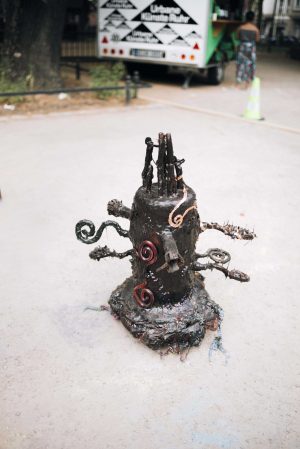
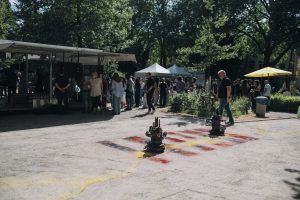
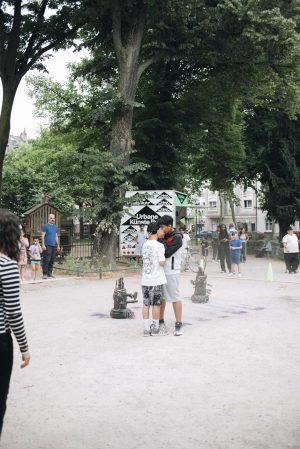
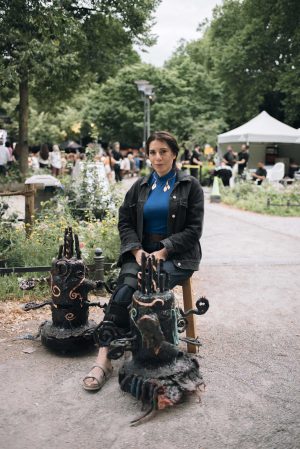
Auf dem Dortmunder Nordmarkt setzten sich zwei Skulpturen aus silikonartiger Textur und rätselhafter Silhouette das erste Mal in Bewegung – aufrecht, körperhaft und mit Mikrofonen versehen. Die über Sensoren gesteuerten Roboter haben mittels KI eines gelernt: das Lästern. Auch in Zukunft sollen Besucher*innen sich um sie versammeln, ihnen zuhören oder etwas zuflüstern können. So wird eine beiläufige, neugierige Öffentlichkeit allmählich in Gespräche verwickelt, die sie nicht vollständig kontrollieren kann. 

Die Roboter hat die Künstlerin Havîn Al-Sîndy in Kooperation mit Schüler*innen der Dortmunder Anne-Frank-Gesamtschule entwickelt. So ist Worte an den Ohren, an der Haut, an der Zelle Output eines Gestaltungsprozesses mit Jugendlichen, die ihre Stimmen, ihren Gossip, ihr Flüstern als Codes der Maschine geliehen haben. Zur Installation gehören auch eine sich durch Bewegung verändernde Bodenzeichnung und ein Film, der zwei aus Gips geformte Vögel in der Natur zeigt. 

Al-Sîndys Praxis kreist um immaterielle Archive – Erinnerungen, Körperwissen, kollektive Gedächtnisse – als fragile, widersprüchliche, doch wirkmächtige Formen von Wissen, und die Frage, wie sie weitergegeben, überschrieben oder verdrängt werden. Das Lästern ist dabei weit mehr als Klatsch: Es ist eine der ältesten Formen der informellen Sprachübertragung, eine des Widerstands für jene, denen offizielle Sprache verwehrt bleibt, eine Form der Oral History, die auf Marktplätzen und Hinterhöfen überlebt. Aber es ist auch ein Instrument der Mächtigen und der Manipulation: Sogar Amtsträger*innen verspotten heute öffentlich, das politische Gebaren scheint irrationaler zu werden. 

Die Frage, die Al-Sîndys Skulpturen stellen, ist also keine technische, sondern eine politische: Was geht verloren, wenn Sprache übersetzt, archiviert, codiert und automatisiert wird – und wessen Sprache war es überhaupt? 

Artist

Open Artsit

Havîn Al-Sîndy

Havîn Al-Sîndy works in Kurdistan and Germany. Her artistic practice moves between performance, sculpture, painting, and moving images.  

View