Jump to main content (press Enter)Jump to the footer (press Enter)

Breadcrumbs

  1. Home
  2. Exhibitions
  3. Exhibition

Die Spielstraße
nchen 1972

23.8. – 1.11.20

In 1972, Werner Ruhnau was invited by the Olympic Organizing Committee to realize the Spielstraße as a supporting program for the Olympic Games in Munich. 

In accordance with the principles of the modern Olympic Games, which were intended to contribute to international understanding and tolerance among nations, the project invited people of all backgrounds to come together at the Spielstraße and enter into communication with one another. The contributions on site included various artistic media, from performing games and video works to objects and performances from the field of visual arts. The focus was on the critical examination of current events from the stadiums, the possibility of participation, and the timeless Olympic ideals. Due to the attack on the Israeli team on September 5th, 1972, the Spielstraße was demolished early on and was hardly received in the aftermath.

The architect Werner Ruhnau lived in Essen until the end of his life and became famous above all for his innovative theater buildings such as the Musiktheater im Revier in Gelsenkirchen. Anita Ruhnau took over the project management of the visual arts division during the realization of the Spielstraße. The exhibition at the Skulpturenmuseum Glaskasten in Marl, curated by Georg Elben, Britta Peters and Jana Kerima Stolzer, approaches the Spielstrasse from a contemporary perspective and for the first time shows film material from the archives of Werner and Anita Ruhnau, as well as original objects by the participating visual artists. In doing so, it approaches the historical events and project plans and invites visitors to reflect on the relevance of the social climate for (urban) society.
Local Blackouts

Lütfiye Güzel

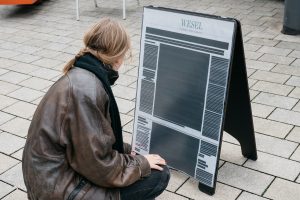
A person in a brown leather jacket looks at a large printed newspaper on a stand with the heading 'Wesel'.

© Daniel Sadrowski

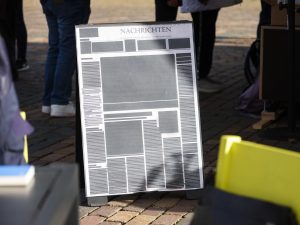
A sign with the word 'NACHRICHTEN' with an abstract newspaper layout with little text.

© Heinrich Holtgreve

Ausgangsmaterial ist ein besonders kurzweiliges Format aus dem Alltag: die Tageszeitung. Lütfiye Güzel, Poetin aus Duisburg und Vertreterin eines konsequent selbstverlegten, körpernahen Schreibens, lässt sich für die Grand Snail Tour von Projektpartner*innen und Passant*innen Lokalzeitungen und -beilagen aus den zu bereisenden Städten zusenden. Aus diesen Dokumenten erzeugt Güzel durch gezieltes Ausstreichen und Schwärzen von Textpassagen insgesamt 53 Gedichte — Local Blackouts —, die auf Aufstellern an jeder Station veröffentlicht werden.

Die Methode der Blackout Poetry ist eine Form der Found Poetry und wird bei Güzel zum politischen Akt. Das Schwärzen zitiert die Logik der Zensur, kehrt sie aber um, denn das unkenntlich Machen hat nicht Unterdrückung, sondern Verdichtung zum Ziel: Was bleibt, wenn der redaktionelle Lärm verschwindet? Lyrische Miniaturen, die in ihrer Knappheit dem Haiku ähnlich ist. Güzels Entscheidung, diese Textarbeiten im öffentlichen Raum zu zeigen, stellt zudem implizit die Frage: Für wen werden solche Texte geschrieben, und wer kommt darin vor?

Lokalzeitungen sind ein ambivalentes Medium. Sie fördern und informieren Nachbarschaften jenseits von Social Media — doch die Sprache und Nachrichtenauswahl ist häufig hetzerisch und vereinfachend. Tatsache ist, dass Lokalzeitungen an Bedeutung und finanzielle Unterstützung verlieren. Güzels Aneignung bewahrt und befragt dieses Erbe zugleich. Präsentiert auf herkömmlichen Presseaufstellern verleiht ihre Arbeit der Grand Snail Tour ein vertrautes Erscheinungsbild von regionaler Kultur und überführt diese gleichzeitig in die poetische Abstraktion.

Artist

Open Artsit

©Ben Knabe

Lütfiye Güzel

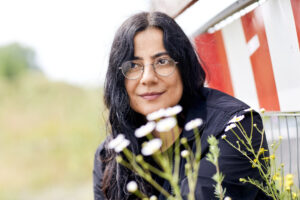
Lütfiye Güzel is a poet and has been publishing poems under her own label go-güzel-publishing since 2014.

View