Jump to main content (press Enter)Jump to the footer (press Enter)

Breadcrumbs

  1. Home
  2. Exhibitions
  3. Ruhrtriennale

My Body Is Not
An Island

©Katja Illner
©Katja Illner
©Katja Illner

12.8. – 23.9.23

Address

Kulturkirche Liebfrauen Duisburg
König-Heinrich-Platz 3
47051 Duisburg

Accessibility

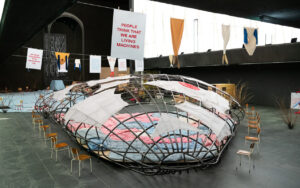
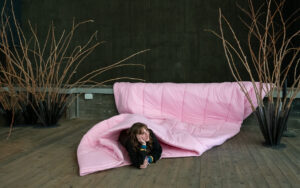
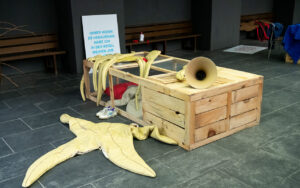
A giant, deconstructed body – part animal, part human – welded from a metal frame, with oversized items of clothing and brightly-coloured costumes that visitors may try on, transport crates and collages of material, unfolds to create an immersive landscape in the extensive installation My Body Is Not An Island by the Czech artist and film-maker Eva Koťátková.

Stories both factual and fictional telling of physical and mental oppression are written into the work. Tales from the perspectives of humans, animals and plants are activated every week by the performer and can be supplemented with the public’s own experiences. 

Originating from her own interest in social structures – such as the family, schools, or work – in this art work, Eva Koťátková explores the question of how normalisation processes shape our everyday lives and can give rise to forms of excessive (self-)control, violence and fear.

Influenced by the poetics of surrealism and theatrical stage designs, the artist has created an inclusive place in which we can face our dreams and our unconscious. My Body Is Not An Island invites children, young people and adults alike to empathise with others and to learn how to use emotions as a way in to the world: Bring your emotions and your jackets too, the artist tells us.

Urbane Künste Ruhr makes its own artistic contribution to each Ruhrtriennale. Following up on Ruhr Ding: Schlaf, an exhibition project across several cities early this summer that addressed our relationship with the body and time in a post-industrial context, it has invited Eva Koťátková to create a site-specific version of My Body Is Not An Island at Liebfrauenkirche Duisburg after the work had previously been seen in Bordeaux and Prague.

Produced by Urbane Künste Ruhr for Ruhrtriennale

Eva Koťátková and Britta Peters in Conversation

Please accept our Privacy Policy in order to display this Vimeo content.
Künstlerin Eva Koťátková und Britta Peters, Künstlerische Leitung von Urbane Künste Ruhr, führen euch bei einem Gespräch durch die Ausstellung „My Body Is Not An Island” in der Kulturkirche Liebfrauen in Duisburg.

©Katja Illner

Artist

Open Artsit

©National Gallery Krepmlová

Eva Kot'átková

In her work, Eva Kot'átková explores forms of power, manipulation, discrimination and control exercised by institutions upon those who deviate from the norm (or what is perceived as such).
View

Worte an den Ohren, an der Haut, an der Zelle

Havîn Al-Sîndy

© Amina Falah

© Amina Falah

© Amina Falah

© Amina Falah

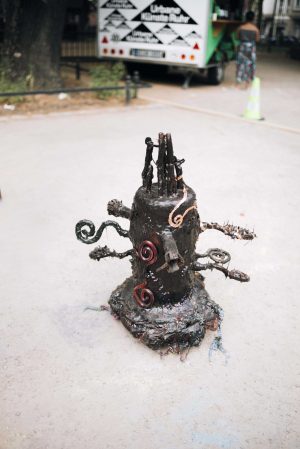
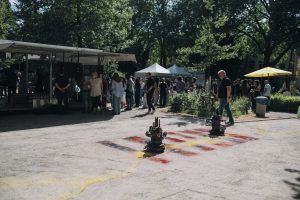
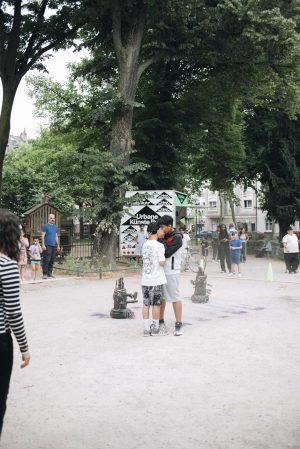
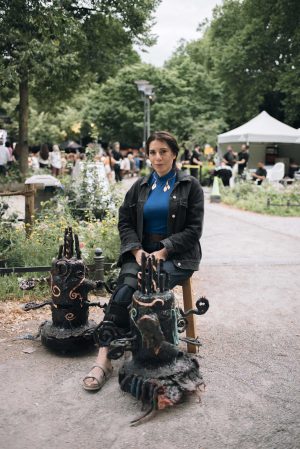
Auf dem Dortmunder Nordmarkt setzten sich zwei Skulpturen aus silikonartiger Textur und rätselhafter Silhouette das erste Mal in Bewegung – aufrecht, körperhaft und mit Mikrofonen versehen. Die über Sensoren gesteuerten Roboter haben mittels KI eines gelernt: das Lästern. Auch in Zukunft sollen Besucher*innen sich um sie versammeln, ihnen zuhören oder etwas zuflüstern können. So wird eine beiläufige, neugierige Öffentlichkeit allmählich in Gespräche verwickelt, die sie nicht vollständig kontrollieren kann. 

Die Roboter hat die Künstlerin Havîn Al-Sîndy in Kooperation mit Schüler*innen der Dortmunder Anne-Frank-Gesamtschule entwickelt. So ist Worte an den Ohren, an der Haut, an der Zelle Output eines Gestaltungsprozesses mit Jugendlichen, die ihre Stimmen, ihren Gossip, ihr Flüstern als Codes der Maschine geliehen haben. Zur Installation gehören auch eine sich durch Bewegung verändernde Bodenzeichnung und ein Film, der zwei aus Gips geformte Vögel in der Natur zeigt. 

Al-Sîndys Praxis kreist um immaterielle Archive – Erinnerungen, Körperwissen, kollektive Gedächtnisse – als fragile, widersprüchliche, doch wirkmächtige Formen von Wissen, und die Frage, wie sie weitergegeben, überschrieben oder verdrängt werden. Das Lästern ist dabei weit mehr als Klatsch: Es ist eine der ältesten Formen der informellen Sprachübertragung, eine des Widerstands für jene, denen offizielle Sprache verwehrt bleibt, eine Form der Oral History, die auf Marktplätzen und Hinterhöfen überlebt. Aber es ist auch ein Instrument der Mächtigen und der Manipulation: Sogar Amtsträger*innen verspotten heute öffentlich, das politische Gebaren scheint irrationaler zu werden. 

Die Frage, die Al-Sîndys Skulpturen stellen, ist also keine technische, sondern eine politische: Was geht verloren, wenn Sprache übersetzt, archiviert, codiert und automatisiert wird – und wessen Sprache war es überhaupt? 

Artist

Open Artsit

Havîn Al-Sîndy

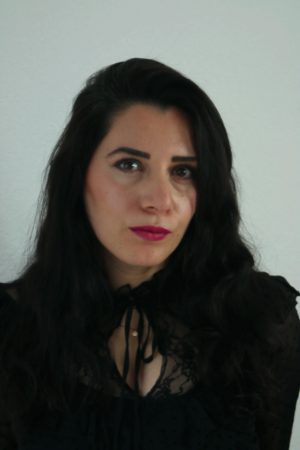
Havîn Al-Sîndy works in Kurdistan and Germany. Her artistic practice moves between performance, sculpture, painting, and moving images.  

View