Jump to main content (press Enter)Jump to the footer (press Enter)

Breadcrumbs

  1. Home
  2. Exhibitions
  3. Ruhrtriennale

Absorption

© Heinrich Holtgreve

14.8. – 25.9.21

Address

ehemaliges Allbauhaus
Pferdemarkt 5-7
45127 Essen

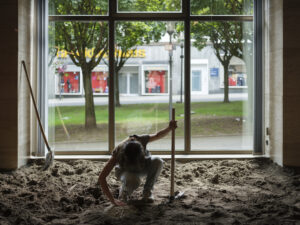
Earth, the underestimated material from which our world grows, penetrates into the furthest corners of a historic building in Essen's city centre. With Absorption, Urbane Künste Ruhr is showing an installation by US artist Asad Raza of great sensual and poetic power, which takes up the entire ground floor of the listed former Allbau building on Pferdemarkt.

Earth is created as a mixture of sand, clay and compost. Organic and inorganic matter is added to this base in the run-up to and during the exhibition, which is processed and composted to create new earth - called ‘Neosoil’ by Raza. A team of ‘cultivators’ will also be on site throughout the duration of the exhibition, constantly filtering, breaking down, analysing and remixing the soil under scientific supervision. The components collected in the region, such as sewage sludge, waste paper or hair, enrich the soil, which is given away as fertile soil to visitors, allotment associations and social organisations during the exhibition period.

At the invitation of Asad Raza, artists Maria Renee Morales Garcia and Agatha Gothe-Snape will add sculptural and performative moments of tension to the process alongside the sound work Ten Years Alive on the Infinite Plain by Tony Conrad. Earlier versions of Absorption were shown at the Kaldor Public Art Project (Sydney, 2019) and the Gropius Bau (Berlin, 2020).

Artist
Open Artsit
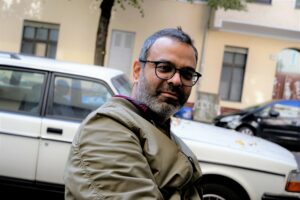
Portrait of artist Asad Raza, who creates interdisciplinary works between art, science, and philosophy, wearing glasses and an olive-green jacket in an urban setting.

© Daniel Sadrowski

Asad Raza

In his work artist Asad Raza often explores dialogic exchange and rejects disciplinary boundaries. Raza conceives of art as a metabolic, active experience combining human, non-human beings.
View

Worte an den Ohren, an der Haut, an der Zelle

Havîn Al-Sîndy

© Amina Falah

© Amina Falah

© Amina Falah

© Amina Falah

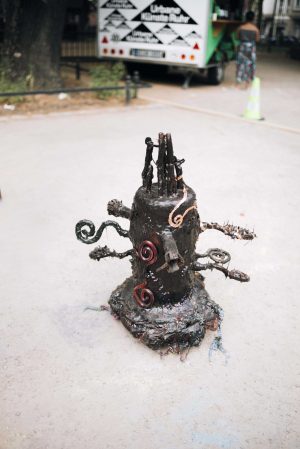
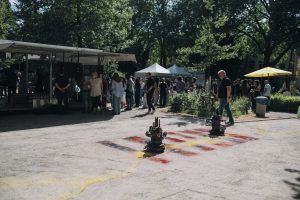
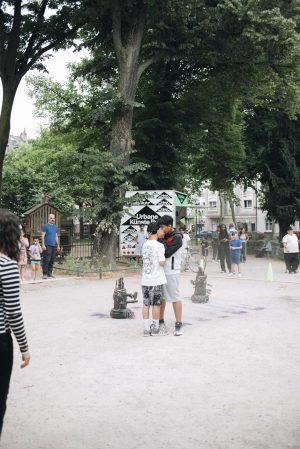
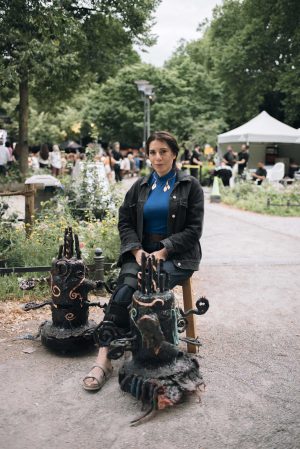
Auf dem Dortmunder Nordmarkt setzten sich zwei Skulpturen aus silikonartiger Textur und rätselhafter Silhouette das erste Mal in Bewegung – aufrecht, körperhaft und mit Mikrofonen versehen. Die über Sensoren gesteuerten Roboter haben mittels KI eines gelernt: das Lästern. Auch in Zukunft sollen Besucher*innen sich um sie versammeln, ihnen zuhören oder etwas zuflüstern können. So wird eine beiläufige, neugierige Öffentlichkeit allmählich in Gespräche verwickelt, die sie nicht vollständig kontrollieren kann. 

Die Roboter hat die Künstlerin Havîn Al-Sîndy in Kooperation mit Schüler*innen der Dortmunder Anne-Frank-Gesamtschule entwickelt. So ist Worte an den Ohren, an der Haut, an der Zelle Output eines Gestaltungsprozesses mit Jugendlichen, die ihre Stimmen, ihren Gossip, ihr Flüstern als Codes der Maschine geliehen haben. Zur Installation gehören auch eine sich durch Bewegung verändernde Bodenzeichnung und ein Film, der zwei aus Gips geformte Vögel in der Natur zeigt. 

Al-Sîndys Praxis kreist um immaterielle Archive – Erinnerungen, Körperwissen, kollektive Gedächtnisse – als fragile, widersprüchliche, doch wirkmächtige Formen von Wissen, und die Frage, wie sie weitergegeben, überschrieben oder verdrängt werden. Das Lästern ist dabei weit mehr als Klatsch: Es ist eine der ältesten Formen der informellen Sprachübertragung, eine des Widerstands für jene, denen offizielle Sprache verwehrt bleibt, eine Form der Oral History, die auf Marktplätzen und Hinterhöfen überlebt. Aber es ist auch ein Instrument der Mächtigen und der Manipulation: Sogar Amtsträger*innen verspotten heute öffentlich, das politische Gebaren scheint irrationaler zu werden. 

Die Frage, die Al-Sîndys Skulpturen stellen, ist also keine technische, sondern eine politische: Was geht verloren, wenn Sprache übersetzt, archiviert, codiert und automatisiert wird – und wessen Sprache war es überhaupt? 

Artist

Open Artsit

Havîn Al-Sîndy

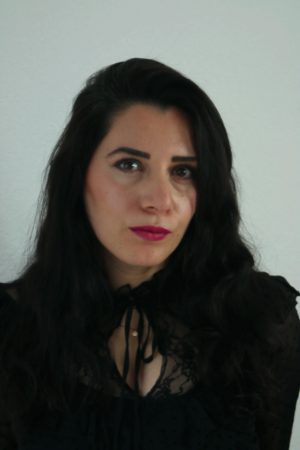
Havîn Al-Sîndy works in Kurdistan and Germany. Her artistic practice moves between performance, sculpture, painting, and moving images.  

View