Jump to main content (press Enter)Jump to the footer (press Enter)

Breadcrumbs

  1. Home
  2. Emscherkunstweg
  3. Public Hybrid

Public Hybrid

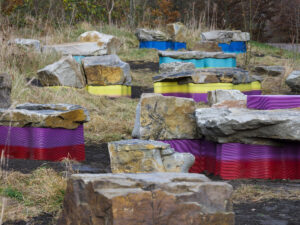
The installation Public Hybrid by David Jablonowski features multiple sandstone and plastic sculptures, their vibrant colors and irregular shapes appearing like artificial rock formations.

© Heinrich Holtgreve

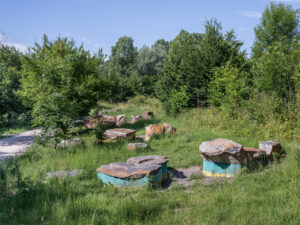
The sculpture Public Hybrid by David Jablonowski stands along the Emscherkunstweg, where layered Ruhr sandstone and 3D-printed plastic elements merge into an abstract landscape.

© Henning Rogge

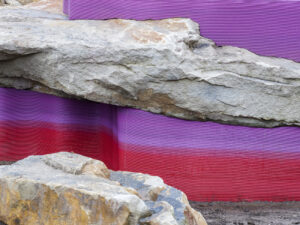
A detailed view of Public Hybrid by David Jablonowski showcases the layered combination of natural sandstone and vividly colored 3D-printed plastic, symbolizing the intersection of nature and technology.

© Heinrich Holtgreve

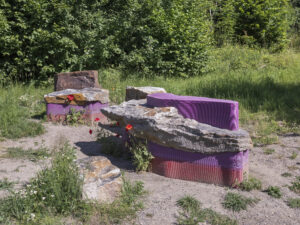
A close-up of Public Hybrid by David Jablonowski shows the colorful, 3D-printed plastic elements blending with natural sandstone, creating a striking contrast.

© Henning Rogge

Address

Emscher-Weg 
Adelenstraße 
44269 Dortmund

Open in Maps

David Jablonowski’s hybrid sculpture is located directly next to the Emscher-Weg bike path in the Schüren district of Dortmund.

In it, the artist, who grew up in Bochum, explores the history and future not only of this particular place, but of the entire Ruhr area as well. At the same time, he has created a contemporary monument that resembles a natural landmark and can be regarded as referring to the ecological improvements that have been made to Emscher River system.

In this multipart installation titled »Public Hybrid«, the artist combines the contrasting materials of sandstone and plastic. 3D printed elements made of recycled plastic and broken sandstone from the Ruhr region are stacked on top of each other like sediments. The resulting amorphous, artificial formations protrude out of the ground in a seemingly random fashion.  

The sandstone comes from the nearby town of Sprockhövel. It was formed about 320 million years ago and is one of the most resistant types of sandstone in Germany. Unlike this raw material that has been used by humans for millennia, the use of recycled plastic elements produced by 3D printing provides a glimpse into a digital, green vision of the future. 3D printing, or additive manufacturing technology, is in principle based on data for computer-aided physical translation. Through 3D printing, Jablonowski implicitly refers to invisible infrastructures that are created by the digital data traffic of public communication. He also juxtaposes waste, which is a material that needs the help of digital technology to become a resource, with geological materials that are quarried in a traditional way. This innovation through the combination of new technologies, nature, and artistic interventions also reflects the project of a generation of restoring the Emscher River.

Artist

Open Artsit

©Frey

David Jablonowski

In his sculptures, David Jablonowski shows the changes in communication and media content, influenced by industrial materials and technologies.
View

Palliative Patterns

Kasia Fudakowski

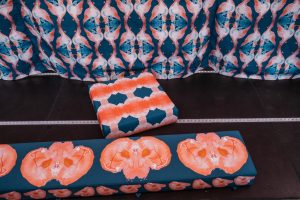
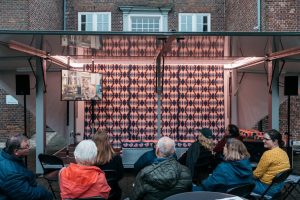
Close-up of padded seat cushions with a colorful pattern.

© Daniel Sadrowski

© Daniel Sadrowski

© Daniel Sadrowski

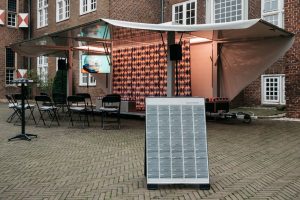
Close-up of a mobile stage with a screen and speakers.

© Daniel Sadrowski

Hast du schon mal über dein eigenes Sterben nachgedacht? Die Künstlerin Kasia Fudakowski fragt in Palliative Patterns, ihrer Arbeit für die Grand Snail Tour, was passiert, wenn wir aufhören würden, den Tod zu verdrängen und stattdessen lernen, mit der Allgegenwart unserer Endlichkeit zu leben. 

Mit ihren Kissen und Vorhängen für den Grand Snail Tour-Trailer übersetzt die Künstlerin diese Idee in einen Raum zum Verweilen. Dazu vervielfältigt und spiegelt sie mikroskopische Aufnahmen von Gewebeveränderungen, die den tödlichen Krankheiten Gehirn-Aneurysma, Lewy-Körperchen-Demenz und Arteriosklerose zugrunde liegen, bis sie ein psychodelisches Muster ergeben, das auch an Rorschach-Tafeln denken lässt. Ursprünglich aus der Psychodiagnostik soll der Rorschach-Test Aufschlüsse über den mentalen Zustand/Gesundheit der*des Patient*innen geben. Hier, bei Fudakowski, werden die Besucher*innen zu Proband*innen, ihre Vorstellungen wiederum zum Teil der Installation.  

Dieses Gedankenspiel wird auch in weiteren Medien- und Veranstaltungsformaten trainiert: Als Gründungsmitglied der internationalen Künstler*innengruppe The Association for the Palliative Turn (APT) fordert Fudakowski geistreich und mit viel Humor immer wieder dazu auf, dem Tod und Abschied zu begegnen und herauszufinden, wie Akzeptanz statt Verdrängung neue Werte definiert: Fürsorge statt Zeitdruck, Qualität vor Quantität und eine Entlastung von dem ewigen Streben nach Fortschritt, denn: Es gibt ein Leben vor dem Tod. 

Palliative Patterns setzt auch eine Werklogik fort, die Fudakowski im Allgemeinen verfolgt: Ihr lebenslang laufendes Skulpturenprojekt Continuouslessness (seit 2017) wird erst mit ihrem Tod vollendet sein. Endlichkeit ist hier kein Thema, sondern strukturelle Bedingung. 

Artist

Open Artsit

Kasia Fudakowski

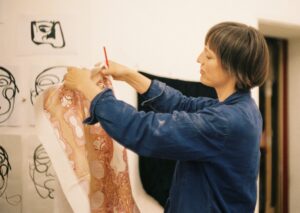
Kasia Fudakowski works with sculpture, film and performance to uncover social enigmas through surreal logic and theory.

View