Jump to main content (press Enter)Jump to the footer (press Enter)

Breadcrumbs

  1. Home
  2. Emscherkunstweg
  3. Neustadt

Neustadt

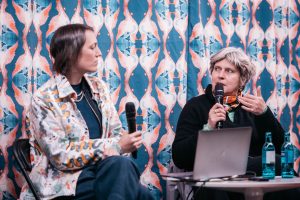
Artists Marta Dyachenko and Julius von Bismarck, together with artistic director Britta Peters, sit in front of Neustadt, a miniature city composed of models of demolished buildings from the Ruhr region.

© Daniel Sadrowski

Address

Landschaftspark Duisburg-Nord
Emscherstraße 71 
47137 Duisburg

Open in Maps

A total of 23 sculptures form a fictitious city composed of various real buildings that have been demolished in the Ruhr region since the turn of the millennium on a scale of 1:25. 

The selection of building types and construction tasks did not follow a strict system, but rather aesthetic, sculptural criteria and the desire to show a cross-section of local urban development. The sculptural installation is deliberately integrated into the seemingly fallow landscape that was actually created as part of the IBA Emscher Park in the 1990s and thus reflects - in addition to remarkable shifts in scale - the relationship between nature and culture. “Neustadt” evokes numerous associations and memories and at the same time invites the viewer to explore both urban planning and ecological issues, which are also reflected in the transformation of the Ruhr area and the Emscher conversion.interventions form an equally hybrid landscape.

Artists

Open Artsit

©Frederike Wetzels

Marta Dyachenko

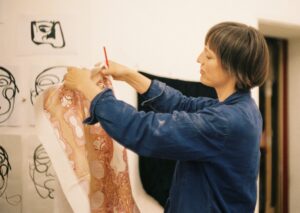
Marta Dyachenko creates installations with model-like sculptures that critically question the relationship between nature, man and landscape.

View
Open Artsit

©Daniel Sadrowski

Julius von Bismarck

In his works, Julius von Bismarck examines perception, natural phenomena and urban space at the interface between art and science.
View

Palliative Patterns

Kasia Fudakowski

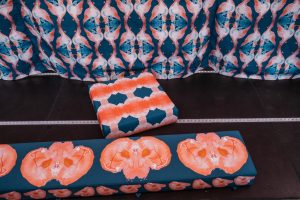
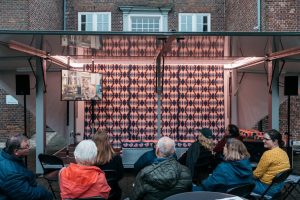
Close-up of padded seat cushions with a colorful pattern.

© Daniel Sadrowski

© Daniel Sadrowski

© Daniel Sadrowski

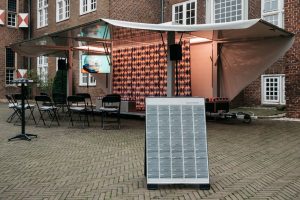
Close-up of a mobile stage with a screen and speakers.

© Daniel Sadrowski

Hast du schon mal über dein eigenes Sterben nachgedacht? Die Künstlerin Kasia Fudakowski fragt in Palliative Patterns, ihrer Arbeit für die Grand Snail Tour, was passiert, wenn wir aufhören würden, den Tod zu verdrängen und stattdessen lernen, mit der Allgegenwart unserer Endlichkeit zu leben. 

Mit ihren Kissen und Vorhängen für den Grand Snail Tour-Trailer übersetzt die Künstlerin diese Idee in einen Raum zum Verweilen. Dazu vervielfältigt und spiegelt sie mikroskopische Aufnahmen von Gewebeveränderungen, die den tödlichen Krankheiten Gehirn-Aneurysma, Lewy-Körperchen-Demenz und Arteriosklerose zugrunde liegen, bis sie ein psychodelisches Muster ergeben, das auch an Rorschach-Tafeln denken lässt. Ursprünglich aus der Psychodiagnostik soll der Rorschach-Test Aufschlüsse über den mentalen Zustand/Gesundheit der*des Patient*innen geben. Hier, bei Fudakowski, werden die Besucher*innen zu Proband*innen, ihre Vorstellungen wiederum zum Teil der Installation.  

Dieses Gedankenspiel wird auch in weiteren Medien- und Veranstaltungsformaten trainiert: Als Gründungsmitglied der internationalen Künstler*innengruppe The Association for the Palliative Turn (APT) fordert Fudakowski geistreich und mit viel Humor immer wieder dazu auf, dem Tod und Abschied zu begegnen und herauszufinden, wie Akzeptanz statt Verdrängung neue Werte definiert: Fürsorge statt Zeitdruck, Qualität vor Quantität und eine Entlastung von dem ewigen Streben nach Fortschritt, denn: Es gibt ein Leben vor dem Tod. 

Palliative Patterns setzt auch eine Werklogik fort, die Fudakowski im Allgemeinen verfolgt: Ihr lebenslang laufendes Skulpturenprojekt Continuouslessness (seit 2017) wird erst mit ihrem Tod vollendet sein. Endlichkeit ist hier kein Thema, sondern strukturelle Bedingung. 

Artist

Open Artsit

Kasia Fudakowski

Kasia Fudakowski works with sculpture, film and performance to uncover social enigmas through surreal logic and theory.

View