Jump to main content (press Enter)Jump to the footer (press Enter)

Breadcrumbs

  1. Home
  2. Emscherkunstweg
  3. Königsgrube

Königsgrube

© Henning Rogge

© Henning Rogge

© Henning Rogge

Address

Hofstraße 24
44651 Herne

Open in Maps

A former pumping station of a disused colliery becomes an installation, the name remains and sounds promising: Königsgrube. Markus Jeschaunig's work, in which he transforms fragments of the demolished building into a hybrid landscape, is characterised by past and future.

From 1860 to 1967, coal mining at the Königsgrube colliery in Herne-Röhlinghausen was extremely productive, then the black gold was extracted, leaving the earth depleted and perforated with subsidence of up to ten metres. The pumping station had the task of channeling the waste water from the neighbouring communities into the Hüller Bach and from there into the Emscher. With the end of coal mining, underground disposal became possible and the pumping station was decommissioned.

The pumping station is now being demolished. Artist Markus Jeschaunig is creating an installation on the partially backfilled foundations that sculpturally integrates various elements of the building: Part of a staircase will be preserved, three pipes will form a solar-powered fountain from which drops of water and sounds can be heard. A quarry forest is being created, a biotope made up of six black alder trees that like it wet and are reminiscent of the floodplain landscapes along the Emscher in pre-industrial times. On the paved forecourt, rainwater can be collected in a cistern via gutters and, together with a photovoltaic pergola, enables completely self-sufficient operation.

As an artistically remodelled ruin, Jeschaunig's work points to both the great technologies and the enormous ecological destruction that mining brought with it, and at the same time shows a way in which new life and climate-positive places can be created in the city.

Artist

Open Artsit

©Daniel Sadrowski

Markus Jeschaunig

Markus Jeschaunig works as an artist and architect, his projects combine art, natural sciences, ecology and activism.

View

Dates

  • Open Event
    Group of cyclists on a tour along the Emscherkunstweg. The cyclists ride on a paved path next to a river, passing under a highway bridge, surrounded by green scenery.

    © Daniel Sadrowski

    So., 30.3.25, 12:30–15 hView

    Bike Tour to the Opening of Königsgrube

  • Open Event
    The former pumping station Königsgrube by Markus Jeschaunig is captured in a winter setting, highlighting its green industrial structures and historical significance.

    © Daniel Sadrowski

    So., 30.3.25, 15 hView

    Opening Königsgrube

Palliative Patterns

Kasia Fudakowski

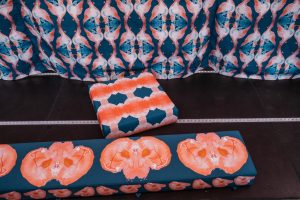
Close-up of padded seat cushions with a colorful pattern.

© Daniel Sadrowski

© Daniel Sadrowski

© Daniel Sadrowski

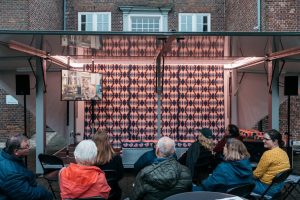
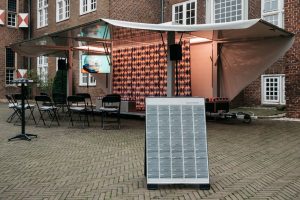
Close-up of a mobile stage with a screen and speakers.

© Daniel Sadrowski

Hast du schon mal über dein eigenes Sterben nachgedacht? Die Künstlerin Kasia Fudakowski fragt in Palliative Patterns, ihrer Arbeit für die Grand Snail Tour, was passiert, wenn wir aufhören würden, den Tod zu verdrängen und stattdessen lernen, mit der Allgegenwart unserer Endlichkeit zu leben. 

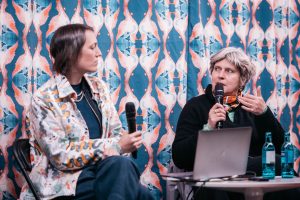
Mit ihren Kissen und Vorhängen für den Grand Snail Tour-Trailer übersetzt die Künstlerin diese Idee in einen Raum zum Verweilen. Dazu vervielfältigt und spiegelt sie mikroskopische Aufnahmen von Gewebeveränderungen, die den tödlichen Krankheiten Gehirn-Aneurysma, Lewy-Körperchen-Demenz und Arteriosklerose zugrunde liegen, bis sie ein psychodelisches Muster ergeben, das auch an Rorschach-Tafeln denken lässt. Ursprünglich aus der Psychodiagnostik soll der Rorschach-Test Aufschlüsse über den mentalen Zustand/Gesundheit der*des Patient*innen geben. Hier, bei Fudakowski, werden die Besucher*innen zu Proband*innen, ihre Vorstellungen wiederum zum Teil der Installation.  

Dieses Gedankenspiel wird auch in weiteren Medien- und Veranstaltungsformaten trainiert: Als Gründungsmitglied der internationalen Künstler*innengruppe The Association for the Palliative Turn (APT) fordert Fudakowski geistreich und mit viel Humor immer wieder dazu auf, dem Tod und Abschied zu begegnen und herauszufinden, wie Akzeptanz statt Verdrängung neue Werte definiert: Fürsorge statt Zeitdruck, Qualität vor Quantität und eine Entlastung von dem ewigen Streben nach Fortschritt, denn: Es gibt ein Leben vor dem Tod. 

Palliative Patterns setzt auch eine Werklogik fort, die Fudakowski im Allgemeinen verfolgt: Ihr lebenslang laufendes Skulpturenprojekt Continuouslessness (seit 2017) wird erst mit ihrem Tod vollendet sein. Endlichkeit ist hier kein Thema, sondern strukturelle Bedingung. 

Artist

Open Artsit

Kasia Fudakowski

Kasia Fudakowski works with sculpture, film and performance to uncover social enigmas through surreal logic and theory.

View