Jump to main content (press Enter)Jump to the footer (press Enter)

Breadcrumbs

  1. Home
  2. Calendar
  3. Performance

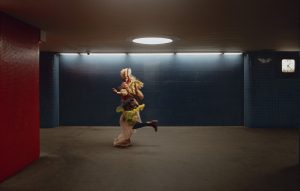
The Troubadour’s Welcome

© Yusuke Mori, Photo: Erdem Akkaya

12.8.26, 19–21 h

Address

Hans-Schalla-Platz am Schauspielhaus Bochum
44789 Bochum

Accessibility

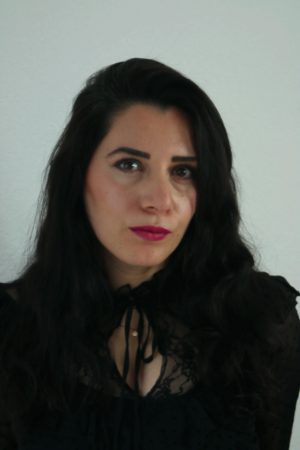
The Troubadour, performed by the songwriter and actress Riah Knight, is touring the Ruhr region for a month – from Bochum to Dortmund, from Duisburg to Essen. Accompanied by her assistant, the Juggler, the Troubadour character meets people, swaps stories, wanders about and finds her way around on public transport whilst searching for places to linger. Along the way, Riah Knight writes and performs her own songs and combines the music that Ari Benjamin Meyers composed in advance for the project with new material. Inspired by the wandering ballad singers of the Middle Ages, this project is both a long-term performance and a social experiment. What is heard, experienced and exchanged in one place will be carried forward to the next. How is this supposedly ‘unknown traveller’ treated in every town she visits? What kind of music will her journey through the region produce?

 Ari Benjamin Meyers (lives and works in Berlin) is an artist and composer who develops structures and processes that redefine the performative, social and ephemeral nature of music. He trained to be a conductor and composer at the Juilliard School, Yale University and the Peabody Institute. Since then, his work has been presented at numerous institutions, festivals and biennals worldwide. He is currently Professor of Sculpture at the Düsseldorf Art Academy. 

Riah Knight (born 1996) is a Romani-British artist and lives in Berlin. Her interdisciplinary practice includes acting, music, writing and dramaturgy.


The Troubadour by Ari Benjamin Meyers is a co-production with Manifesta 16 Ruhr.
Performance The Troubadour: Riah Knight
Assistant / The Juggler: Christian Löffel

Organised by Manifesta 16 Ruhr.
Worte an den Ohren, an der Haut, an der Zelle

Havîn Al-Sîndy

© Amina Falah

© Amina Falah

© Amina Falah

© Amina Falah

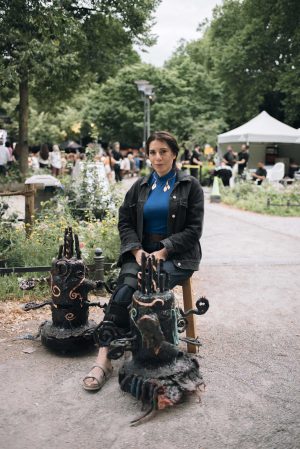
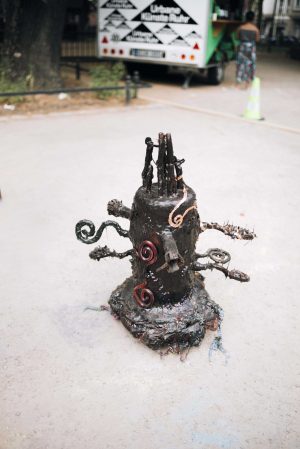
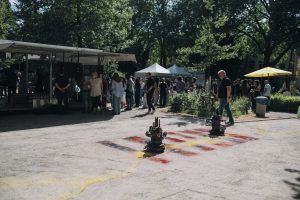
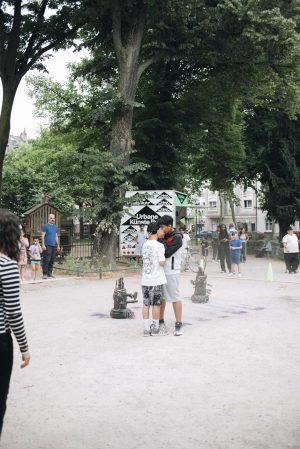
Auf dem Dortmunder Nordmarkt setzten sich zwei Skulpturen aus silikonartiger Textur und rätselhafter Silhouette das erste Mal in Bewegung – aufrecht, körperhaft und mit Mikrofonen versehen. Die über Sensoren gesteuerten Roboter haben mittels KI eines gelernt: das Lästern. Auch in Zukunft sollen Besucher*innen sich um sie versammeln, ihnen zuhören oder etwas zuflüstern können. So wird eine beiläufige, neugierige Öffentlichkeit allmählich in Gespräche verwickelt, die sie nicht vollständig kontrollieren kann. 

Die Roboter hat die Künstlerin Havîn Al-Sîndy in Kooperation mit Schüler*innen der Dortmunder Anne-Frank-Gesamtschule entwickelt. So ist Worte an den Ohren, an der Haut, an der Zelle Output eines Gestaltungsprozesses mit Jugendlichen, die ihre Stimmen, ihren Gossip, ihr Flüstern als Codes der Maschine geliehen haben. Zur Installation gehören auch eine sich durch Bewegung verändernde Bodenzeichnung und ein Film, der zwei aus Gips geformte Vögel in der Natur zeigt. 

Al-Sîndys Praxis kreist um immaterielle Archive – Erinnerungen, Körperwissen, kollektive Gedächtnisse – als fragile, widersprüchliche, doch wirkmächtige Formen von Wissen, und die Frage, wie sie weitergegeben, überschrieben oder verdrängt werden. Das Lästern ist dabei weit mehr als Klatsch: Es ist eine der ältesten Formen der informellen Sprachübertragung, eine des Widerstands für jene, denen offizielle Sprache verwehrt bleibt, eine Form der Oral History, die auf Marktplätzen und Hinterhöfen überlebt. Aber es ist auch ein Instrument der Mächtigen und der Manipulation: Sogar Amtsträger*innen verspotten heute öffentlich, das politische Gebaren scheint irrationaler zu werden. 

Die Frage, die Al-Sîndys Skulpturen stellen, ist also keine technische, sondern eine politische: Was geht verloren, wenn Sprache übersetzt, archiviert, codiert und automatisiert wird – und wessen Sprache war es überhaupt? 

Artist

Open Artsit

Havîn Al-Sîndy

Havîn Al-Sîndy works in Kurdistan and Germany. Her artistic practice moves between performance, sculpture, painting, and moving images.  

View