Jump to main content (press Enter)Jump to the footer (press Enter)

Breadcrumbs

  1. Home
  2. Artists
  3. Profile

Kyoco Taniyama & Nico Alexander Taniyama
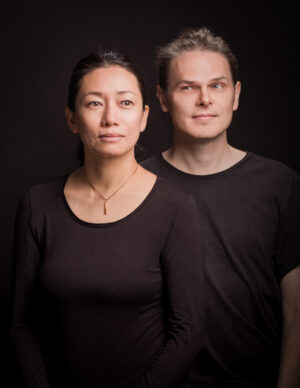
©Roland Baege

Kyoco+Nico are an artist duo from Tokyo and Berlin. The behaviour as well as the verbal syntax of the two cities tend to be exact opposites. Kyoco+Nico monitor such country-specific contradictions during their everyday life that influence the binary range of their subject matter, such as macro and microscopic views, digital and analogue, together with the past and future.

Their working process begins site-specifically as 'physical explorers'. Reflections on these accumulated experiences accompany their path to conceptual abstraction, both play with the attraction of paradoxes that are usually to be avoided. For Ruhr Ding: Territorien, Kyoco+Nico are combining their forms of expression, such as sculpture and media installation, for a third time, with a view to social transformation as a result of the shift from industrialization to digitalization.

Kyoco Taniyama visualizes her critical inquiry into current events, which she gathers by exploring foreign locations and social structures in a humorous way using photography, sculpture and installation.

Nico Alexander Taniyama combines his dual interest in media art and philosophical thought. His meta-approach, 'Everything we do, we can attempt on the meta-level', reflects both his theoretical and visual work.
Palliative Patterns

Kasia Fudakowski

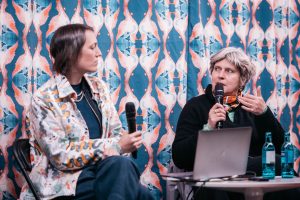
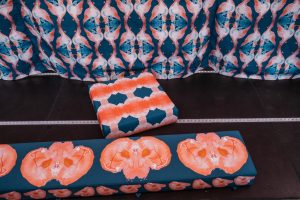
Close-up of padded seat cushions with a colorful pattern.

© Daniel Sadrowski

© Daniel Sadrowski

© Daniel Sadrowski

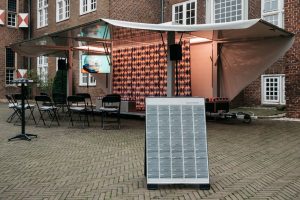
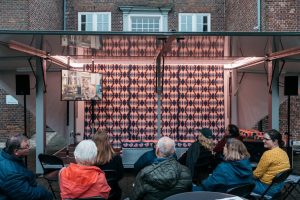
Close-up of a mobile stage with a screen and speakers.

© Daniel Sadrowski

Hast du schon mal über dein eigenes Sterben nachgedacht? Die Künstlerin Kasia Fudakowski fragt in Palliative Patterns, ihrer Arbeit für die Grand Snail Tour, was passiert, wenn wir aufhören würden, den Tod zu verdrängen und stattdessen lernen, mit der Allgegenwart unserer Endlichkeit zu leben. 

Mit ihren Kissen und Vorhängen für den Grand Snail Tour-Trailer übersetzt die Künstlerin diese Idee in einen Raum zum Verweilen. Dazu vervielfältigt und spiegelt sie mikroskopische Aufnahmen von Gewebeveränderungen, die den tödlichen Krankheiten Gehirn-Aneurysma, Lewy-Körperchen-Demenz und Arteriosklerose zugrunde liegen, bis sie ein psychodelisches Muster ergeben, das auch an Rorschach-Tafeln denken lässt. Ursprünglich aus der Psychodiagnostik soll der Rorschach-Test Aufschlüsse über den mentalen Zustand/Gesundheit der*des Patient*innen geben. Hier, bei Fudakowski, werden die Besucher*innen zu Proband*innen, ihre Vorstellungen wiederum zum Teil der Installation.  

Dieses Gedankenspiel wird auch in weiteren Medien- und Veranstaltungsformaten trainiert: Als Gründungsmitglied der internationalen Künstler*innengruppe The Association for the Palliative Turn (APT) fordert Fudakowski geistreich und mit viel Humor immer wieder dazu auf, dem Tod und Abschied zu begegnen und herauszufinden, wie Akzeptanz statt Verdrängung neue Werte definiert: Fürsorge statt Zeitdruck, Qualität vor Quantität und eine Entlastung von dem ewigen Streben nach Fortschritt, denn: Es gibt ein Leben vor dem Tod. 

Palliative Patterns setzt auch eine Werklogik fort, die Fudakowski im Allgemeinen verfolgt: Ihr lebenslang laufendes Skulpturenprojekt Continuouslessness (seit 2017) wird erst mit ihrem Tod vollendet sein. Endlichkeit ist hier kein Thema, sondern strukturelle Bedingung. 

Artist

Open Artsit

Kasia Fudakowski

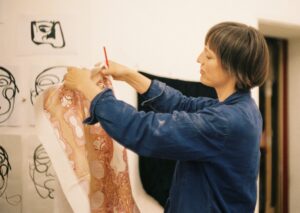
Kasia Fudakowski works with sculpture, film and performance to uncover social enigmas through surreal logic and theory.

View