Jump to main content (press Enter)Jump to the footer (press Enter)

Breadcrumbs

  1. Home
  2. Zu Gast
  3. Zu Gast Jahrgang 2024

Zu Gast Jahrgang 2024

© Daniel Sadrowski

For 2024, Urbane Künste Ruhr is awarding six research stays for guest artists for three months each in Dortmund, Duisburg and Bochum.

During their stay, they will develop a context-specific project that will be presented to the public in an exhibition in 2025. The guest artist programme is aimed at artists and collectives who are interested in working in the Ruhr area and in a contemporary perspective on the region and its themes.

The programme was implemented together with the regional cooperation partners Stiftung Geschichte des Ruhrgebiets and Stiftung Industriedenkmalpflege und Geschichtskultur and with different focal points.

Artists and collectives were able to submit their context-specific project via an open call until 31 March. A total of six positions (two per focus) were selected from the submissions by an expert jury.

Artists

Open Artsit

©Daniel Sadrowski

Ramona Schacht & Luca Bublik

Ramona Schacht studied photography in Heidi Specker's class at the HGB Leipzig until 2020, Luca Bublik completed his doctorate at the Bauhaus University in Weimar. Both live in Leipzig.

View
Open Artsit

©Daniel Sadrowski

Paula Pedraza

In her artistic practice, Paula Pedraza is concerned with decolonial and feminist theories, surveillance architecture and is interested in experimental design and hybrid spatial constructions.

View
Open Artsit

©Daniel Sadrowski

Marlin de Haan

In her artistic practice, Marlin de Haan deals with the tensions between bodies and objects in space as well as the possibilities and limits of action areas, performance and narrative formats.

View
Open Artsit

©Daniel Sadrowski

Jonas Leifert & Franziska Pierwoss

Jonas Leifert's work addresses social issues from the perspective of the Ruhr area, Franziska Pierwoss develops site-specific installations that question personal and political relationships.

View
Open Artsit

©Daniel Sadrowski

Arhun Aksakal

Arhun Aksakal is interested in human perception, urban psychology and geographical infrastructures and investigates phenomena of civilizational activity and geological time.

View
Open Artsit

©Daniel Sadrowski

Anna R. Winder

Anna R. Winder (*1995 in Aarhus) is part of the b_books collective, which runs a bookshop and a publishing house and is a co-editor of wormhole newspaper.
View

Palliative Patterns

Kasia Fudakowski

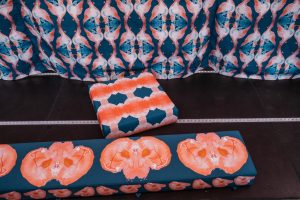
Close-up of padded seat cushions with a colorful pattern.

© Daniel Sadrowski

© Daniel Sadrowski

© Daniel Sadrowski

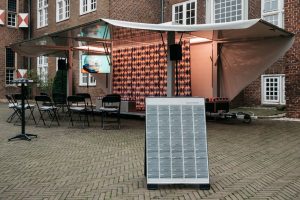
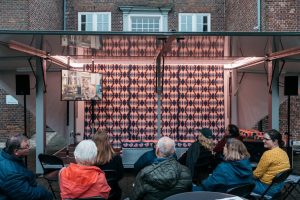
Close-up of a mobile stage with a screen and speakers.

© Daniel Sadrowski

Hast du schon mal über dein eigenes Sterben nachgedacht? Die Künstlerin Kasia Fudakowski fragt in Palliative Patterns, ihrer Arbeit für die Grand Snail Tour, was passiert, wenn wir aufhören würden, den Tod zu verdrängen und stattdessen lernen, mit der Allgegenwart unserer Endlichkeit zu leben. 

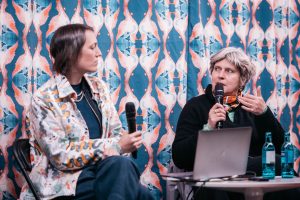
Mit ihren Kissen und Vorhängen für den Grand Snail Tour-Trailer übersetzt die Künstlerin diese Idee in einen Raum zum Verweilen. Dazu vervielfältigt und spiegelt sie mikroskopische Aufnahmen von Gewebeveränderungen, die den tödlichen Krankheiten Gehirn-Aneurysma, Lewy-Körperchen-Demenz und Arteriosklerose zugrunde liegen, bis sie ein psychodelisches Muster ergeben, das auch an Rorschach-Tafeln denken lässt. Ursprünglich aus der Psychodiagnostik soll der Rorschach-Test Aufschlüsse über den mentalen Zustand/Gesundheit der*des Patient*innen geben. Hier, bei Fudakowski, werden die Besucher*innen zu Proband*innen, ihre Vorstellungen wiederum zum Teil der Installation.  

Dieses Gedankenspiel wird auch in weiteren Medien- und Veranstaltungsformaten trainiert: Als Gründungsmitglied der internationalen Künstler*innengruppe The Association for the Palliative Turn (APT) fordert Fudakowski geistreich und mit viel Humor immer wieder dazu auf, dem Tod und Abschied zu begegnen und herauszufinden, wie Akzeptanz statt Verdrängung neue Werte definiert: Fürsorge statt Zeitdruck, Qualität vor Quantität und eine Entlastung von dem ewigen Streben nach Fortschritt, denn: Es gibt ein Leben vor dem Tod. 

Palliative Patterns setzt auch eine Werklogik fort, die Fudakowski im Allgemeinen verfolgt: Ihr lebenslang laufendes Skulpturenprojekt Continuouslessness (seit 2017) wird erst mit ihrem Tod vollendet sein. Endlichkeit ist hier kein Thema, sondern strukturelle Bedingung. 

Artist

Open Artsit

Kasia Fudakowski

Kasia Fudakowski works with sculpture, film and performance to uncover social enigmas through surreal logic and theory.

View