Jump to main content (press Enter)Jump to the footer (press Enter)

Breadcrumbs

  1. Home
  2. Zu Gast
  3. Zu Gast

Zu Gast Jahrgang 2026

© Daniel Sadrowski

Application Deadline

27.3.2026

Research Stay

1.9.-30.11.2026

Urbane Künste Ruhr is awarding three research residencies at the House for the History of the Ruhr in Bochum.

Together with the History of the Ruhr Foundation (Stiftung Geschichte des Ruhrgebiets), we are awarding three three-month research residencies at the House for the History of the Ruhr (Haus der Geschichte des Ruhrgebiets) in Bochum for the year 2026. The programme is aimed at artists whose practice includes research and who are interested in developing a contemporary perspective on the Ruhr region and its themes. Through the affiliation with the foundation and a workspace at the House for the History of the Ruhr, including access to the library and archive, the residency enables an intensive engagement with the region.

During the research phase, residents are invited to develop a project idea in close exchange with the local curatorial team. Depending on its suitability, the project may become part of a curated public programme in Duisburg in 2027.

Questions of mobility and positioning within the art field, institutional critique, and context-specific artistic practices will be part of the event’s programme in Duisburg in 2027 and are explicitly welcome as points of departure. The residency is particularly suitable for artists working with text, language, film, or performance.

The History of the Ruhr Foundation

Founded in 1998, the foundation promotes research about the history and present of the Ruhr area and provides extensive publications and journals as well as numerous archives for this purpose. The foundation building houses the Library of the Ruhr and the archive, which are both available to artists. The archive also contains numerous documents on artistic projects and project plans in the context of the European Capital of Culture RUHR.2010 GmbH. In addition, there is a close connection to the Institute for Social Movements (Institut für Soziale Bewegungen) at the Ruhr University Bochum, from which the guest artists can also benefit. 

For whom?

The programme is aimed at professional artists whose practice is related to artistic research and who have a particular interest in working with archives. 

It is mandatory that the artists spend at least 75% of their time in the Ruhr area.

What does the Programme in Cooperation with the History of the Ruhr Foundation offer?

  • A research stay from 1.9. – 30.11.2026 with curatorial support and close exchange with the team of Urbane Künste Ruhr
  • Support with networking in the region
  • A guest artist's fee of € 5,000 gross
  • A workspace in the foundation's building
  • Costs for arrival and departure will be covered once
  • Accommodation in Bochum will be provided
  • Reimbursement of public transport travel costs for research purposes

Application Modalities for the Guest Artist Programme

We welcome applications from all people regardless of gender, nationality, ethnic and social origin, religious affiliation, disability, age, gender issues and identity. We offer our support in finding suitable solutions for individual needs, for example regarding accessibility.

Application Process: 

  • Application Deadline: 27.3.2026
  • Submission of application documents via online form
  • An expert jury will select the artistic positions
  • Applicants will be notified from late April 2026 onwards

Questions can be directed to
zugast@urbanekuensteruhr.de 
Alisha Raissa Danscher (Curator Urbane Künste Ruhr)
Jolande Hörrmann (Project Coordination)

NEW RUHR MAP

Jordi Colomer

© Amina Falah

© Amina Falah

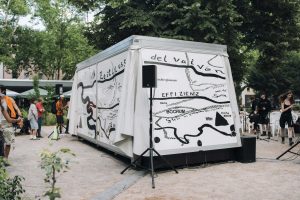
Karten sind niemals neutral, sie vermessen, begrenzen und kontrollieren, was sichtbar ist, blenden aber Trampelpfade und Abkürzungen genauso wie Gefühle von Angst oder Freude aus. Mit NEW RUHR MAP greift der katalanische Künstler Jordi Colomer dieses Missverhältnis auf und verwandelt die Kartierung in ein kollektives, performatives Wissensformat. 

Gemeinsam mit lokalen Teilnehmer*innen eines Mapping-Workshops, die aus einem guten Dutzend verschiedener, spanischsprachiger Länder kommen und im Ruhrgebiet leben, hat Colomer für den Grand Snail Tour-Trailer eine neue Ruhrgebietskarte entwickelt. Die Schnecke – ein langsames, tragendes, ortsbezogenes Wesen – wird zur Metapher für eine andere Art des Stadtdurchquerens: nicht optimiert, nicht top-down geplant, sondern getragen von gelebter Erfahrung, Erinnerung und kollektiver Imagination. 

Regionen werden stetig neu kartiert – von Stadtplaner*innen, Investor*innen, Kulturpolitiker*innen. Was dabei oft ungezeichnet bleibt, sind die Karten der Vielen: Migrationsrouten, Treffpunkte, affektive Geographien von Menschen, deren Perspektiven selten in offiziellen Repräsentationen auftauchen. NEW RUHR MAP knüpft nicht zuletzt an das Konzept der „New Cartographies“ des panafrikanische Projekts Chimurenga an: Kartieren als Praxis der Selbstermächtigung, als Werkzeug, um andere Geografien des Wissens und des Erlebens sichtbar zu machen – jenseits kolonialer und administrativer Blickregime.  

Unter anderem bekannt geworden durch die Videoserie Anarchitekton (2002–2004), in der Architekturmodelle durch Großstädte getragen werden, interessiert sich Colomer gleichermaßen für das Utopische wie das Dystopische im Stadtbild – für Stadtplanung als Versprechen und als Scheitern. NEW RUHR MAP setzt diese Reflexion mit und durch eine Community fort, die ihre eigenen Geschichten in den Stadtraum einschreibt. 

Please accept our Privacy Policy in order to display this Vimeo content.
Gemeinsam mit den Teilnehmer*innen eines Mapping-Workshops, die der spanischsprachigen Community im Ruhrgebiet angehören, hat der spanische Künstler Jordi Colomer die mobile Architektur der Grand Snail Tour neu gestaltet und wird seine Arbeit beim Stopp der Grand Snail Tour "Wertschätzen in Dortmund" vor Ort präsentieren. Mehr Infos zum Projekt: https://www.urbanekuensteruhr.de/grand-snail-tour/dortmund

Artist

Open Artsit

Jordi Colomer

Jordi Colomer's (*Barcelona 1962) practice spans film, photography, sculpture and installation, often involving collective participation.

View