Jump to main content (press Enter)Jump to the footer (press Enter)

Breadcrumbs

  1. Home
  2. Publications
  3. Booklet

Exhibition booklet
Uncanny Shifts. An exhibition close to Dortmund main station
Authors

Alisha Raissa Danscher, Britta Peters

Editors

Lea Marie Berner, Alisha Raissa Danscher, Sabine Funk, Britta Peters

Translations

Michelle Miles

Layout

Studio Yukiko

Year
2026
Download Booklet (PDF)

Familiar environments are changing, fundamental orders are shifting, and threatening events are repeating themselves: 

The uncanny could be considered a state that describes the prevailing mood of the present. While committed scientists are trying to find ways out of the global crises, feelings of fear and uncertainty are mixed with polemics, denial and rejection in the discourse fueled by authoritarian voices.

The exhibition Uncanny Shifts uses artistic means to address some ecological, social, and political interactions of our time. At various locations around Dortmund's main railway station, sculptural, installation and performative works interact with their surroundings. They encounter a complex present with new inventions, curiosity, prudence, beauty and melancholic analyses.

With Works by Ellinor Aurora Aasgaard & Zayne Armstrong, Anushka Chkheidze, Aleksandra Domanović, Kein schöner Archiv (Michael Annoff & Nuray Demir), Katrin Mayer, Hans Ostapenko with MNPL, Ziran Sha Pei, Joanna Piotrowska, Neda Saeedi, sakasaka, Silke Schönfeld, Transsolar, UH HUH HER, Driant Zeneli and The Troubadour by Ari Benjamin Meyers in co-production with Manifesta 16 Ruhr

Some projects were developed as part of the programme Zu Gast bei Urbane Künste Ruhr.
An exhibition by Urbane Künste Ruhr for the Ruhrtriennale 2026

Exhibition

  • Open Event

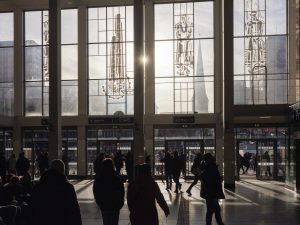
    © Heinrich Holtgreve

    Sa., 22.8. – So., 4.10.26View

    Uncanny Shifts

Local Blackouts

Lütfiye Güzel

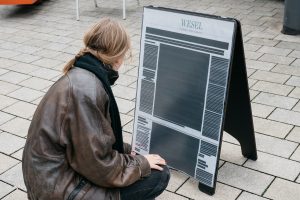
A person in a brown leather jacket looks at a large printed newspaper on a stand with the heading 'Wesel'.

© Daniel Sadrowski

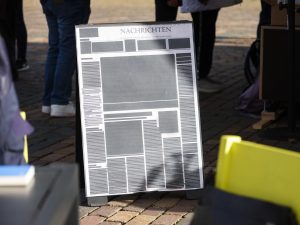
A sign with the word 'NACHRICHTEN' with an abstract newspaper layout with little text.

© Heinrich Holtgreve

Ausgangsmaterial ist ein besonders kurzweiliges Format aus dem Alltag: die Tageszeitung. Lütfiye Güzel, Poetin aus Duisburg und Vertreterin eines konsequent selbstverlegten, körpernahen Schreibens, lässt sich für die Grand Snail Tour von Projektpartner*innen und Passant*innen Lokalzeitungen und -beilagen aus den zu bereisenden Städten zusenden. Aus diesen Dokumenten erzeugt Güzel durch gezieltes Ausstreichen und Schwärzen von Textpassagen insgesamt 53 Gedichte — Local Blackouts —, die auf Aufstellern an jeder Station veröffentlicht werden.

Die Methode der Blackout Poetry ist eine Form der Found Poetry und wird bei Güzel zum politischen Akt. Das Schwärzen zitiert die Logik der Zensur, kehrt sie aber um, denn das unkenntlich Machen hat nicht Unterdrückung, sondern Verdichtung zum Ziel: Was bleibt, wenn der redaktionelle Lärm verschwindet? Lyrische Miniaturen, die in ihrer Knappheit dem Haiku ähnlich ist. Güzels Entscheidung, diese Textarbeiten im öffentlichen Raum zu zeigen, stellt zudem implizit die Frage: Für wen werden solche Texte geschrieben, und wer kommt darin vor?

Lokalzeitungen sind ein ambivalentes Medium. Sie fördern und informieren Nachbarschaften jenseits von Social Media — doch die Sprache und Nachrichtenauswahl ist häufig hetzerisch und vereinfachend. Tatsache ist, dass Lokalzeitungen an Bedeutung und finanzielle Unterstützung verlieren. Güzels Aneignung bewahrt und befragt dieses Erbe zugleich. Präsentiert auf herkömmlichen Presseaufstellern verleiht ihre Arbeit der Grand Snail Tour ein vertrautes Erscheinungsbild von regionaler Kultur und überführt diese gleichzeitig in die poetische Abstraktion.

Artist

Open Artsit

©Ben Knabe

Lütfiye Güzel

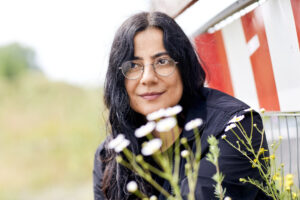
Lütfiye Güzel is a poet and has been publishing poems under her own label go-güzel-publishing since 2014.

View