Jump to main content (press Enter)Jump to the footer (press Enter)

Breadcrumbs

  1. Home
  2. Publications
  3. Urbane Künste Ruhr 2018-2023
  4. Essay

Climate Grief and the Visible Horizon
by Meehan Crist

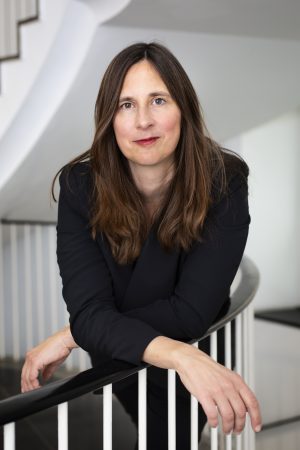
©Heinrich Holtgreve

(1) Ovid (2014). Metamorphoses. Translated by David Raeburn.
(2) Freud, S. (1917) Mourning and Melancholia.

The second book in the Metamorphoses by the Roman poet Ovid opens with a story that can be read as a climate metaphor. Phaëthon, the hot-headed son of Phoebus, the Sun God, is living on Earth with his mortal mother and feels the god has not acknowledged him as his rightful son. Hoping to prove his parentage, Phaëthon goes up into the sky and asks Phoebus for a sign that the god is indeed his father. “Ask me whatever favor you want,” says Phoebus, “and I’ll bestow it.” The boy responds: “I want to drive the chariot.” The request chills the Sun God to his core.

The chariot in question is the one Phoebus uses to take the sun across the sky each day. This golden chariot is drawn by a team of magnificent horses that only Phoebus can control. “Please ask me for anything else”, he says to his son, “Don’t ask me for something that can only end in your demise. You’re too young, not strong enough. Even the other gods cannot control this chariot.” But the boy is headstrong and hellbent on driving his father’s chariot. Phoebus relents. He hands Phaëthon the reins and off go boy and chariot into the sky. But as they race through the zodiac, the horses are spooked by the terrifying things in the celestial firmament – they bolt. The boy can’t control them. He is dragged out into the darkest outer reaches of space, then the horses reverse course and race back toward Earth, too close, and the flaming ball of the sun begins scorching the Earth’s surface. Phaëthon looks down and sees the world on fire.

The earth now burst into flames on all of
the hills and the mountains,
split into huge wide cracks, and dried as it lost
its moisture.
The corn turned white and the trees were
charred into
leafless skeletons;
Parched grain offered the perfect fuel for
self-ruination.
These losses were trifling. Destruction fell
upon great
walled cities;
mighty nations with all their peoples the
conflagration
turned into ashes […]
Phaëthon now looked down on a world in
flames […]
Wrapped in the pitchy darkness, he didn’t
know where he was going. (1)

The Earth, scorched and parched-lipped, calls out to Jupiter, “You have to do something. I’m dying.” The ‘king of the gods’ hears this plea and fires a thunderbolt at the chariot. Phaethon is instantly killed, and his corpse rains down from the heavens with his hair on fire like a comet. The terrified horses plunge into the ocean.

After his son’s death, Phoebus is unmoored by grief. He won’t drive the chariot, but the other gods implore him to take up the reins. “You have to,” they say. “We need the day.” Heart still heavy, he returns to the sky.

There is an obvious way to read this story as a metaphor for climate change. The planet is heating up. Ice is melting and fires are raging. Around the world, records are being set for the hottest temperatures in recorded history. (It’s almost a little too on-the-nose – just as in the story, the Arctic Circle is on fire.) In this reading, humanity is the boy: our hubristic desire to take control of what was never meant to be ours drives the world into chaos and destruction. Ted Hughes wrote a poem based on this story as just such a metaphor. But I think we can read it a little differently.

What if we, as readers, shift our identification from the boy to the people on Earth? Another way this story serves as an apt metaphor for climate change, one ignored by the more obvious interpretation, is that it includes marginalized, voiceless people who aren’t responsible for the destruction they’re living through. What was it like for the people in those burning cities and fields – how does it feel to witness that kind of destruction? What terrible fear would you feel? What horror and grief?

This question is not theoretical. People today are experiencing, in varied and unevenly distributed ways, what no generation of humans has ever faced: the ongoing loss of the planet as we have known it. This might mean the loss of your home to fire or flood, or the loss of a landscape that has defined your community. Do you rebuild a charred and smoldering home knowing there will be more fires? As your town sinks beneath the encroaching ocean, how much more than a home is lost? Climate change can mean the loss of a favorite childhood beach, or forest, or frozen swath of tundra, that feels like part of who you are and to which you can never return. When fisheries collapse because fish can no longer be found in the sea, this loss encompasses whole towns and industries based on those fish existing. It means loss of jobs, income, food security, and culture. We don’t have good language for talking about the kind of grief such loss entails. We don’t know how to process this grief in a way that enables us to move forward.

There are few grief paradigms that can perhaps help us to understand new forms of climate grief. In the classic essay Mourning and Melancholia (1917), Freud differentiates between two responses to loss. He describes mourning as a normal human reaction to loss, “the reaction to the loss of a loved person, or to the loss of some abstraction which has taken the place of one, such as one‘s country, liberty, an ideal, and so on”. Melancholia includes a prolonged period of mourning with all the same features, with an additional pathological skewing of self-regard – you begin to hate yourself a bit. “Profound mourning” writes Freud, “contains the same painful frame of mind, the same loss of interest in the outside world… the same loss of capacity to adopt any new object of love (which would mean replacing him).”2 In other words, you hang on to whatever was lost because letting it go to love something else becomes a rejection of the lost beloved. While mourning and melancholia are very similar processes, melancholia just won’t end – you remain transfixed, frozen in melancholia, unable to move on.

Another classic grief paradigm that offers insight is the “five stages of grief” outlined by psychiatrist Elisabeth Kübler-Ross. Her thinking aligns roughly with Freud’s concept of mourning, but breaks the process into stages: denial, anger, bargaining, depression and acceptance. I find it intriguing that in some visual representations of this process, depicted as a horizonal line with two hills, the second hill is labeled “acceptance” and appears higher than the first, implying that the successful mourner has ended up somewhere higher, and thus better, than before.

If Kübler-Ross’s model describes a process akin to Freud’s mourning, a third paradigm developed in the 90s known as “complicated grief ” describes a process more like melancholia. The symptoms of complicated grief are the same as those of “normal” grief – the defining element is the duration of the feelings. The mourner gets stuck in an early, acute stage of grief where the future seems bleak and empty. According to Dr. Katherine Shear at Columbia University, complicated grief occurs in only a small percentage of people who tend to have difficult relationships and a family or personal history of mental health disorders. The mourner is unable to process grief in the more “normal” sense of mourning, and they experience their negative symptoms as a way of remaining connected to what has been lost. You can hear echoes of Freud: grief is a form of love, so if you stop grieving, you’ve stopped loving – that in itself is painful.

While these grief paradigms are undoubtedly useful, all three stress finality. Someone has died. Something is gone. There’s been a concrete loss. It’s the job of the mourner to grieve appropriately and move on. This diminishes their usefulness in terms of understanding climate grief. They don’t map neatly onto climate grief because often we don’t know what the loss is, or will be. You don’t know if today’s flood zones will be tomorrow’s ocean. You can’t know how high or how fast the water will rise. The effects of climate change do not offer the sort of finality that can actually help us decide to let go, and move forward.

In the 1970s, when family therapist and psychologist Pauline Boss was working with people whose family members had gone missing in action, she came up with a new paradigm for grief that I think might be more apt: grief without closure, or “ambiguous loss”. Boss describes two types of ambiguous loss. In the first, the object of love is physically absent but remains psychologically present, as with those grieving a soldier missing in action. (Recently, a friend told me a story about a woman whose son went missing in action. Twenty years later someone in uniform came walking up to the house and she went racing out the front door thinking it might be him.) In the second type of ambiguous loss, the object of love is physically present but psychologically absent. Consider a loved one with Alzheimer’s. The person is still there – you can sit by them and hold their hand. You can still be in the same room, but in some sense the person is not really there. How do you grieve the loss of someone who’s sitting right in front of you? As Boss writes, “There is no closure. The challenge is to learn to live with the ambiguity.” Loss without closure seems closer to what some people are feeling in our warming world. But even ambiguous loss doesn’t map perfectly to climate grief, because with ambiguous loss the endpoint may still be known. With the Alzheimer’s patient, you know that in the end they’re going to die. With sea level rise, the end remains unknown, and unknowable.

We don’t have a paradigm for grief that requires us to embrace both ambiguity and finality. We don’t have a paradigm for grief that is both personal and global. The climate crisis presents us with multiple modes of grieving to try and fit into one coherent psychological space. Individually and collectively we’re stuck in a psychic gap which feels like chaos but also makes some sense. The question becomes, how do we decide what to let go of, what to fight for and what to mourn, so that we can move forward into a new sort of future?

by Meehan Crist
Kamen

Begleitet wird die Grand Snail Tour von Künstler*innen aus dem Bereich Literatur, Fotografie und Zeichnung, die zeitgleich zum Aufenthalt des Tourmobils, Eindrücke und Reflexionen aus jeweils derselben Stadt sammeln und diese sie visuell oder literarisch ins Bild setzen. So entsteht ein Paratext zur 3-jährigen Tour, der in Form einer Reisechronik, ein Kaleidoskop an Geschichten, Verbindungen, Momentaufnahmen in den 53 Städten der Region als Gleichzeitigkeiten und Ungleichzeitigkeiten zur Grand Snail Tour sichtbar werden lässt.

Kamen und sein Kreuz von Kathrin Röggla

1. Vorher, ich will es ja wissen

Sehr viel Geographie in Kamen, zu viel für meine Vorstellung vom Ruhrgebiet. Vom Flüsschen Seseke zum Kurler Busch über das Heerener Holz unweit vom Haarstrang bis zum Kamener Kreuz. Gamer in Kamen, ja sicher. Groyper in Kamen? Keine Ahnung, werde es nicht herausfinden in der kurzen Zeit. Erwartung an Kamen – viel Busch, viel Wind, viel Herbst und Autobahn. Eine Kirche. Häuschen. Google Maps zeigt allerdings viele Cafés, das kann ich nicht glauben. Viermal so groß wie Bebra, das kann ich mir auch nicht vorstellen.

Ich lese: „Die Hauptverbindungsstrecke zwischen der Kamener Innenstadt und Methler ist die Westicker Straße, die sich nach einem großzügigen Ausbau in den 1970er Jahren zu einem Unfallschwerpunkt entwickelt hatte. Durch den Bau mehrerer Kreisverkehre wurde dieser Entwicklung begegnet.“ Der Unfallschwerpunkt lässt also grüßen, Kreisverkehre werden mich erwarten.

Es gibt ein Drachenflugfestival im Herbst. Getrennt von der Stadt durch Autobahntrassen.

Kommt man nach Kamen besser mit dem Auto? Das Wahrzeichen der Stadt ist schließlich ihr Autobahnkreuz.

90 Menschen leben nordöstlich des Kreuzes. So knapp 50.000 woanders. Eigentlich eine Mogelpackung: Heeren, Rottum, Derne, Heeren-Werve, Kamen-Süd, alles ein einziges Konglomerat. Kamen ist eine Shrinking City, bis 2050 nur noch 39.000. Eine alte SPD-Hochburg, die nun langsam nach Grün abgedriftet ist und jetzt auch AfD-Zuwachs zu verzeichnen hat. In der Kommunalwahl vom Wochenende wurde in Bergkamen per Los zwischen einem AfD-Kandidaten und einer SPD-Kandidatin entschieden. Eine andere Headline: „Darum dauert die Auszählung der Stimmen in Kamen so lang.“ 

Es ist die Stadt der Stauprognosen, ansonsten wie auch anderswo dort: Abibälle – Gesamtschule und Gymnasium, Stadtfeste, Volksfeste, Sparkassen Thriathlon – und irgendwo ein Schild mit „Ruhrpottfritten“.

Der Polizeifunk vermeldet, dass bei einem Einbruch Bargeld „und ein Haartrockner“ entwendet worden sei, sowie eine Cannabisfarm entdeckt und ein Zigarettenautomat gesprengt wurde. Eine Straße heißt „Am Geist“, da werde ich ankommen. Es ist tatsächlich eine Geistersstraße, werde ich feststellen.


2. Da sein

10.00: Die Rezeptionistin des Hotels im Süden kommt aus Bergkamen und beschwört täglich das Kamener Kreuz, das tatsächlich immer noch seinen Rang in den Verkehrsnachrichten verteidigt. Sie habe auf einer Urlaubsreise von hier nach Pforzheim 19 Baustellen gezählt. Das sei doch verrückt. Ja, ihre Gäste seien Leute, die hier in dem Industriegewerbe ringsum arbeiteten. Und die Spanier aus dem Frühstücksraum?, frage ich. Die würden zur Messe in Dortmund gehen, das sei zu teuer dort zu wohnen.

10.20: Die Tankstellenfrau aus Heeren-Werve kennt sich hier nicht aus. Sie kommt aus Kamen und das ist 5km entfernt. Ein niedriges Flugzeug erinnert mich daran, dass der Flughafen Dortmund nicht weit entfernt ist.

10.40: Die Apothekerin hält mich für eine Person aus Kamen. Das geht aber schnell hier.

Hinter mir Berichte über die Situation nach der Scheidung auf der Terrasse der Bäckerei Grobe, die beiden Frauenstimmen besprechen das, was man bekommt und was man bezahlt in verschiedenen beruflichen Situationen. Ansonsten Rentner, einer mit einem Cowboyhut, das hat mich interessiert. Wie kann man durch Kamen laufen als 85-jähriger mit Cowboyhut?

Es ist die merkwürdigste Form des Tourismus, die ich jemals machte. Denn natürlich sitze ich entrückt von jeglichem Alltag wie eine Touristin im Café und bestaune die Absonderlichkeiten der Provinz. Eine extrem angreifbare Position.

Ich lese: Wer die Meme Culture nicht versteht, und über den Attentäter von Charlie Kirk schreibt, der richte journalistisch mehr Schaden an als es was bringt, schreibt Rechtsextremismusexpertin Natascha Strobl. [1]

Die Frauen hinter mir sind aufgestanden, sie haben sich zum Abstand noch Komplimente über ihre Kleidung gemacht. Die ältere Frauenrunde drinnen spricht weiter. Sie sind zu viert, Eigentlich könnten sie Kartenspielen, wie meine Oma das gemacht hat. Ich werde Kartenspielen. Ganz sicher.

11.00: Bei Thalia ums Eck habe ich Kaleb Erdmanns „Die Ausweichschule“ über den Erfurter Amoklauf gekauft, sie hatten eine kleine Auswahl an Literatur da. Ich habe es gewählt, weil es so schön mündlich beginnt. Ein Gespräch im Fluss, das finde ich gut als Romanfang. Es wird dann sehr flüssig, vielleicht zu flüssig. „Gibt dem eine Chance“ sage ich mir auf der Terrasse der Bäckerei Grobe im 1. Stock. 

Von dort aus der Überblick. Gerade wirkt die Szenerie so: Die Leute wachen auf nach ihrem Berufsleben und gehen dann als Rentner durch ihre Städte und wundern sich? Viele haben diese zweifelnden Mienen. Verstärkt wird der Eindruck durch die Tatsache, dass zahlreiche ältere Leute mit kleinen Elektromobilen sich bewegen.

12.26 – der gelbe Prosegurwagen kommt durch, um 12.30 fährt er wieder weiter.

Seit 12.00 vermehrt junge Menschen. Sie sprechen in ihr Handy, sie unterhalten sich, sie schauen nicht misstrauisch drein. Sie telefonieren auch viel mehr als die älteren. Überhaupt viel mehr Stimmen. Es ist erstaunlich, wie sich die Stadt plötzlich füllt. Das Giraffengraffiti in der namenlosen Straße vor mir bleibt aber nach wie vor überraschend.

Die Anzeige für die Busabfahrten am Marktplatz ist so gehängt, dass man sie am besten aus dem Backcafé sehen kann.  Auf dem Einbahnstraßenschild klebt endlich ein Borussia-Dortmund-Aufkleber – darauf habe ich gewartet!

12.47: Der Mann, der die Zunge immer rausstreckt, kommt nochmal auf die ganz genau gleiche Weise vorbeigefahren, ich frage mich, ob das ein Glitch ist, eine Schleife.

13:08: Zuerst einzelne, jetzt ganze Gruppen an Schulkindern unterwegs. Die Stadt füllt sich schlagartig mit Stimmen.

14:20 Die Inhaberin des Asia Wok Laden und ich stellen fest, dass wir beide vor fünf Jahren aus Berlin weggezogen sind. Wir freuen uns, sind Artgenossen. Sie aus Pankow, ich aus Neukölln, sie habe aber eine Tante in Neukölln. Es sei hier in Kamen so wie in Pankow, grün und ruhiger. Ich befrage sie zur Geisterstraße „Am Geist“, denn da steht jede Menge leer. Coronaerbe, meint sie, nach Corona gab es einige Pleiten, darunter auch das große Hotel, das ihr gegenüber ist. Die ganze Straße ist sehr gespenstisch.

15:00 Ausflug nach Bergkamen und hinauf auf die Halde Großes Holz, um einmal von oben alles zu sehen: das ist das Ruhrgebiet von oben. Der Schock des großen ehemaligen Zechengeländes und der Industriekomplexe in Bergkamen weicht hier einem grünen Eindruck. „Das Ruhrgebiet ist von oben grün“ wird auch jemand später sagen. Mit mir Hundebesitzer, Radler, unten dann Jugendliche, die im Auto sitzen bleiben, auf dem Rückweg der Partyservice am Straßenrand. Die vielen Buslinien. 

16.00: Der Marktplatz, das würde ich zurück in Kamen im Café erfahren, sei abends von Alkis besetzt, da gab es oft Schlägereien, man müsse alles reinräumen, rechtsrum ist die Drogenszene, aber jetzt sei das Ordnungsamt am Platz, und das hilft. Im Grunde wiederholt sie die immer wieder gehörte Erzählung einer shrinking city, wie Alles immer schlechter, die Läden machten alle schon um 16.00 zu und seien zum größten Teil abgewandert. Deichmann, Karstadt, Schlecker. Alles weg, die Boutiquen, die Kneipen, der Bäcker am Platz, alles weg, keine Leute finde man mehr, keine Arbeitskräfte, aber das sei überall so. Später werde ich sehr wohl Deichmann finden und auch sehen, dass einige Geschäfte noch offen haben.

Die Cafébetreiberin erzählt, sie habe früher das Krankenhauscafé gemacht, jetzt sei sie seit fünf Jahren hier, die fünf Jahre, die Zeit der Pandemie scheint alles verändert zu haben in dieser Stadt. Der Platz sei nicht schön, da sei nichts bunt, sie würde am liebsten alles betonieren und Schulklassen den Asphalt bunt bemalen lassen. Warum denn das? Die alten Leute stürzten hier bei dem Pflaster. Was sie schon für Stürze gesehen habe! Sie lebe von 80% Stammkunden, morgens war das Café übervoll. „Unna ist ganz anders.“

18.00 Verschränkter Herbst: Mal kalt, mal warm, die Luft ist durcheinander. Gleich gibt es die Afterworkparty organisiert von der „Familienbande“, die uns vielleicht Konkurrenz machen wird. Aber es wird alles ganz anders. Alle Stühle und Sitzgelegenheiten sind besetzt, als die Kolumnen der Kamenerin Esra Canpalat zu hören sind. Hinter ihr werden die wunderbaren Fotos von Fatih Kurçeren projiziert, Portraits der oft jugendlichen Bewohner*innen, Sites. Sie zeigen mir die involvierte Seite der Beobachtung, die meine touristischen Schnappschüsse blass aussehen lassen, denn natürlich habe ich gemacht, was Großstädterinnen immer machen, nämlich das Skurrile der Provinz zu fotografieren. Hinter mir sitzen die beiden Verantwortlichen aus der Stadtbibliothek. Irgendwer sagte den Satz. „Das Beste an Kamen ist, dass man mit der Bahn in nur zehn Minuten nach Dortmund kommt.“ Ich glaube dieser Aussage nicht.


3. Fortfahren


[1] https://www.moment.at/story/was-ist-ein-groyper/

Stops

Open "Kamen"
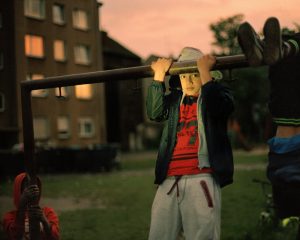
Photograph by Fatih Kurçeren: A child hangs from a metal bar on a playground while other children play nearby.

Pithead © Fatih Kurçeren

18.9.25, 18–21 h

Watching in Kamen

Kamen

Artist

Open Artsit

Kathrin Röggla

Kathrin Röggla (born in Salzburg in 1971) lives in Cologne and works as a writer of prose and plays. Her most recent publications are her essay collection Nichts sagen. Nichts hören. Nichts sehen. (S. Fischer, 2025), her novel Laufendes Verfahren (S. Fischer, 2023), and her play Kein Plan (Kafkas Handy), which premiered this February.

View