Breadcrumbs
Hollow space, Hologram, Holy Earth, Holzwickede, Home officeby June Drevet
©Heinrich Holtgreve
The Urbane Künste Ruhr magazines #1 to #9, created from 2018 to 2023, form the core of the book at hand. Inspired by the idea of summarising the years past, but also of portraying the processuality of an artistic programme playing out in public space, we decided to create a structural approach to navigating the already existing content – rather than conceiving a whole new publication.
At first glance, an index is an alphabetically ordered list of terms, which allows a narration to arise due to its sheer number and cluster of entries. The coexistence of seemingly foreign terms actually lends each individual word its narrative character: something emerges between the words – hollow space, hologram, Holy Earth, Holzwickede, home office – that spreads wings and takes on a life of its own in our imagination.
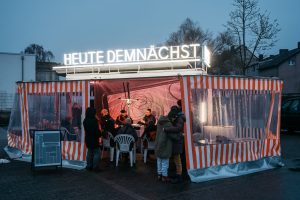
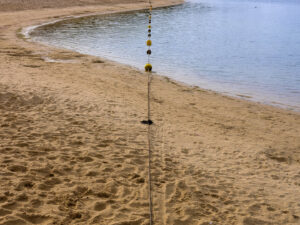
The creation of such an index gains in appeal if one has spent time following the system chosen with close and enduring interest. We decided to create the indexical structure according to the two fundamental aspects that strongly sustained the programme throughout all the years: sites and people. The pictorial plane shows Urbane Künste Ruhr colleagues since 2018 as well as smartphone pictures of numerous on-site encounters from the same period. After an initial analysis of all magazines, a list of 1,500 entries including people (and groups) was compiled.
Several site references were easy to define – countries, cities, continents, terms related to the cardinal directions. Others were not so obvious: facade, mesh, outside the box, quarantine? What makes a site a site? And how can language foster spatial dimensions? For this reason, the index in the end contains terms that are not sites per se, though they become sites when viewed through spectacles that make their spatial dimensions discernible. The word emotional world, for example: it is not a place where we can pull out a lawn chair and sit down, yet we can let somebody in, meaning that one can set foot in an emotional world, so to say.
All of the words listed reference magazine pages. The structure of the index thus serves to facilitate navigation back to the texts, mirroring the way Urbane Künste Ruhr leads people to familiar and unfamiliar sites, emphasising their special features by taking a unique perspective. For us, it was important to remain as close to the original as possible during the process of surveying the material: we treated all entries the same, whether specific (Haniel spoil tip or Hauptstraße 52) or more general (industrial parks or inside). If a site involved more than one element, for instance several factory buildings, then we used the term in plural form. If a preposition was necessary – as in outside the box for example – then we included it as well. Occasionally there were some unsuccessful potential entries. For example, it was a challenge to deal with terms that in German are considered places but lack a direct equivalent in English, or vice versa. An example of this is the German word Schutz, which has a spatial connotation in the magazine text referenced, yet the term had been originally translated as protection and thus required an additional translation in the index – shelter – so that it makes sense in the site index.
When looking up words from the index, readers may notice that not all terms were translated in the same way. This is because we attach importance to retaining the nuances of the original texts, rather than adding new translations after the fact. As an example, in the English index the German word Rathausplatz (Town Hall Square) is listed, but also Herner Sea as a translation of Herner Meer. This also reflects the changes in editorial teams, and of translators and copyeditors in recent years. Moreover, the editors of the present volume decided on the simple solution of listing streets without adding the respective city behind the name of the street. Of course, the street Hauptstraße (Main Street) is found in more than one city, yet we have intentionally refrained from making direct references. Indeed, the readers are invited to leaf through the part of the book referenced in the index to discover for themselves which Hauptstraße is meant, or even to use the book to research the phenomenon of the Hauptstraße in Ruhr area cities on the whole.
The given orientation structure and our reflection on formal and editorial decisions, as touched upon here, are intended to illustrate how many different spaces we engage with in everyday life. In this sense, this index is not just a list of terms – it is an attempt to document and mediate Urbane Künste Ruhr’s countless physical and mental exploratory tours in book form.
by June Drevet