Jump to main content (press Enter)Jump to the footer (press Enter)

Breadcrumbs

  1. Home
  2. Publications
  3. Urbane Künste Ruhr 2018-2023
  4. Essay

Hollow space, Hologram, Holy Earth, Holzwickede, Home office
by June Drevet

©Heinrich Holtgreve

The Urbane Künste Ruhr magazines #1 to #9, created from 2018 to 2023, form the core of the book at hand. Inspired by the idea of summarising the years past, but also of portraying the processuality of an artistic programme playing out in public space, we decided to create a structural approach to navigating the already existing content – rather than conceiving a whole new publication.

At first glance, an index is an alphabetically ordered list of terms, which allows a narration to arise due to its sheer number and cluster of entries. The coexistence of seemingly foreign terms actually lends each individual word its narrative character: something emerges between the words – hollow space, hologram, Holy Earth, Holzwickede, home office – that spreads wings and takes on a life of its own in our imagination.

The creation of such an index gains in appeal if one has spent time following the system chosen with close and enduring interest. We decided to create the indexical structure according to the two fundamental aspects that strongly sustained the programme throughout all the years: sites and people. The pictorial plane shows Urbane Künste Ruhr colleagues since 2018 as well as smartphone pictures of numerous on-site encounters from the same period. After an initial analysis of all magazines, a list of 1,500 entries including people (and groups) was compiled.

Several site references were easy to define – countries, cities, continents, terms related to the cardinal directions. Others were not so obvious: facade, mesh, outside the box, quarantine? What makes a site a site? And how can language foster spatial dimensions? For this reason, the index in the end contains terms that are not sites per se, though they become sites when viewed through spectacles that make their spatial dimensions discernible. The word emotional world, for example: it is not a place where we can pull out a lawn chair and sit down, yet we can let somebody in, meaning that one can set foot in an emotional world, so to say.

All of the words listed reference magazine pages. The structure of the index thus serves to facilitate navigation back to the texts, mirroring the way Urbane Künste Ruhr leads people to familiar and unfamiliar sites, emphasising their special features by taking a unique perspective. For us, it was important to remain as close to the original as possible during the process of surveying the material: we treated all entries the same, whether specific (Haniel spoil tip or Hauptstraße 52) or more general (industrial parks or inside). If a site involved more than one element, for instance several factory buildings, then we used the term in plural form. If a preposition was necessary – as in outside the box for example – then we included it as well. Occasionally there were some unsuccessful potential entries. For example, it was a challenge to deal with terms that in German are considered places but lack a direct equivalent in English, or vice versa. An example of this is the German word Schutz, which has a spatial connotation in the magazine text referenced, yet the term had been originally translated as protection and thus required an additional translation in the index – shelter – so that it makes sense in the site index. 

When looking up words from the index, readers may notice that not all terms were translated in the same way. This is because we attach importance to retaining the nuances of the original texts, rather than adding new translations after the fact. As an example, in the English index the German word Rathausplatz (Town Hall Square) is listed, but also Herner Sea as a translation of Herner Meer. This also reflects the changes in editorial teams, and of translators and copyeditors in recent years. Moreover, the editors of the present volume decided on the simple solution of listing streets without adding the respective city behind the name of the street. Of course, the street Hauptstraße (Main Street) is found in more than one city, yet we have intentionally refrained from making direct references. Indeed, the readers are invited to leaf through the part of the book referenced in the index to discover for themselves which Hauptstraße is meant, or even to use the book to research the phenomenon of the Hauptstraße in Ruhr area cities on the whole.

The given orientation structure and our reflection on formal and editorial decisions, as touched upon here, are intended to illustrate how many different spaces we engage with in everyday life. In this sense, this index is not just a list of terms – it is an attempt to document and mediate Urbane Künste Ruhr’s countless physical and mental exploratory tours in book form. 

by June Drevet
Breckerfeld

Begleitet wird die Grand Snail Tour von Künstler*innen aus dem Bereich Literatur, Fotografie und Illustration, die zeitgleich zum Aufenthalt des Tourmobils, Eindrücke und Reflexionen aus jeweils derselben Stadt sammeln und diese sie visuell oder literarisch ins Bild setzen. So entsteht ein Paratext zur 3-jährigen Tour, der in Form einer Reisechronik, ein Kaleidoskop an Geschichten, Verbindungen, Momentaufnahmen in den 53 Städten der Region als Gleichzeitigkeiten und Ungleichzeitigkeiten zur Grand Snail Tour sichtbar werden lässt.

© Daniel Sadrowski

© Daniel Sadrowski

Eine Landpartie von Caren Jeß

Ich fahr da rein mit dem Bus. 
„Schönen Abend noch!“
ruft der Fahrer den Fahrgästen nach, allen,
„have a nice evening!“
Downtown in Breckerfeld. Die Tür des Hotels ist massiv und aus Holz, im Zimmer roll ich mich auf beige-grauer Auslegeware, Schreibtisch und Bett Buche hell, ansonsten viel Silbermetallic, wie in den 00ern, als das die Lieblingsfarbe für Autos war. 
Nachts noch geh ich spazieren und bemerke Breckerfelds beeindruckendes Höhenprofil. Die liebliche Landschaft, die losgeht, wo die gestalteten Vorgärten aufhören, seh ich dann tags drauf bei Sonnenschein. Der Lokaljournalist sagt,
„die Breckerfelder leben gerne in Breckerfeld.“
Ich guck es mir genauer an: Hansering-Park, drum herum viel Universalverbundpflasterstein, historischer Stadtkern, Bronze-Ensemble an der Denkmalstraße, denn Breckerfeld machte einstmals in Stahl, im Norden Aldi, Rewe, Edeka, im Osten ein beträchtlicher Friedhof, außerdem Autos, die hier Kreisel rein, Kreisel raus, über die Frankfurter Straße durch Breckerfeld adern.
„Mit Milch oder mit Sahne?“, 
werd ich gefragt im Eiscafé Venezia, nachdem ich einen Cappuccino bestelle, doch da liebäugle ich längst mit dem Eisbecher „Flipper“, weil der mit einem „Touch Amarenasauce“ kommt, und ich will das schon allein, weil ich das Wort Touch ewig nicht gehört hab. Aber leider keine Zeit für diese Ewigkeit, denn ich will wissen, was die Kinder ins All schicken wollen: 
»Funken in Breckerfeld«
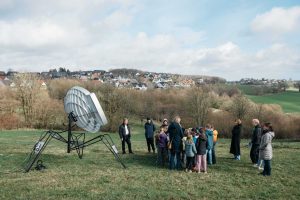
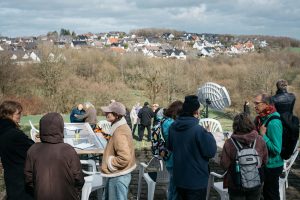
deshalb sind wir hier. Zwischen Schule und Sportplatz ist er aufgestellt: Mona Schulzeks Outer Space Transmitter. Er sendet Botschaften ins All. Direkt aus Breckerfeld. Eine Grundschulklasse kommt, holt die Stifte raus, die Zettel. Die Kinder haben mehr Fragen als Wünsche, schonmal interessant, sie richten sie aber nicht ziellos ins All, in alles, was da sein könnte, sondern gehen direkt rein, in medias res, 
„Aliens“, 
komm, darum geht es doch hier, und über die wollen wir natürlich ALLES wissen, erstmal:
„was könnt ihr?“
Direkt meine Lieblingsfrage. Sie zielt ins Wesen extraterrestrischen Lebens und fragt entwaffnend klug, was Akademiker:innen auch nicht besser wissen wollen könnten.
Dann:
„Seid ihr nett?“
„Wollt ihr Krieg?“
„Könnt ihr Basketball?“
Ich hoffe, die Aliens antworten. Mona Schulzek nimmt die Fragen jedenfalls ernst, übersetzt sie in ihr eigens entwickeltes Zeichensystem, und sendet.
„Wenn ihr nett seid, zeigt euch!“
Die Künstlerin erklärt den Kindern,
„Es gibt mehr Sterne im All als Sandkörner auf der Erde.“ 
Sie staunen nicht schlecht, und ich frag mich, wo eigentlich die Transmitter-Monas meiner Kindheit waren. Ein lizenzierter Hobby-Funker zeigt den Kindern sein Funkgerät, sagt, 
„So ein Gerät habt ihr sicher alle zuhause zum Räuber und Gendarm spielen.“
Die Kinder gucken. 
„Digga“,
murmeln sie, zeichnen noch ein Pferd und noch ein Alien, dann kommt der Bus.
Und es ist wieder ruhig um den Outer Space Transmitter.
Als ich überlege, welche Botschaft ich ins All senden würde, geht mir noch einmal der „Touch“ durch den Kopf, und alle verabschieden sich. Die Künstlerin, das Team und ich.
Bei meinem letzten Spaziergang über wunderschöne Pfade dieser kleinsten Hansestadt der Welt (stimmt nicht, das ist Werben an der Elbe, hab gegoogelt), durch die Dämmerung entlang dem ersten zarten Frühlingsgrün, komm ich an einem Gartenzwerg im Wald vorbei, erschreck mich hart, doch gehe erwachsen weiter.
Bevor meine Zeit hier vorbei ist, treibt mich mein Hunger noch ins „Wirtshaus Anno 1739“, und das möchte ich bitte genauso mit nachhause nehmen. Jedoch es gehört Breckerfeld. Und das hat auch die passenden Menschen dafür, die glasklar lachen oder scheppernd wie Büchsen, Hauptsache heiter, und ihre Brause schlürfen, die Tasse Kaffee und auch das Glas Wein. 
„Wir haben erst vor einer Woche aufgemacht!“
Toi toi toi! Es ist Leben in Breckerfeld.

Stops

Open "Breckerfeld"

© Daniel Sadrowski

12.3.26, 11–17 h

Transmitting in Breckerfeld

Breckerfeld

Artist

Open Artsit

©Jewgeni Roppel

Caren Jeß

Caren Jeß, born in Eckernförde in 1985, studied German philology and modern German literature in Freiburg i.Br. and Berlin. 

View