Jump to main content (press Enter)Jump to the footer (press Enter)

Breadcrumbs

  1. Home
  2. Exhibitions
  3. Exhibition

Die Spielstraße
nchen 1972

23.8. – 1.11.20

In 1972, Werner Ruhnau was invited by the Olympic Organizing Committee to realize the Spielstraße as a supporting program for the Olympic Games in Munich. 

In accordance with the principles of the modern Olympic Games, which were intended to contribute to international understanding and tolerance among nations, the project invited people of all backgrounds to come together at the Spielstraße and enter into communication with one another. The contributions on site included various artistic media, from performing games and video works to objects and performances from the field of visual arts. The focus was on the critical examination of current events from the stadiums, the possibility of participation, and the timeless Olympic ideals. Due to the attack on the Israeli team on September 5th, 1972, the Spielstraße was demolished early on and was hardly received in the aftermath.

The architect Werner Ruhnau lived in Essen until the end of his life and became famous above all for his innovative theater buildings such as the Musiktheater im Revier in Gelsenkirchen. Anita Ruhnau took over the project management of the visual arts division during the realization of the Spielstraße. The exhibition at the Skulpturenmuseum Glaskasten in Marl, curated by Georg Elben, Britta Peters and Jana Kerima Stolzer, approaches the Spielstrasse from a contemporary perspective and for the first time shows film material from the archives of Werner and Anita Ruhnau, as well as original objects by the participating visual artists. In doing so, it approaches the historical events and project plans and invites visitors to reflect on the relevance of the social climate for (urban) society.
Tablescapes

Nils Norman

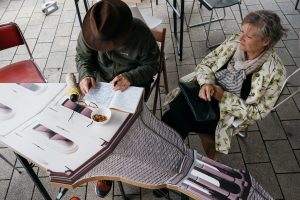
Two people sit at a table with a printed surface featuring an architectural motif. One person wears a brown hat and writes in a notebook, while the other, in a floral coat, sits holding a black bag.

© Daniel Sadrowski

© Daniel Sadrowski

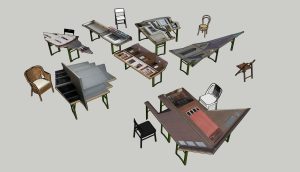
Neutral und funktional sollten mobile Tische sein. Doch die von Nils Norman irritieren diese Selbstverständlichkeit: Ihre Oberflächen zeigen ausgefräste Elemente unterschiedlicher Architekturen aus dem Ruhrgebiet – Kirchtürme, Fassaden aus der Gründerzeit, Platten- oder Gewerbebauten. Was als schlichte Arbeitsunterlage dient, wird zur opulenten Modelllandschaft. 

Norman arbeitet seit vielen Jahren interdisziplinär an der Schnittstelle von Skulptur, Natur, Architektur, Stadtplanung, Möbeldesign und Pädagogik, stets zur Frage: Wem gehört der öffentliche Raum und wer darf ihn gestalten? Er entwickelte Fußgängerbrücken, Theatervorhänge, Spielplätze, Gärten und Wegeleitsysteme, wobei er mit viel Humor seine Kritik an gängigen Vorstellungen von Stadtentwicklung, Lokalpolitik und ökonomischen Systemen formuliert. In seinem Archiv Urbanomics sammelt er seit 1997 Sicherheitsarchitekturen, wobei ihn die Frage nach der Gestaltung von Kontrolle interessiert und wie die Nutzung eines Raumes durch dessen Design beeinflusst wird. Mit dem umgebauten Reisebus mit Gewächshaus und Lesesaal Geocruiser (2002) schuf er eine mobile Bildungs- und Begegnungsinfrastruktur. 2005 ließ er mit einer 80m langen Brücke inklusive See und Insel einen neu gebauten Stadtteil im dänischen Roskilde mit seinen Nachbarschaften verbinden. 

Normans Tische für die Grand Snail Tour erfüllen eine Funktion und unterlaufen sie zugleich. Die klappbaren Gestelle verbinden Flexibilität und Mobilität mit barocker Ausgestaltung – Oberflächen, die mehr erzählen als nötig. Als Teil der Sammlung reisen sie von Beginn an mit, werden aufgestellt, verwendet und wieder eingeklappt. An jedem Stopp treffen die Tisch-Landschaften auf neue Stadträume und erzeugen stets eine produktive Reibung zwischen dem abgebildeten und tatsächlichen Ort. 

Artist

Open Artsit

Nils Norman

Nils Norman is an artist living in Amsterdam and Munich. He works across the disciplines of public art, architecture and urban planning.

View