Jump to main content (press Enter)Jump to the footer (press Enter)

Breadcrumbs

  1. Home
  2. Exhibitions
  3. Exhibition

Die Spielstraße
nchen 1972

23.8. – 1.11.20

In 1972, Werner Ruhnau was invited by the Olympic Organizing Committee to realize the Spielstraße as a supporting program for the Olympic Games in Munich. 

In accordance with the principles of the modern Olympic Games, which were intended to contribute to international understanding and tolerance among nations, the project invited people of all backgrounds to come together at the Spielstraße and enter into communication with one another. The contributions on site included various artistic media, from performing games and video works to objects and performances from the field of visual arts. The focus was on the critical examination of current events from the stadiums, the possibility of participation, and the timeless Olympic ideals. Due to the attack on the Israeli team on September 5th, 1972, the Spielstraße was demolished early on and was hardly received in the aftermath.

The architect Werner Ruhnau lived in Essen until the end of his life and became famous above all for his innovative theater buildings such as the Musiktheater im Revier in Gelsenkirchen. Anita Ruhnau took over the project management of the visual arts division during the realization of the Spielstraße. The exhibition at the Skulpturenmuseum Glaskasten in Marl, curated by Georg Elben, Britta Peters and Jana Kerima Stolzer, approaches the Spielstrasse from a contemporary perspective and for the first time shows film material from the archives of Werner and Anita Ruhnau, as well as original objects by the participating visual artists. In doing so, it approaches the historical events and project plans and invites visitors to reflect on the relevance of the social climate for (urban) society.
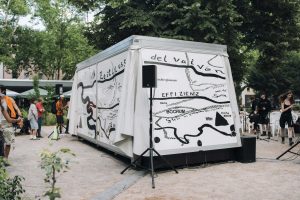
NEW RUHR MAP

Jordi Colomer

© Amina Falah

© Amina Falah

Karten sind niemals neutral, sie vermessen, begrenzen und kontrollieren, was sichtbar ist, blenden aber Trampelpfade und Abkürzungen genauso wie Gefühle von Angst oder Freude aus. Mit NEW RUHR MAP greift der katalanische Künstler Jordi Colomer dieses Missverhältnis auf und verwandelt die Kartierung in ein kollektives, performatives Wissensformat. 

Gemeinsam mit lokalen Teilnehmer*innen eines Mapping-Workshops, die aus einem guten Dutzend verschiedener, spanischsprachiger Länder kommen und im Ruhrgebiet leben, hat Colomer für den Grand Snail Tour-Trailer eine neue Ruhrgebietskarte entwickelt. Die Schnecke – ein langsames, tragendes, ortsbezogenes Wesen – wird zur Metapher für eine andere Art des Stadtdurchquerens: nicht optimiert, nicht top-down geplant, sondern getragen von gelebter Erfahrung, Erinnerung und kollektiver Imagination. 

Regionen werden stetig neu kartiert – von Stadtplaner*innen, Investor*innen, Kulturpolitiker*innen. Was dabei oft ungezeichnet bleibt, sind die Karten der Vielen: Migrationsrouten, Treffpunkte, affektive Geographien von Menschen, deren Perspektiven selten in offiziellen Repräsentationen auftauchen. NEW RUHR MAP knüpft nicht zuletzt an das Konzept der „New Cartographies“ des panafrikanische Projekts Chimurenga an: Kartieren als Praxis der Selbstermächtigung, als Werkzeug, um andere Geografien des Wissens und des Erlebens sichtbar zu machen – jenseits kolonialer und administrativer Blickregime.  

Unter anderem bekannt geworden durch die Videoserie Anarchitekton (2002–2004), in der Architekturmodelle durch Großstädte getragen werden, interessiert sich Colomer gleichermaßen für das Utopische wie das Dystopische im Stadtbild – für Stadtplanung als Versprechen und als Scheitern. NEW RUHR MAP setzt diese Reflexion mit und durch eine Community fort, die ihre eigenen Geschichten in den Stadtraum einschreibt. 

Please accept our Privacy Policy in order to display this Vimeo content.
Gemeinsam mit den Teilnehmer*innen eines Mapping-Workshops, die der spanischsprachigen Community im Ruhrgebiet angehören, hat der spanische Künstler Jordi Colomer die mobile Architektur der Grand Snail Tour neu gestaltet und wird seine Arbeit beim Stopp der Grand Snail Tour "Wertschätzen in Dortmund" vor Ort präsentieren. Mehr Infos zum Projekt: https://www.urbanekuensteruhr.de/grand-snail-tour/dortmund

Artist

Open Artsit

Jordi Colomer

Jordi Colomer's (*Barcelona 1962) practice spans film, photography, sculpture and installation, often involving collective participation.

View