Jump to main content (press Enter)Jump to the footer (press Enter)

Breadcrumbs

  1. Home
  2. Exhibitions
  3. Ruhrtriennale

My Body Is Not
An Island

©Katja Illner
©Katja Illner
©Katja Illner

12.8. – 23.9.23

Address

Kulturkirche Liebfrauen Duisburg
König-Heinrich-Platz 3
47051 Duisburg

Accessibility

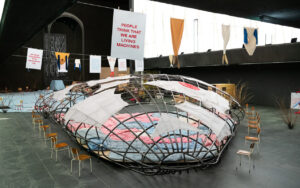
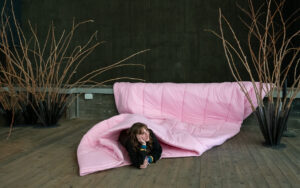
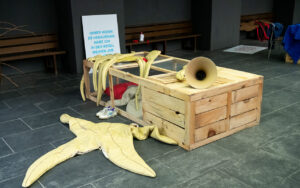
A giant, deconstructed body – part animal, part human – welded from a metal frame, with oversized items of clothing and brightly-coloured costumes that visitors may try on, transport crates and collages of material, unfolds to create an immersive landscape in the extensive installation My Body Is Not An Island by the Czech artist and film-maker Eva Koťátková.

Stories both factual and fictional telling of physical and mental oppression are written into the work. Tales from the perspectives of humans, animals and plants are activated every week by the performer and can be supplemented with the public’s own experiences. 

Originating from her own interest in social structures – such as the family, schools, or work – in this art work, Eva Koťátková explores the question of how normalisation processes shape our everyday lives and can give rise to forms of excessive (self-)control, violence and fear.

Influenced by the poetics of surrealism and theatrical stage designs, the artist has created an inclusive place in which we can face our dreams and our unconscious. My Body Is Not An Island invites children, young people and adults alike to empathise with others and to learn how to use emotions as a way in to the world: Bring your emotions and your jackets too, the artist tells us.

Urbane Künste Ruhr makes its own artistic contribution to each Ruhrtriennale. Following up on Ruhr Ding: Schlaf, an exhibition project across several cities early this summer that addressed our relationship with the body and time in a post-industrial context, it has invited Eva Koťátková to create a site-specific version of My Body Is Not An Island at Liebfrauenkirche Duisburg after the work had previously been seen in Bordeaux and Prague.

Produced by Urbane Künste Ruhr for Ruhrtriennale

Eva Koťátková and Britta Peters in Conversation

Please accept our Privacy Policy in order to display this Vimeo content.
Künstlerin Eva Koťátková und Britta Peters, Künstlerische Leitung von Urbane Künste Ruhr, führen euch bei einem Gespräch durch die Ausstellung „My Body Is Not An Island” in der Kulturkirche Liebfrauen in Duisburg.

©Katja Illner

Artist

Open Artsit

©National Gallery Krepmlová

Eva Kot'átková

In her work, Eva Kot'átková explores forms of power, manipulation, discrimination and control exercised by institutions upon those who deviate from the norm (or what is perceived as such).
View

Tablescapes

Nils Norman

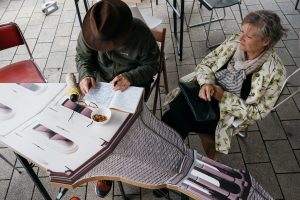
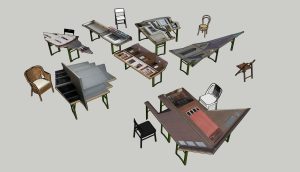
Two people sit at a table with a printed surface featuring an architectural motif. One person wears a brown hat and writes in a notebook, while the other, in a floral coat, sits holding a black bag.

© Daniel Sadrowski

© Daniel Sadrowski

Neutral und funktional sollten mobile Tische sein. Doch die von Nils Norman irritieren diese Selbstverständlichkeit: Ihre Oberflächen zeigen ausgefräste Elemente unterschiedlicher Architekturen aus dem Ruhrgebiet – Kirchtürme, Fassaden aus der Gründerzeit, Platten- oder Gewerbebauten. Was als schlichte Arbeitsunterlage dient, wird zur opulenten Modelllandschaft. 

Norman arbeitet seit vielen Jahren interdisziplinär an der Schnittstelle von Skulptur, Natur, Architektur, Stadtplanung, Möbeldesign und Pädagogik, stets zur Frage: Wem gehört der öffentliche Raum und wer darf ihn gestalten? Er entwickelte Fußgängerbrücken, Theatervorhänge, Spielplätze, Gärten und Wegeleitsysteme, wobei er mit viel Humor seine Kritik an gängigen Vorstellungen von Stadtentwicklung, Lokalpolitik und ökonomischen Systemen formuliert. In seinem Archiv Urbanomics sammelt er seit 1997 Sicherheitsarchitekturen, wobei ihn die Frage nach der Gestaltung von Kontrolle interessiert und wie die Nutzung eines Raumes durch dessen Design beeinflusst wird. Mit dem umgebauten Reisebus mit Gewächshaus und Lesesaal Geocruiser (2002) schuf er eine mobile Bildungs- und Begegnungsinfrastruktur. 2005 ließ er mit einer 80m langen Brücke inklusive See und Insel einen neu gebauten Stadtteil im dänischen Roskilde mit seinen Nachbarschaften verbinden. 

Normans Tische für die Grand Snail Tour erfüllen eine Funktion und unterlaufen sie zugleich. Die klappbaren Gestelle verbinden Flexibilität und Mobilität mit barocker Ausgestaltung – Oberflächen, die mehr erzählen als nötig. Als Teil der Sammlung reisen sie von Beginn an mit, werden aufgestellt, verwendet und wieder eingeklappt. An jedem Stopp treffen die Tisch-Landschaften auf neue Stadträume und erzeugen stets eine produktive Reibung zwischen dem abgebildeten und tatsächlichen Ort. 

Artist

Open Artsit

Nils Norman

Nils Norman is an artist living in Amsterdam and Munich. He works across the disciplines of public art, architecture and urban planning.

View