Jump to main content (press Enter)Jump to the footer (press Enter)

Breadcrumbs

  1. Home
  2. Exhibitions
  3. Ruhrtriennale

My Body Is Not
An Island

©Katja Illner
©Katja Illner
©Katja Illner

12.8. – 23.9.23

Address

Kulturkirche Liebfrauen Duisburg
König-Heinrich-Platz 3
47051 Duisburg

Accessibility

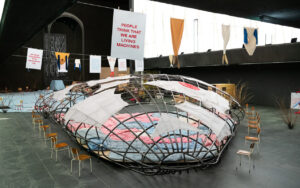
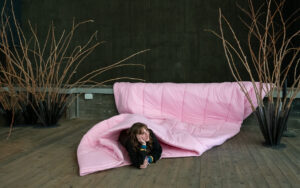
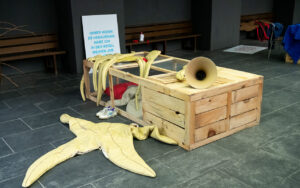
A giant, deconstructed body – part animal, part human – welded from a metal frame, with oversized items of clothing and brightly-coloured costumes that visitors may try on, transport crates and collages of material, unfolds to create an immersive landscape in the extensive installation My Body Is Not An Island by the Czech artist and film-maker Eva Koťátková.

Stories both factual and fictional telling of physical and mental oppression are written into the work. Tales from the perspectives of humans, animals and plants are activated every week by the performer and can be supplemented with the public’s own experiences. 

Originating from her own interest in social structures – such as the family, schools, or work – in this art work, Eva Koťátková explores the question of how normalisation processes shape our everyday lives and can give rise to forms of excessive (self-)control, violence and fear.

Influenced by the poetics of surrealism and theatrical stage designs, the artist has created an inclusive place in which we can face our dreams and our unconscious. My Body Is Not An Island invites children, young people and adults alike to empathise with others and to learn how to use emotions as a way in to the world: Bring your emotions and your jackets too, the artist tells us.

Urbane Künste Ruhr makes its own artistic contribution to each Ruhrtriennale. Following up on Ruhr Ding: Schlaf, an exhibition project across several cities early this summer that addressed our relationship with the body and time in a post-industrial context, it has invited Eva Koťátková to create a site-specific version of My Body Is Not An Island at Liebfrauenkirche Duisburg after the work had previously been seen in Bordeaux and Prague.

Produced by Urbane Künste Ruhr for Ruhrtriennale

Eva Koťátková and Britta Peters in Conversation

Please accept our Privacy Policy in order to display this Vimeo content.
Künstlerin Eva Koťátková und Britta Peters, Künstlerische Leitung von Urbane Künste Ruhr, führen euch bei einem Gespräch durch die Ausstellung „My Body Is Not An Island” in der Kulturkirche Liebfrauen in Duisburg.

©Katja Illner

Artist

Open Artsit

©National Gallery Krepmlová

Eva Kot'átková

In her work, Eva Kot'átková explores forms of power, manipulation, discrimination and control exercised by institutions upon those who deviate from the norm (or what is perceived as such).
View

NEW RUHR MAP

Jordi Colomer

© Amina Falah

© Amina Falah

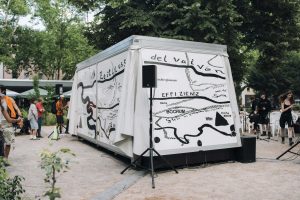
Karten sind niemals neutral, sie vermessen, begrenzen und kontrollieren, was sichtbar ist, blenden aber Trampelpfade und Abkürzungen genauso wie Gefühle von Angst oder Freude aus. Mit NEW RUHR MAP greift der katalanische Künstler Jordi Colomer dieses Missverhältnis auf und verwandelt die Kartierung in ein kollektives, performatives Wissensformat. 

Gemeinsam mit lokalen Teilnehmer*innen eines Mapping-Workshops, die aus einem guten Dutzend verschiedener, spanischsprachiger Länder kommen und im Ruhrgebiet leben, hat Colomer für den Grand Snail Tour-Trailer eine neue Ruhrgebietskarte entwickelt. Die Schnecke – ein langsames, tragendes, ortsbezogenes Wesen – wird zur Metapher für eine andere Art des Stadtdurchquerens: nicht optimiert, nicht top-down geplant, sondern getragen von gelebter Erfahrung, Erinnerung und kollektiver Imagination. 

Regionen werden stetig neu kartiert – von Stadtplaner*innen, Investor*innen, Kulturpolitiker*innen. Was dabei oft ungezeichnet bleibt, sind die Karten der Vielen: Migrationsrouten, Treffpunkte, affektive Geographien von Menschen, deren Perspektiven selten in offiziellen Repräsentationen auftauchen. NEW RUHR MAP knüpft nicht zuletzt an das Konzept der „New Cartographies“ des panafrikanische Projekts Chimurenga an: Kartieren als Praxis der Selbstermächtigung, als Werkzeug, um andere Geografien des Wissens und des Erlebens sichtbar zu machen – jenseits kolonialer und administrativer Blickregime.  

Unter anderem bekannt geworden durch die Videoserie Anarchitekton (2002–2004), in der Architekturmodelle durch Großstädte getragen werden, interessiert sich Colomer gleichermaßen für das Utopische wie das Dystopische im Stadtbild – für Stadtplanung als Versprechen und als Scheitern. NEW RUHR MAP setzt diese Reflexion mit und durch eine Community fort, die ihre eigenen Geschichten in den Stadtraum einschreibt. 

Please accept our Privacy Policy in order to display this Vimeo content.
Gemeinsam mit den Teilnehmer*innen eines Mapping-Workshops, die der spanischsprachigen Community im Ruhrgebiet angehören, hat der spanische Künstler Jordi Colomer die mobile Architektur der Grand Snail Tour neu gestaltet und wird seine Arbeit beim Stopp der Grand Snail Tour "Wertschätzen in Dortmund" vor Ort präsentieren. Mehr Infos zum Projekt: https://www.urbanekuensteruhr.de/grand-snail-tour/dortmund

Artist

Open Artsit

Jordi Colomer

Jordi Colomer's (*Barcelona 1962) practice spans film, photography, sculpture and installation, often involving collective participation.

View