Jump to main content (press Enter)Jump to the footer (press Enter)

Breadcrumbs

  1. Home
  2. Exhibitions
  3. Ruhrtriennale

My Body Is Not
An Island

©Katja Illner
©Katja Illner
©Katja Illner

12.8. – 23.9.23

Address

Kulturkirche Liebfrauen Duisburg
König-Heinrich-Platz 3
47051 Duisburg

Accessibility

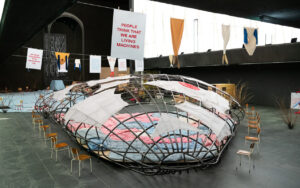
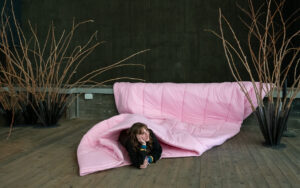
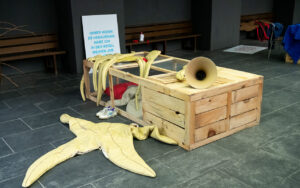
A giant, deconstructed body – part animal, part human – welded from a metal frame, with oversized items of clothing and brightly-coloured costumes that visitors may try on, transport crates and collages of material, unfolds to create an immersive landscape in the extensive installation My Body Is Not An Island by the Czech artist and film-maker Eva Koťátková.

Stories both factual and fictional telling of physical and mental oppression are written into the work. Tales from the perspectives of humans, animals and plants are activated every week by the performer and can be supplemented with the public’s own experiences. 

Originating from her own interest in social structures – such as the family, schools, or work – in this art work, Eva Koťátková explores the question of how normalisation processes shape our everyday lives and can give rise to forms of excessive (self-)control, violence and fear.

Influenced by the poetics of surrealism and theatrical stage designs, the artist has created an inclusive place in which we can face our dreams and our unconscious. My Body Is Not An Island invites children, young people and adults alike to empathise with others and to learn how to use emotions as a way in to the world: Bring your emotions and your jackets too, the artist tells us.

Urbane Künste Ruhr makes its own artistic contribution to each Ruhrtriennale. Following up on Ruhr Ding: Schlaf, an exhibition project across several cities early this summer that addressed our relationship with the body and time in a post-industrial context, it has invited Eva Koťátková to create a site-specific version of My Body Is Not An Island at Liebfrauenkirche Duisburg after the work had previously been seen in Bordeaux and Prague.

Produced by Urbane Künste Ruhr for Ruhrtriennale

Eva Koťátková and Britta Peters in Conversation

Please accept our Privacy Policy in order to display this Vimeo content.
Künstlerin Eva Koťátková und Britta Peters, Künstlerische Leitung von Urbane Künste Ruhr, führen euch bei einem Gespräch durch die Ausstellung „My Body Is Not An Island” in der Kulturkirche Liebfrauen in Duisburg.

©Katja Illner

Artist

Open Artsit

©National Gallery Krepmlová

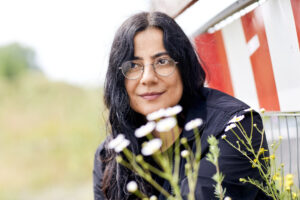
Eva Kot'átková

In her work, Eva Kot'átková explores forms of power, manipulation, discrimination and control exercised by institutions upon those who deviate from the norm (or what is perceived as such).
View

Local Blackouts

Lütfiye Güzel

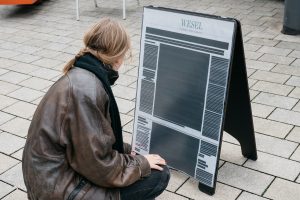
A person in a brown leather jacket looks at a large printed newspaper on a stand with the heading 'Wesel'.

© Daniel Sadrowski

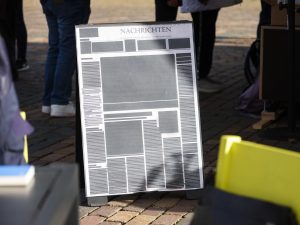
A sign with the word 'NACHRICHTEN' with an abstract newspaper layout with little text.

© Heinrich Holtgreve

Ausgangsmaterial ist ein besonders kurzweiliges Format aus dem Alltag: die Tageszeitung. Lütfiye Güzel, Poetin aus Duisburg und Vertreterin eines konsequent selbstverlegten, körpernahen Schreibens, lässt sich für die Grand Snail Tour von Projektpartner*innen und Passant*innen Lokalzeitungen und -beilagen aus den zu bereisenden Städten zusenden. Aus diesen Dokumenten erzeugt Güzel durch gezieltes Ausstreichen und Schwärzen von Textpassagen insgesamt 53 Gedichte — Local Blackouts —, die auf Aufstellern an jeder Station veröffentlicht werden.

Die Methode der Blackout Poetry ist eine Form der Found Poetry und wird bei Güzel zum politischen Akt. Das Schwärzen zitiert die Logik der Zensur, kehrt sie aber um, denn das unkenntlich Machen hat nicht Unterdrückung, sondern Verdichtung zum Ziel: Was bleibt, wenn der redaktionelle Lärm verschwindet? Lyrische Miniaturen, die in ihrer Knappheit dem Haiku ähnlich ist. Güzels Entscheidung, diese Textarbeiten im öffentlichen Raum zu zeigen, stellt zudem implizit die Frage: Für wen werden solche Texte geschrieben, und wer kommt darin vor?

Lokalzeitungen sind ein ambivalentes Medium. Sie fördern und informieren Nachbarschaften jenseits von Social Media — doch die Sprache und Nachrichtenauswahl ist häufig hetzerisch und vereinfachend. Tatsache ist, dass Lokalzeitungen an Bedeutung und finanzielle Unterstützung verlieren. Güzels Aneignung bewahrt und befragt dieses Erbe zugleich. Präsentiert auf herkömmlichen Presseaufstellern verleiht ihre Arbeit der Grand Snail Tour ein vertrautes Erscheinungsbild von regionaler Kultur und überführt diese gleichzeitig in die poetische Abstraktion.

Artist

Open Artsit

©Ben Knabe

Lütfiye Güzel

Lütfiye Güzel is a poet and has been publishing poems under her own label go-güzel-publishing since 2014.

View