Breadcrumbs
Healing Complex
Takeover
©Caroline Seidel
Address
Ehemalige St. Bonifatiuskirche
Cranger Straße 338-342
45891 Gelsenkirchen
Accessibility
Healing Complex (2018-ongoing) is an Urbane Künste Ruhr project initiated by artist Irena Haiduk that tests new forms of social interaction.
In the third phase of the project, Urbane Künste Ruhr invited two artists - found through an open call - to take part in a research and work residency. From April to the end of June 2024, Anne Arndt and Camilo Pachón took over the site and developed a programme for the neighbourhood and other interested parties. The guests became hosts and opened the doors of the Healing Complex as an open studio, inviting people to workshops, walks and readings and seeking dialogue with visitors from Erle, Gelsenkirchen and the surrounding area. In this open process, the Takeover invited visitors to follow and actively participate in the artistic process.
Walking as a democratic means of transport is a central component of our urban experience. But how do we experience urban space and its paths? The evaluation of public space varies depending on the person and perspective - who is allowed to move, when and how? The artist Anne Arndt consciously devotes herself to walking without a practical purpose and invites us to perceive urban space through different lenses. Together with her and local contemporary witnesses, we would like to explore Erle from new perspectives. After the walks, we will meet for Hanging Out_ at the Healing Complex to examine, discuss and reflect on the cultural meanings of walking in our society.
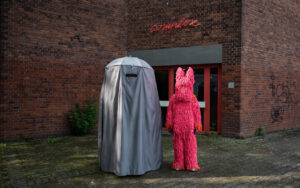
How does community develop and function? What are common values? What do we want to share? What do we want to create together? Camilo Pachón's artistic work is based on the principle that all energy emanates from human relationships. With this in mind, he uses art as a tool to bring people together, connect them on different levels and create situations that encourage direct communication and interaction. Using masks, costumes and rituals from the carnival in the form of workshops and parades, the artist aims to transform the Healing Complex into a "masked temple", The Ancient Masked Temple, in whose transformation everyone should participate.
Artists

© Sara Alvarado
Camilo Pachón
With The Ancient Masked Temple, Camilo Pachón aims to create a collective space in the Healing Complex with a programme of workshops, readings, performances and the traditions of carnival.
© Anne Arndt
Anne Arndt
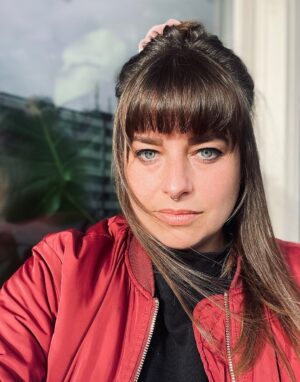
In her cross-media works, Anne Arndt critically and humorously scrutinises our public living space as a mirror of social cultures of power and remembrance.