Breadcrumbs
Healing Complex
(2018 — ongoing)

Address
Ehemalige St. Bonifatiuskirche
Cranger Straße 338-342
45891 Gelsenkirchen
Since 3rd June 2022, Urbane Künste Ruhr had been running the project Healing Complex (2018-ongoing) in Gelsenkirchen, initiated by artist Irena Haiduk, modelled on ancient healing sites that combined art and healing.
In her artistic practice, Haiduk collaborates with art institutions, which in turn can become economic catalysts for the production of paintings, books, texts, films and scenographies, metallurgy, weavings, architecture and garments, thus stimulating the public's imagination. At the heart of the project, baking as a universal and unifying element between people and cultures: a central oven was used to create a place for joint work and exchange for interested audiences and local residents.
Fungi serve humans as food, medicinal or intoxicating agents; they are sedentary like plants, but cannot photosynthesise. Therefore, they have to feed like animals by ingesting organic substances and digesting them through enzymes. In the kingdom of living things, fungi form a category of their own: they are neither plants (Plantae) nor animals (Animalia), but are related to both. As for us humans, communication and cooperation are essential for their organisation: they often live in symbioses formed via the mycelium – the complex, mostly underground network of fungal filaments from which mushrooms can then sprout above ground. The mycelium distributes vital nutrients in the soil and is also called "nature's glue" because it breaks down decaying material and holds it together. At the same time, it creates connections, giving rise to its own economy: they form the social network between the different organisms.
With an economy that is not only metaphorically based on the model of mushroom cultures – myconomy – the Healing Complex will reopen in March 2023. In addition to its own mushroom cultivation, which visitors can cultivate and harvest, the potential of networks will also be explored. Tokens designed by artist Irena Haiduk will serve as currency on site. To expand the myconomy, these tokens will also be available at the other exhibition venues of Ruhr Ding: Schlaf in Mülheim, Witten and Essen. They can be exchanged at the Healing Complex for workshops or participatory activities, the proceeds of which in turn remain with the participants. This circulating economy creates a network of knowledge exchange and cooperation in which experimentation can take place and through which new, reciprocal links are created.
Artist
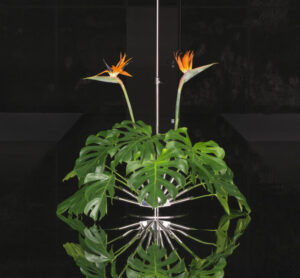
©Irena Haiduk
Irena Haiduk
In June 2022, Irena Haiduk opens the exhibition Healing Complex (2018—ongoing) in the former church of St. Bonifatius, which is becoming a new meeting and community place in Gelsenkirchen.