Jump to main content (press Enter)Jump to the footer (press Enter)

Breadcrumbs

  1. Home
  2. Emscherkunstweg
  3. Emscher Folly

Emscher Folly

Emscher Folly, a bicycle sculpture by Nicole Wermers, consists of over 50 bicycles arranged in a triangular shape, symbolizing mobility and urban transformation in the Ruhr area.

© Henning Rogge

Address

Kläranlage Duisburg-Alte Emscher
Alsumer Straße 215 
47166 Duisburg

Open in Maps

The artist Nicole Wermers has created a sculpture out of over 50 bicycles and a triangular bicycle stand she designed. 

She thus shifts an image familiar from urban space to a place marked by industrial work, abandoned and seemingly inhospitable, metaphorically speaking: in the engine room of everyday life between sewage plant and steelworks, the bicycles seem mysteriously out of place. Freed from their use, their design emerges all the more clearly. Close to the former mouth of the River Emscher, Emscher Folly also refers to the artificiality of a landscape as strongly shaped by man as the Emscher region.

Nicole Wermers lives and works in London and Emsdetten. She has been a professor at the Academy of Fine Arts in Munich since 2017. She was a fellow of the German Academy Villa Massimo in Rome in 2012 and was nominated for the Turner Prize in 2015. In her sculptures, photographs and collages, the artist combines formal questions with investigations of urban space and its social, economic and psychological inscriptions.

Artist

Open Artsit

Nicole Wermers

Nicole Wermers uses sculptures and collages to depict urban space, social structures and the recomposition of everyday objects.
View

Local Blackouts

Lütfiye Güzel

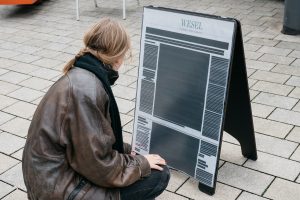
A person in a brown leather jacket looks at a large printed newspaper on a stand with the heading 'Wesel'.

© Daniel Sadrowski

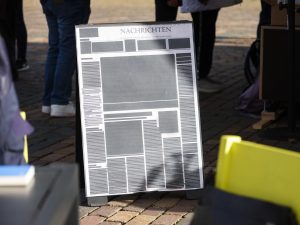
A sign with the word 'NACHRICHTEN' with an abstract newspaper layout with little text.

© Heinrich Holtgreve

Ausgangsmaterial ist ein besonders kurzweiliges Format aus dem Alltag: die Tageszeitung. Lütfiye Güzel, Poetin aus Duisburg und Vertreterin eines konsequent selbstverlegten, körpernahen Schreibens, lässt sich für die Grand Snail Tour von Projektpartner*innen und Passant*innen Lokalzeitungen und -beilagen aus den zu bereisenden Städten zusenden. Aus diesen Dokumenten erzeugt Güzel durch gezieltes Ausstreichen und Schwärzen von Textpassagen insgesamt 53 Gedichte — Local Blackouts —, die auf Aufstellern an jeder Station veröffentlicht werden.

Die Methode der Blackout Poetry ist eine Form der Found Poetry und wird bei Güzel zum politischen Akt. Das Schwärzen zitiert die Logik der Zensur, kehrt sie aber um, denn das unkenntlich Machen hat nicht Unterdrückung, sondern Verdichtung zum Ziel: Was bleibt, wenn der redaktionelle Lärm verschwindet? Lyrische Miniaturen, die in ihrer Knappheit dem Haiku ähnlich ist. Güzels Entscheidung, diese Textarbeiten im öffentlichen Raum zu zeigen, stellt zudem implizit die Frage: Für wen werden solche Texte geschrieben, und wer kommt darin vor?

Lokalzeitungen sind ein ambivalentes Medium. Sie fördern und informieren Nachbarschaften jenseits von Social Media — doch die Sprache und Nachrichtenauswahl ist häufig hetzerisch und vereinfachend. Tatsache ist, dass Lokalzeitungen an Bedeutung und finanzielle Unterstützung verlieren. Güzels Aneignung bewahrt und befragt dieses Erbe zugleich. Präsentiert auf herkömmlichen Presseaufstellern verleiht ihre Arbeit der Grand Snail Tour ein vertrautes Erscheinungsbild von regionaler Kultur und überführt diese gleichzeitig in die poetische Abstraktion.

Artist

Open Artsit

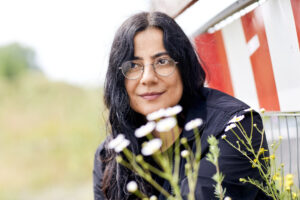
©Ben Knabe

Lütfiye Güzel

Lütfiye Güzel is a poet and has been publishing poems under her own label go-güzel-publishing since 2014.

View