Jump to main content (press Enter)Jump to the footer (press Enter)

Breadcrumbs

  1. Home
  2. Emscherkunstweg

Emscherkunstweg

The Emscherkunstweg is a public art collection along the Emscher. The cooperation project is implemented by Urbane Künste Ruhr (until 30.9.2025), the Emschergenossenschaft and the Regionalverband Ruhr and is under the patronage of Ina Brandes, Minister for Culture and Science of the State of North Rhine-Westphalia. The public art collection emerged from the temporary exhibition format Emscherkunst, which has accompanied the Emscher conversion by the Emschergenossenschaft since 2010. Emscherkunst was initiated on the occasion of the RUHR.2010 Capital of Culture and subsequently continued as a triennial. Since 2019, the Emscherkunstweg has been a permanent sculpture trail and thus a sustainable exhibition format for the region. Five new works of art were added to the existing works. The extension was designed by Britta Peters, artistic director of Urbane Künste Ruhr, together with curator Marijke Lukowicz.

Open "Neustadt"
Artists Marta Dyachenko and Julius von Bismarck, together with artistic director Britta Peters, sit in front of Neustadt, a miniature city composed of models of demolished buildings from the Ruhr region.

© Daniel Sadrowski

Neustadt

Duisburg

A total of 23 sculptures form a fictitious city, on a scale of 1:25, made up of various real buildings that have been demolished in the Ruhr area since the turn of the millennium.

Open "Königsgrube"

© Henning Rogge

Königsgrube

Herne

A former pumping station of a disused colliery on the Emscherkunstweg becomes an installation, the name remains and sounds promising: Königsgrube.

Open "Pool Lines"
The sculpture Pool Lines by Sofía Táboas consists of two large triangular structures covered in shimmering green mosaic tiles, blending into the surrounding landscape.

© Henning Rogge

Pool Lines

Dortmund

Two large triangles together constitute a third triangular form. Their waist-high walls are about one metre thick; they both taper and flatten towards the ground.

Open "Emscher Folly"
Emscher Folly, a bicycle sculpture by Nicole Wermers, consists of over 50 bicycles arranged in a triangular shape, symbolizing mobility and urban transformation in the Ruhr area.

© Henning Rogge

Emscher Folly

Duisburg

For the Emscherkunstweg, artist Nicole Wermers has created a sculpture from over 50 bicycles and a triangular bicycle stand she designed.

Open "Public Hybrid"
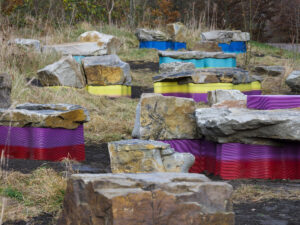
The installation Public Hybrid by David Jablonowski features multiple sandstone and plastic sculptures, their vibrant colors and irregular shapes appearing like artificial rock formations.

© Heinrich Holtgreve

Public Hybrid

Dortmund

David Jablonowski’s hybrid sculpture is located directly next to the Emscher-Weg bike path in the Schüren district of Dortmund.

NEW RUHR MAP

Jordi Colomer

© Amina Falah

© Amina Falah

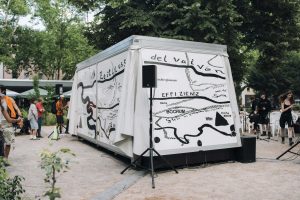
Karten sind niemals neutral, sie vermessen, begrenzen und kontrollieren, was sichtbar ist, blenden aber Trampelpfade und Abkürzungen genauso wie Gefühle von Angst oder Freude aus. Mit NEW RUHR MAP greift der katalanische Künstler Jordi Colomer dieses Missverhältnis auf und verwandelt die Kartierung in ein kollektives, performatives Wissensformat. 

Gemeinsam mit lokalen Teilnehmer*innen eines Mapping-Workshops, die aus einem guten Dutzend verschiedener, spanischsprachiger Länder kommen und im Ruhrgebiet leben, hat Colomer für den Grand Snail Tour-Trailer eine neue Ruhrgebietskarte entwickelt. Die Schnecke – ein langsames, tragendes, ortsbezogenes Wesen – wird zur Metapher für eine andere Art des Stadtdurchquerens: nicht optimiert, nicht top-down geplant, sondern getragen von gelebter Erfahrung, Erinnerung und kollektiver Imagination. 

Regionen werden stetig neu kartiert – von Stadtplaner*innen, Investor*innen, Kulturpolitiker*innen. Was dabei oft ungezeichnet bleibt, sind die Karten der Vielen: Migrationsrouten, Treffpunkte, affektive Geographien von Menschen, deren Perspektiven selten in offiziellen Repräsentationen auftauchen. NEW RUHR MAP knüpft nicht zuletzt an das Konzept der „New Cartographies“ des panafrikanische Projekts Chimurenga an: Kartieren als Praxis der Selbstermächtigung, als Werkzeug, um andere Geografien des Wissens und des Erlebens sichtbar zu machen – jenseits kolonialer und administrativer Blickregime.  

Unter anderem bekannt geworden durch die Videoserie Anarchitekton (2002–2004), in der Architekturmodelle durch Großstädte getragen werden, interessiert sich Colomer gleichermaßen für das Utopische wie das Dystopische im Stadtbild – für Stadtplanung als Versprechen und als Scheitern. NEW RUHR MAP setzt diese Reflexion mit und durch eine Community fort, die ihre eigenen Geschichten in den Stadtraum einschreibt. 

Please accept our Privacy Policy in order to display this Vimeo content.
Gemeinsam mit den Teilnehmer*innen eines Mapping-Workshops, die der spanischsprachigen Community im Ruhrgebiet angehören, hat der spanische Künstler Jordi Colomer die mobile Architektur der Grand Snail Tour neu gestaltet und wird seine Arbeit beim Stopp der Grand Snail Tour "Wertschätzen in Dortmund" vor Ort präsentieren. Mehr Infos zum Projekt: https://www.urbanekuensteruhr.de/grand-snail-tour/dortmund

Artist

Open Artsit

Jordi Colomer

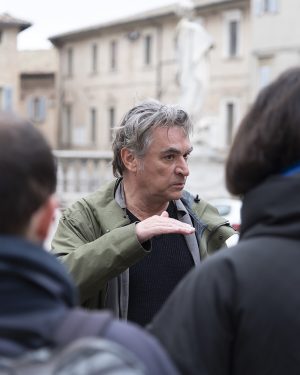
Jordi Colomer's (*Barcelona 1962) practice spans film, photography, sculpture and installation, often involving collective participation.

View