Jump to main content (press Enter)Jump to the footer (press Enter)

Breadcrumbs

  1. Home
  2. Artists
  3. Profile

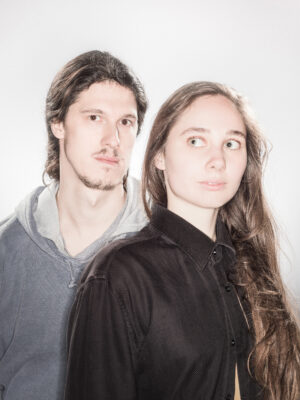
Viola Relle & Raphael Weilguni

©Roland Baege

Viola Relle (*1992 Budapest) and Raphael Weilguni (*1989 Augsburg) have been working together since 2012. Viola and Raphael create their works collectively. They model simultaneously on sometimes large ceramics, which become relics of a process of communication and negotiation that takes place while they are working. Nothing is chosen at random or lightly, because everything has to be justifiable in front of the other. Transformative processes, both in the landscape, such as the extraction of resources or ruins, and in the human body (digestion) emerge as themes in her works and establish connections between material and economy, landscape, architecture and body. Each sculpture is the result of its own developments, some of which are unforeseen due to the firing process. The integration of the sculptures into performative projects (e.g. Raphael and Franz have been making music for you since 2012) and the site-specific and collective projects of the two, such as the construction of an open workshop with a kiln in Munich or the exchange with passers-by on the streets of New York, which led to the work Hero, locate the traditional medium of ceramics in the present and open it up to a broader cultural and social exchange.
Palliative Patterns

Kasia Fudakowski

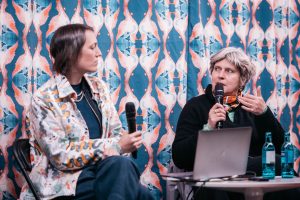
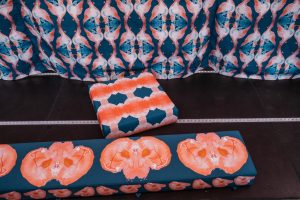
Close-up of padded seat cushions with a colorful pattern.

© Daniel Sadrowski

© Daniel Sadrowski

© Daniel Sadrowski

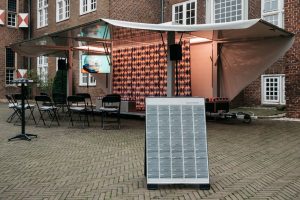
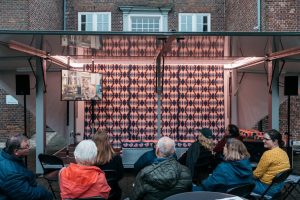
Close-up of a mobile stage with a screen and speakers.

© Daniel Sadrowski

Hast du schon mal über dein eigenes Sterben nachgedacht? Die Künstlerin Kasia Fudakowski fragt in Palliative Patterns, ihrer Arbeit für die Grand Snail Tour, was passiert, wenn wir aufhören würden, den Tod zu verdrängen und stattdessen lernen, mit der Allgegenwart unserer Endlichkeit zu leben. 

Mit ihren Kissen und Vorhängen für den Grand Snail Tour-Trailer übersetzt die Künstlerin diese Idee in einen Raum zum Verweilen. Dazu vervielfältigt und spiegelt sie mikroskopische Aufnahmen von Gewebeveränderungen, die den tödlichen Krankheiten Gehirn-Aneurysma, Lewy-Körperchen-Demenz und Arteriosklerose zugrunde liegen, bis sie ein psychodelisches Muster ergeben, das auch an Rorschach-Tafeln denken lässt. Ursprünglich aus der Psychodiagnostik soll der Rorschach-Test Aufschlüsse über den mentalen Zustand/Gesundheit der*des Patient*innen geben. Hier, bei Fudakowski, werden die Besucher*innen zu Proband*innen, ihre Vorstellungen wiederum zum Teil der Installation.  

Dieses Gedankenspiel wird auch in weiteren Medien- und Veranstaltungsformaten trainiert: Als Gründungsmitglied der internationalen Künstler*innengruppe The Association for the Palliative Turn (APT) fordert Fudakowski geistreich und mit viel Humor immer wieder dazu auf, dem Tod und Abschied zu begegnen und herauszufinden, wie Akzeptanz statt Verdrängung neue Werte definiert: Fürsorge statt Zeitdruck, Qualität vor Quantität und eine Entlastung von dem ewigen Streben nach Fortschritt, denn: Es gibt ein Leben vor dem Tod. 

Palliative Patterns setzt auch eine Werklogik fort, die Fudakowski im Allgemeinen verfolgt: Ihr lebenslang laufendes Skulpturenprojekt Continuouslessness (seit 2017) wird erst mit ihrem Tod vollendet sein. Endlichkeit ist hier kein Thema, sondern strukturelle Bedingung. 

Artist

Open Artsit

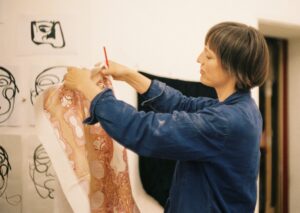
Kasia Fudakowski

Kasia Fudakowski works with sculpture, film and performance to uncover social enigmas through surreal logic and theory.

View