Jump to main content (press Enter)Jump to the footer (press Enter)

Breadcrumbs

  1. Home
  2. Zu Gast
  3. Zu Gast

Zu Gast
Jahrgang 2021

© Daniel Sadrowski

For the 2020/2021 edition, the focus will be on artists whose work deals in the broadest sense with 'climate' and 'sleep', the thematic brackets of the Ruhr Ding editions 2021 and 2022.

The residencies, which generally last three or twelve months, are initially awarded independently of specific project proposals and enable artists to familiarise themselves with the region, incorporate this experience into their existing work or develop new ideas from it.

For the first time in 2021, the Haus der Geschichte des Ruhrgebiets in Bochum and the Halfmannshof in Gelsenkirchen have opened their doors to artists who want to use the specific digital or content-related research opportunities for their work on site. Since the start of the programme, there have been collaborations with the KunstVereineRuhr, an association of various art associations and artists' houses in the region, as well as the Ringlokschuppen Ruhr and the Makroscope - Centre for Art and Technology in Mülheim an der Ruhr.

Artists
Open Artsit

©Daniel Sadrowski

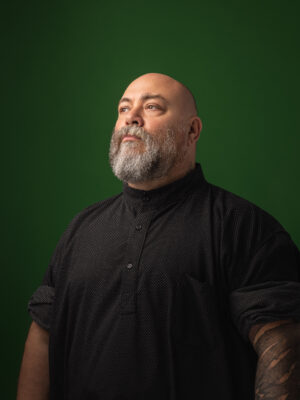
Yuki Jungesblut

Yuki Jungesblut seeks out potentialities and instances of overlap between imagination, fiction and reality, often exploring underdetermined states and liminality in general.
View
Open Artsit

©Roland Baege

Viron Erol Vert

In his artistic practice, Viron Erol Vert probes – against the background of his own intercultural experiences – identity constructs and different aspects related to the self and the other.

View
Open Artsit

©Roland Baege

Vanessa Nica Mueller

Vanessa Nica Mueller's films and artwork focus on aspects of memory, the relation of human, nature and urban space, the uncanny and the construction of conditions.

View
Open Artsit

©Roland Baege

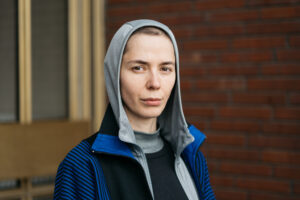
Thomas Taube

By means of multi-channel installations, associative, reflective and surreal sequences, Taube works against conventional cinematographic codes.
View
Open Artsit

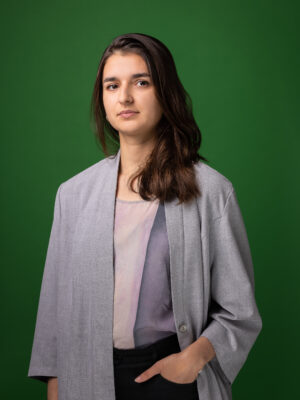
Nicoleta Moise

Nicoleta Moise is a visual artist, writer and researcher with different mediums combining photography, video and performance and focusses on making visible less known stories, characters or events.
View
Open Artsit

©Roland Baege

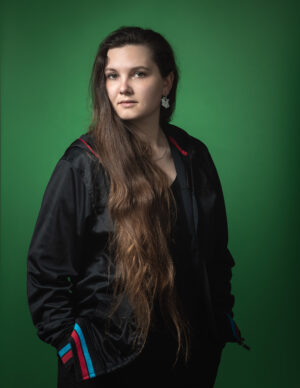
Nadine Rangosch

Natural sciences, visual culture and mythological stories inspire Nadine Rangosch to build her own vocabulary, translating abstract concepts into spatial arrangements.
View
Open Artsit

©Roland Baege

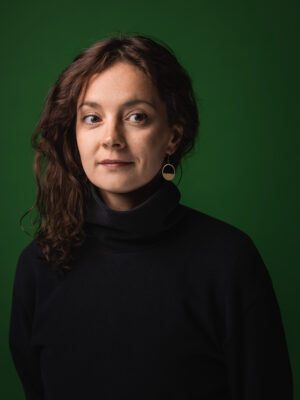
Laura Leppert

Laura Leppert works with film, installation and text. Her installations and cinematic spaces are constructed in fragments and are constantly in motion.
View
Open Artsit

©Roland Baege

Kristina Paustian

Kristina Paustian examines cultural anthropological and socio-political topics. In cinematic images she focusses in particular on the themes of times of upheaval and technical utopias.

View
Open Artsit

©Daniel Sadrowski

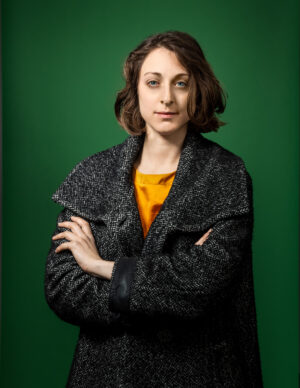
Julia Lübbecke

In her works, Julia Lübbecke deals with the relation between body and institution. She explores this connection to examine dominant structures of order and creates processes to make them fragile.
View
Open Artsit

©Roland Baege

Jessica Arseneau

Jessica Arseneau explores the way human perception and subjectivity is shaped by social codes, patterns of behaviour, accelerating culture and technological progress.
View
Open Artsit

©Daniel Sadrowski 

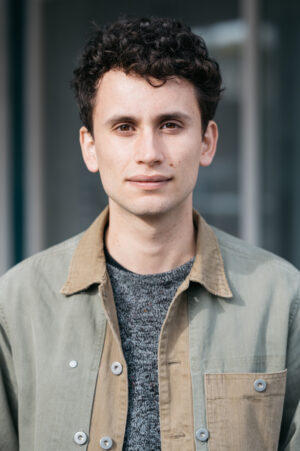
Guy Königstein

In his recent projects Guy Königstein researches the different ways we live the past in the present, for instance through practices of commemoration, archiving or archaeology.
View
Open Artsit

©Daniel Sadrowski

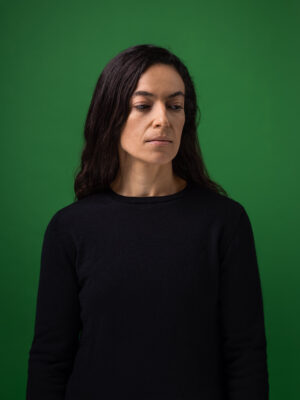
David Reiber Otálora

In his cinematic / sculptural works David Reiber Otálora deals with exoticisms and colonial representations of the so-called other and explores possibilities to affirm them into ambiguous narratives.
View
Open Artsit

©Roland Baege

Adriana Arroyo

Adriana Arroyo's works reference to geological activity, to reveal possible relationships between the movement of the Earth, politics and the fragility of the body and the mind.
View

Werne

Begleitet wird die Grand Snail Tour von Künstler*innen aus dem Bereich Literatur, Fotografie und Zeichnung, die zeitgleich zum Aufenthalt des Tourmobils, Eindrücke und Reflexionen aus jeweils derselben Stadt sammeln und diese sie visuell oder literarisch ins Bild setzen. So entsteht ein Paratext zur 3-jährigen Tour, der in Form einer Reisechronik, ein Kaleidoskop an Geschichten, Verbindungen, Momentaufnahmen in den 53 Städten der Region als Gleichzeitigkeiten und Ungleichzeitigkeiten zur Grand Snail Tour sichtbar werden lässt.

Werne von Franziska Klose

Städte sind Cohabitate – artenübergreifende Lebensräume, urbane Biotope. 

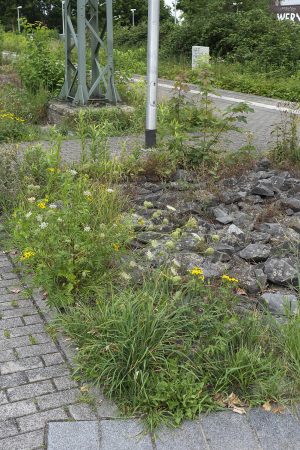
In Werne gelten meine Blicke und Bilder der urbanen Flora und ihrer Habitate: Baustellen, Hinterhöfe, Fassadengrün, Blumenkübel, Brachflächen, Wasserläufe, Maisfelder, Blumenampeln, Steingärten und gleich bei meiner Ankunft die „Beete" aus Gleisschotter mit Ruderalpflanzen.

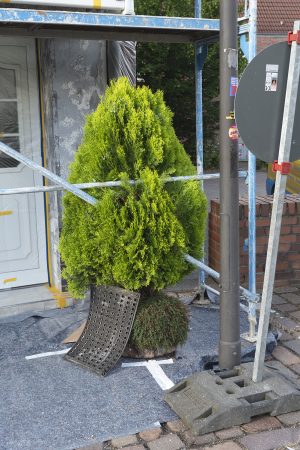
01 Werne Südmauer
Hauseingang mit Baugerüst, Fußmatte, Straßenschild, Lampenmast und Blümenkübel, darin mit Lebensbaum (Thuja) und Zwergmispel (Cotoneaster)

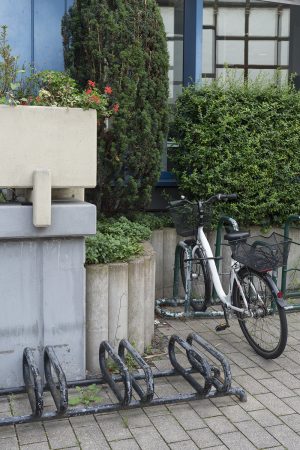
02 Werne Sparkasse
Hausfassade, Fahrradständer und diverse Blumenkübel mit Eibe (Taxus baccata), Pelargonie (Pelargonium), Ysander (Pachysandra), Buchsbaum (Buxus sempervirens) und Efeu (Hedera helix) sowie Gemüse-Gänsedistel (Sonchus oleraceus) und Hornklee (Lotus)

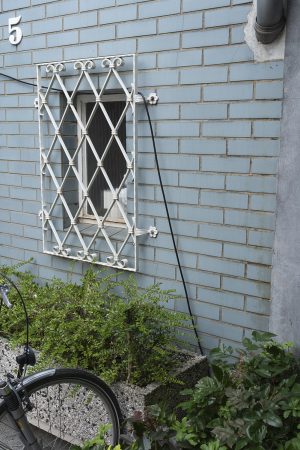
03 Werne Hinterhof
Gekachelte Hauswand, florales Fenstergitter und Blumentrog mit Immergrüner Kriech-Heckenkirsche (Lonicera pileata) und Ilex (Ilex aquifolium)

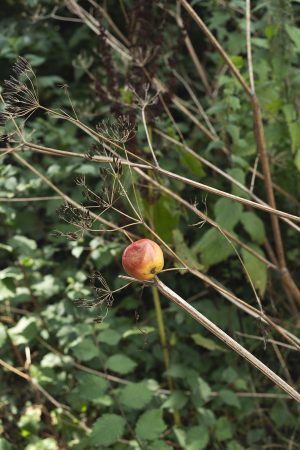
04 Werne Friedhof
Apfel (Malus), aufgespießt auf einem Wiesen-Kerbel (Anthriscus sylvestris), dahinter Ampfer (Rumex), Große Brennnessel (Urtica dioica) und Haselnuss (Corylus avellana)

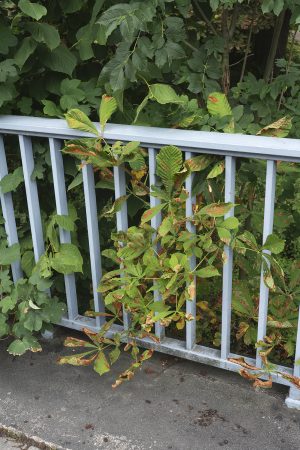
05 Werne Hornebachbrücke
Geländer an der Hornebach-Brücke, Gewöhnliche Kastanie (Aesculus hippocastanum), Sommerlinde (Tilia platyphyllos), Berg-Ahorn (Acer pseudoplatanus) und Esche (Fraxinus excelsior)

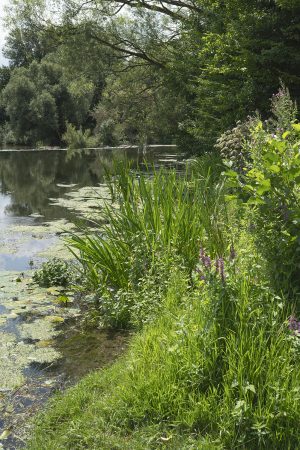
06 Werne Lippewehr
Am Lippe-Ufer, Gräser (Poa), Schwertlilie (Iridaceae), Flatterbinse (Juncus effusus), Wasserminze (Mentha aquatica), Gelbe Teichrose (Nuphar lutea), Ulme (Ulmus), Wiesen-Bärenklau (Heracleum sphondylium), Zottiges Weidenröschen (Epilobium hirsutum), Ackerwinde (Convolvulus arvensis), Weiderich (Lythrum) und Weiden (Salix) in Hintergrund

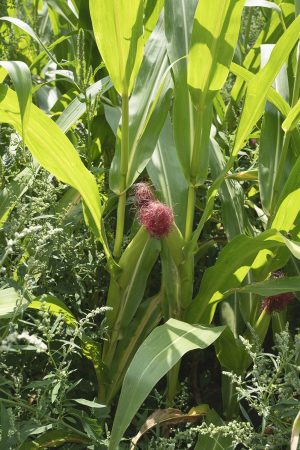
07 Werne MaisFeld
Maisfeld (Zea mays) mit Weißem Gänsefuß (Chenopodium album) und Rauhaarigem Amarant (Amaranthus retroflexus)

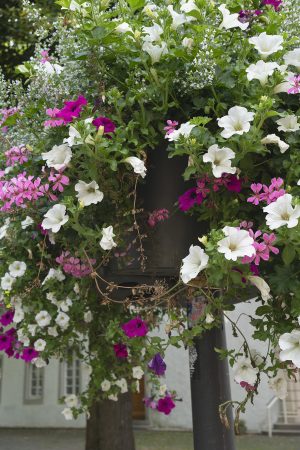
08 Werne Kloster
Blumenampel mit Petunien (Penunia), Pelargonien (Pelargonium) und Kleinblütiger Bergminze (Clinopodium nepeta)

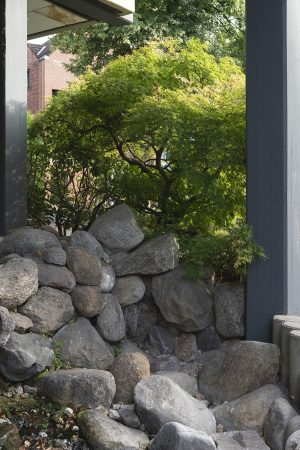
09 Werne Sparkasse
Steingarten mit kleinem Brunnen, Japanischem Ahorn (Acer japonicum), Ilex (Ilex aquifolium), Vogelmiere (Stellaria media), Kanadischer Goldrute (Solidago canadensis) und Moosen

10 Werne Bahnhof
Angelegte Beete am Bahnsteig: Gleisschotter mit typischer Spontanvegetation/Wildwuchs: Rainfarn (Tanacetum vulgare), Wilde Möhre (Daucus carota), Stinkender Storchschnabel (Geranium robertianum), Kompass-Lattich (Lactuca serriola), Löwenzahn (Taraxacum officinale), Mäusegerste (Hordeum murinum), Kriech-Quecke (Elymus repens), Bergahorn (Acer pseudoplatanus), Kanadische Goldrute (Solidago canadensis), Blauer Natternkopf (Echium vulgare), Spitzwegerich (Plantago lanceolata), Vogelmiere (Stellaria media), Wiesen-Knäuelgras (Dactylis glomerata), Wilder Hafer (Avena fatua), Jacobs-Greiskraut (Senecio erucifolius) und Flechten

Stops

Open "Werne"
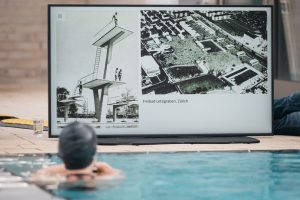
Screen displaying historical images of the Letzigraben outdoor pool in Zurich, viewed from the water.

© Daniel Sadrowski

24.7.25, 16–21 h

Chilling in Werne

Werne

Artist

Open Artsit

© Camilo Pachón

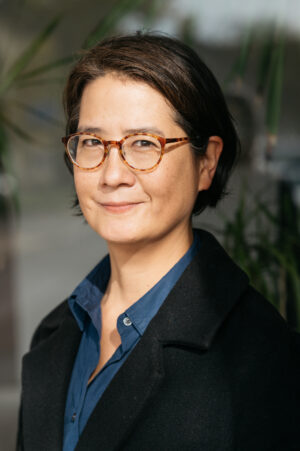
Franziska Klose

Franziska Klose (* 1977) is an artist and photographer. She has been working on post-industrial landscapes and contemporary nature since 2010. 

View