Jump to main content (press Enter)Jump to the footer (press Enter)

Breadcrumbs

  1. Home
  2. Zu Gast
  3. Zu Gast

Zu Gast Jahrgang 2026

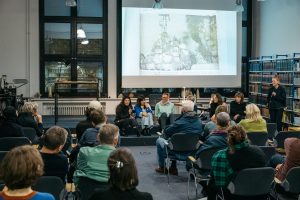
© Daniel Sadrowski

Application Deadline

27.3.2026

Research Stay

1.9.-30.11.2026

Urbane Künste Ruhr is awarding three research residencies at the House for the History of the Ruhr in Bochum.

Together with the History of the Ruhr Foundation (Stiftung Geschichte des Ruhrgebiets), we are awarding three three-month research residencies at the House for the History of the Ruhr (Haus der Geschichte des Ruhrgebiets) in Bochum for the year 2026. The programme is aimed at artists whose practice includes research and who are interested in developing a contemporary perspective on the Ruhr region and its themes. Through the affiliation with the foundation and a workspace at the House for the History of the Ruhr, including access to the library and archive, the residency enables an intensive engagement with the region.

During the research phase, residents are invited to develop a project idea in close exchange with the local curatorial team. Depending on its suitability, the project may become part of a curated public programme in Duisburg in 2027.

Questions of mobility and positioning within the art field, institutional critique, and context-specific artistic practices will be part of the event’s programme in Duisburg in 2027 and are explicitly welcome as points of departure. The residency is particularly suitable for artists working with text, language, film, or performance.

The History of the Ruhr Foundation

Founded in 1998, the foundation promotes research about the history and present of the Ruhr area and provides extensive publications and journals as well as numerous archives for this purpose. The foundation building houses the Library of the Ruhr and the archive, which are both available to artists. The archive also contains numerous documents on artistic projects and project plans in the context of the European Capital of Culture RUHR.2010 GmbH. In addition, there is a close connection to the Institute for Social Movements (Institut für Soziale Bewegungen) at the Ruhr University Bochum, from which the guest artists can also benefit. 

For whom?

The programme is aimed at professional artists whose practice is related to artistic research and who have a particular interest in working with archives. 

It is mandatory that the artists spend at least 75% of their time in the Ruhr area.

What does the Programme in Cooperation with the History of the Ruhr Foundation offer?

  • A research stay from 1.9. – 30.11.2026 with curatorial support and close exchange with the team of Urbane Künste Ruhr
  • Support with networking in the region
  • A guest artist's fee of € 5,000 gross
  • A workspace in the foundation's building
  • Costs for arrival and departure will be covered once
  • Accommodation in Bochum will be provided
  • Reimbursement of public transport travel costs for research purposes

Application Modalities for the Guest Artist Programme

We welcome applications from all people regardless of gender, nationality, ethnic and social origin, religious affiliation, disability, age, gender issues and identity. We offer our support in finding suitable solutions for individual needs, for example regarding accessibility.

Application Process: 

  • Application Deadline: 27.3.2026
  • Submission of application documents via online form
  • An expert jury will select the artistic positions
  • Applicants will be notified from late April 2026 onwards

Questions can be directed to
zugast@urbanekuensteruhr.de 
Alisha Raissa Danscher (Curator Urbane Künste Ruhr)
Jolande Hörrmann (Project Coordination)

Haltern am See

The Grand Snail Tour will be accompanied by literary, photographic and illustrative artists, who will collect impressions and reflections from the same city at the same time as the Trailer is there and put them into visual or literary form. The result is a paratext on the three-year tour, a travel chronicle in the form of a kaleidoscope of stories, connections and snapshots in the 53 cities of the region, revealing the simultaneities and non-simultaneities of the Grand Snail Tour.

Haltern am See von Luna Ali

Haltestelle fast verpasst, ich greife nach all meinen Sachen, die Bahn hielt schon an, ich stieg aus, laufe zur Bank, setze alles ab. Angekommen, alles in der Tasche verstaut. Es geht los. Ich atme die Luft ein, vielleicht riecht sie hier anders, ich stelle keinen Unterschied fest.

An einem Unterstand hängt das Gemälde eines Mannes. Er blickt ernst, grün trägt er. Sein Vorname ist übermalt, aber unter dem Weiß lese ich noch Torquato, noch sichtbar der Nachname: Tasso. Ich denke an Goethe, aber weiß nicht weiter als ein Poet, der in den Wahnsinn wandert. 

Lebenstein lese ich auf dem Weg an einem ehemaligen jüdischen Friedhof vorbei, die Namen im Stein der Gräber ausgeschlagen. Lebenstein, der einzige Überlebende Jude aus Haltern am See. Lebenstein schreibt, dass er vor seiner ersten Reise nach Deutschland noch voller Hass und Wut war, 1938 aus seinem Haus vertrieben worden zu sein. Lebenstein sagte, der Weltfriede läge in den Händen derjeniger, die es sich wünschen. Was muss also geschehen, um von Wut und Hass zu Weltfrieden und Versöhnung zu kommen? Ich schreibe und denke an Syrien.

Trotzdem weiter bis zum See, an einem anderen Friedhof vorbei. Hier liegen ganze Familien, die Gräber tragen ihre Namen. 

Entlang am See, die Baume tragen auch Namen. Entlang am See ein Zaun, im See Trinkwasser. Ich setze mich auf eine Bank, am Zaun, hier steht: „Das, was ich fühle, passt nicht in deinen kapitalistischen Kopf“. Ich esse meine Walnuss-Ahorn-Schnecke.

Regen gibt es heute nicht, die Sonne scheint. Ich ziehe meine Jacke aus, es ist zu warm. Weiter geht es, ich laufe in die andere Richtung. Der Aushang informiert, dass die Fähre am 13. April 2024 ausfällt.

Nari nareen, albi min gamaloo, schallt es aus einem weißen Transporter, ein Klassiker aus dem Jahr 2000. Der Paketboote von Hermes, ich sehe ihn nun zum zweiten Mal. Das erste Mal an einer Ampel, mit einem anderen Lied. Das zweite Mal hält er an, steigt aus, holt ein Paket von hinten, verschwindet zwischen den Häusern, kehrt zurück, steigt ein, fährt davon, beliefert die Stadt.

Ankommen ist einfach in Haltern am See, merke ich ein paar Stunden später. Es ist lebendig hier, am Brunnen vor der Kirche spielen Kinder. Alles nicht ruhig, laut, Geschrei, Gelächter, vielleicht liegt es am Wetter, vielleicht aber auch an dem Gefühl „Shoppen, wo andere Urlaub machen“, wie es in einem Schaufenster hängt. Der See ist ja nur teilweise umzäunt, erfahre ich. Man schwimmt hier im Trinkwasser. 

Manchmal ist es nicht so einfach ins Blaue hineinzuschreiben, da muss das Gefühl schon sehr stark sein. Einfacher ist es, einen Textauftrag zu geben. Ich beauftrage das Büro für außerordentliche Schreibangelegenheiten mir eine Chronik für meinen Aufenthalt in Haltern am See zu schreiben. Insgesamt erhalten sie 38 Aufträge, von denen Caren Jeß und Tim Holland uns sechs vorlesen. Haltern am See vergibt vor allem Aufträge für Liebesbriefe, aber ein Wohnungsgesuch und eine Kündigung gibt es auch. Mir bleibt FF im Kopf.

Skulpturen im öffentlichen Raum, meine Sammlung: Drei Gänse und ein Mädchen mit einem Stock in der Hand. Der gescheiterte Varus, schaut ungläubig. Zwei Männer im Sprung. Eine Kuh am Wegesrand. Zwei Frauen und ein Hund am Marktbrunnen. Unschlüssig bin ich darüber, was es mit den Skulpturen auf sich hat, was sie in ihrer Summe bedeuten, ein Bruchteil habe ich nur gesehen. Ist es die Erzählung der Stadt? Die Aneignung des öffentlichen Raumes aus den Fängen der Bauverordnung? Ist eine Skulptur nicht selbst eine Art Blackbox eines komplizierten Verwaltungsprozesses? 

Extrablatt, Feierabend. 

Einen letzten Absatz will ich noch schreiben: Der Name der Stadt bietet Späße wie „Zusammenhalte(r)n für Demokratie!“ Dass es in Tagen wie diesen leider nicht nur ein Wortspiel ist, sondern dringende Pflicht, ist die bittere Realität in einer pluralen Gesellschaft. Der Angriff auf elementare Grundrechte wurde schon vor den Koalitionsverhandlungen durch „die kleine Anfrage“ der CDU deutlich. Nun wissen wir, dass es bei „kleinen Anfragen“ nicht bleiben wird. Vom Entzug von Staatsbürgerschaften ist die Rede und damit, wie Hannah Arendt einst festgestellt hat, vom Recht, Rechte zu haben. Was wir erleben, ist keine Wiederholung, sondern eine Kontinuität.

Artist

Open Artsit

©Paul Lovis Wagner

Luna Ali

Luna Ali, born in Syria in 1993, has worked as an author on productions at the Düsseldorf, Dortmund and Hanover theaters as well as in Berlin.

View