Jump to main content (press Enter)Jump to the footer (press Enter)

Breadcrumbs

  1. Home
  2. Publications
  3. Publication

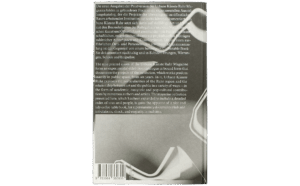
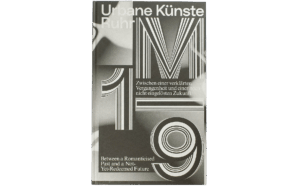
Urbane Künste Ruhr 2018-2023
Between a Romanticised Past and a Not Yet Redeemed Future
Editor

Britta Peters, Alisha Raissa Danscher, June Drevet, Kerstin Finkel

Texts

Etel Adnan, Beatriz Colomina, Daniel Talesnik, Ellen Wagner, Angharad Williams, Serhij Zadan e.a.

Designer

Lamm & Kirch

Year
2024
Publisher
BOM DIA BOA TARDE BOA NOITE
ISBN
978-3-96436-080-9
order here

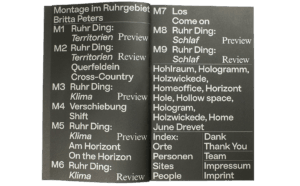
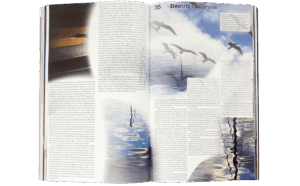
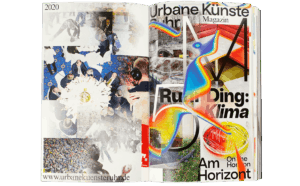
Nine printed issues of the Urbane Künste Ruhr magazine were published from 2018-2023. The magazine documented the institution's projects, in particular the Ruhr Ding exhibition format, and reflected on them in accompanying texts.

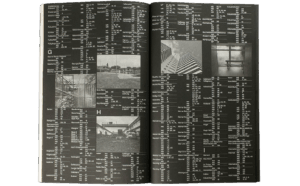
From the outset, 500 copies of each edition of the magazine were set aside for later use. The individual issues are now brought together in a 670-page catalogue. It has also been expanded to include an index of people and places as well as an editorial by Artistic Director Britta Peters. New projects can always be discovered by leafing through the catalogue, while the index enables a playful, retrospective discourse analysis.

In academic, essayistic and pop-cultural contributions by numerous authors and artists, the publication explores the special features of the Ruhr region and the relationship between art and the public sphere ‘between a glorified past and a future not yet realised’. 

  • Open Article

    Montage im Ruhrgebiet

    Editorial

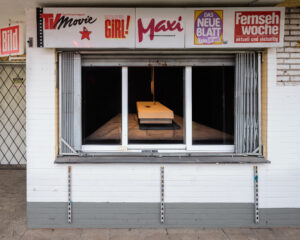
    The author Wolfgang Welsch, in his 1987 book Unsere postmoderne Moderne (Our Postmodern Modern), introduces a vivid anecdote meant to aid in understanding the concept of postmodernity: he presents to the reader a person who is meandering through Munich. His gaze falls on an advertising text which had been put up on posters all around the city prior to the 1972 Olympic Games.
    View
  • Open Article

    Climate Grief and the Visible Horizon

    Essay

    The second book in the Metamorphoses by the Roman poet Ovid opens with a story that can be read as a climate metaphor. Phaëthon, the hot-headed son of Phoebus, the Sun God, is living on Earth with his mortal mother and feels the god has not acknowledged him as his rightful son. Hoping to prove his parentage, Phaëthon goes up into the sky and asks Phoebus for a sign that the god is indeed his father. “Ask me whatever favor you want,” says Phoebus, “and I’ll bestow it.” The boy responds: “I want to drive the chariot.” The request chills the Sun God to his core.

    ©Heinrich Holtgreve

    View
  • Open Article

    The 24/7 Bed

    Essay

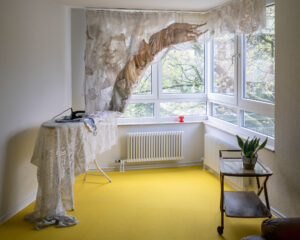
    When John Lennon and Yoko Ono married secretly in Gibraltar on March 20, 1969, the ceremony lasted only three minutes. But these minutes, so elaborately protected, were in fact the end of privacy. They promptly invited a global audience into their honeymoon bed, a weeklong Bed-In for Peace held from March 25 to 31, 9am to 9pm, in room 902 of the Amsterdam Hilton International Hotel. Two of the most public people in the world put themselves in a literal fishbowl, the glass box of the Hilton. But the workday didn’t end at 9pm. John and Yoko repeatedly declared that they wanted to conceive a baby during that week. The bed is both protest site and factory for baby production: a fucktory.
    View
  • Open Article

    Hollow space, Hologram, Holy Earth, Holzwickede, Home office

    Essay

    The Urbane Künste Ruhr magazines #1 to #9, created from 2018 to 2023, form the core of the book at hand. Inspired by the idea of summarising the years past, but also of portraying the processuality of an artistic programme playing out in public space, we decided to create a structural approach to navigating the already existing content – rather than conceiving a whole new publication.
    ©Heinrich Holtgreve
    View

Haltern am See

The Grand Snail Tour will be accompanied by literary, photographic and illustrative artists, who will collect impressions and reflections from the same city at the same time as the Trailer is there and put them into visual or literary form. The result is a paratext on the three-year tour, a travel chronicle in the form of a kaleidoscope of stories, connections and snapshots in the 53 cities of the region, revealing the simultaneities and non-simultaneities of the Grand Snail Tour.

Haltern am See von Luna Ali

Haltestelle fast verpasst, ich greife nach all meinen Sachen, die Bahn hielt schon an, ich stieg aus, laufe zur Bank, setze alles ab. Angekommen, alles in der Tasche verstaut. Es geht los. Ich atme die Luft ein, vielleicht riecht sie hier anders, ich stelle keinen Unterschied fest.

An einem Unterstand hängt das Gemälde eines Mannes. Er blickt ernst, grün trägt er. Sein Vorname ist übermalt, aber unter dem Weiß lese ich noch Torquato, noch sichtbar der Nachname: Tasso. Ich denke an Goethe, aber weiß nicht weiter als ein Poet, der in den Wahnsinn wandert. 

Lebenstein lese ich auf dem Weg an einem ehemaligen jüdischen Friedhof vorbei, die Namen im Stein der Gräber ausgeschlagen. Lebenstein, der einzige Überlebende Jude aus Haltern am See. Lebenstein schreibt, dass er vor seiner ersten Reise nach Deutschland noch voller Hass und Wut war, 1938 aus seinem Haus vertrieben worden zu sein. Lebenstein sagte, der Weltfriede läge in den Händen derjeniger, die es sich wünschen. Was muss also geschehen, um von Wut und Hass zu Weltfrieden und Versöhnung zu kommen? Ich schreibe und denke an Syrien.

Trotzdem weiter bis zum See, an einem anderen Friedhof vorbei. Hier liegen ganze Familien, die Gräber tragen ihre Namen. 

Entlang am See, die Baume tragen auch Namen. Entlang am See ein Zaun, im See Trinkwasser. Ich setze mich auf eine Bank, am Zaun, hier steht: „Das, was ich fühle, passt nicht in deinen kapitalistischen Kopf“. Ich esse meine Walnuss-Ahorn-Schnecke.

Regen gibt es heute nicht, die Sonne scheint. Ich ziehe meine Jacke aus, es ist zu warm. Weiter geht es, ich laufe in die andere Richtung. Der Aushang informiert, dass die Fähre am 13. April 2024 ausfällt.

Nari nareen, albi min gamaloo, schallt es aus einem weißen Transporter, ein Klassiker aus dem Jahr 2000. Der Paketboote von Hermes, ich sehe ihn nun zum zweiten Mal. Das erste Mal an einer Ampel, mit einem anderen Lied. Das zweite Mal hält er an, steigt aus, holt ein Paket von hinten, verschwindet zwischen den Häusern, kehrt zurück, steigt ein, fährt davon, beliefert die Stadt.

Ankommen ist einfach in Haltern am See, merke ich ein paar Stunden später. Es ist lebendig hier, am Brunnen vor der Kirche spielen Kinder. Alles nicht ruhig, laut, Geschrei, Gelächter, vielleicht liegt es am Wetter, vielleicht aber auch an dem Gefühl „Shoppen, wo andere Urlaub machen“, wie es in einem Schaufenster hängt. Der See ist ja nur teilweise umzäunt, erfahre ich. Man schwimmt hier im Trinkwasser. 

Manchmal ist es nicht so einfach ins Blaue hineinzuschreiben, da muss das Gefühl schon sehr stark sein. Einfacher ist es, einen Textauftrag zu geben. Ich beauftrage das Büro für außerordentliche Schreibangelegenheiten mir eine Chronik für meinen Aufenthalt in Haltern am See zu schreiben. Insgesamt erhalten sie 38 Aufträge, von denen Caren Jeß und Tim Holland uns sechs vorlesen. Haltern am See vergibt vor allem Aufträge für Liebesbriefe, aber ein Wohnungsgesuch und eine Kündigung gibt es auch. Mir bleibt FF im Kopf.

Skulpturen im öffentlichen Raum, meine Sammlung: Drei Gänse und ein Mädchen mit einem Stock in der Hand. Der gescheiterte Varus, schaut ungläubig. Zwei Männer im Sprung. Eine Kuh am Wegesrand. Zwei Frauen und ein Hund am Marktbrunnen. Unschlüssig bin ich darüber, was es mit den Skulpturen auf sich hat, was sie in ihrer Summe bedeuten, ein Bruchteil habe ich nur gesehen. Ist es die Erzählung der Stadt? Die Aneignung des öffentlichen Raumes aus den Fängen der Bauverordnung? Ist eine Skulptur nicht selbst eine Art Blackbox eines komplizierten Verwaltungsprozesses? 

Extrablatt, Feierabend. 

Einen letzten Absatz will ich noch schreiben: Der Name der Stadt bietet Späße wie „Zusammenhalte(r)n für Demokratie!“ Dass es in Tagen wie diesen leider nicht nur ein Wortspiel ist, sondern dringende Pflicht, ist die bittere Realität in einer pluralen Gesellschaft. Der Angriff auf elementare Grundrechte wurde schon vor den Koalitionsverhandlungen durch „die kleine Anfrage“ der CDU deutlich. Nun wissen wir, dass es bei „kleinen Anfragen“ nicht bleiben wird. Vom Entzug von Staatsbürgerschaften ist die Rede und damit, wie Hannah Arendt einst festgestellt hat, vom Recht, Rechte zu haben. Was wir erleben, ist keine Wiederholung, sondern eine Kontinuität.

Artist

Open Artsit

©Paul Lovis Wagner

Luna Ali

Luna Ali, born in Syria in 1993, has worked as an author on productions at the Düsseldorf, Dortmund and Hanover theaters as well as in Berlin.

View