Jump to main content (press Enter)Jump to the footer (press Enter)

Breadcrumbs

  1. Home
  2. Publications
  3. Publication

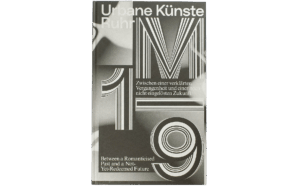
Urbane Künste Ruhr 2018-2023
Between a Romanticised Past and a Not Yet Redeemed Future
Editor

Britta Peters, Alisha Raissa Danscher, June Drevet, Kerstin Finkel

Texts

Etel Adnan, Beatriz Colomina, Daniel Talesnik, Ellen Wagner, Angharad Williams, Serhij Zadan e.a.

Designer

Lamm & Kirch

Year
2024
Publisher
BOM DIA BOA TARDE BOA NOITE
ISBN
978-3-96436-080-9
order here

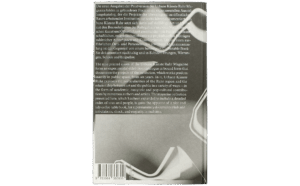
Nine printed issues of the Urbane Künste Ruhr magazine were published from 2018-2023. The magazine documented the institution's projects, in particular the Ruhr Ding exhibition format, and reflected on them in accompanying texts.

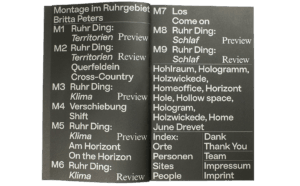
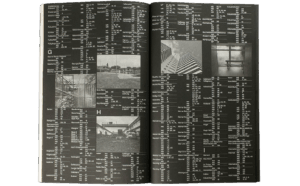
From the outset, 500 copies of each edition of the magazine were set aside for later use. The individual issues are now brought together in a 670-page catalogue. It has also been expanded to include an index of people and places as well as an editorial by Artistic Director Britta Peters. New projects can always be discovered by leafing through the catalogue, while the index enables a playful, retrospective discourse analysis.

In academic, essayistic and pop-cultural contributions by numerous authors and artists, the publication explores the special features of the Ruhr region and the relationship between art and the public sphere ‘between a glorified past and a future not yet realised’. 

  • Open Article

    Montage im Ruhrgebiet

    Editorial

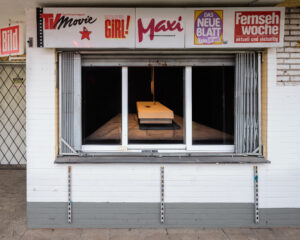
    The author Wolfgang Welsch, in his 1987 book Unsere postmoderne Moderne (Our Postmodern Modern), introduces a vivid anecdote meant to aid in understanding the concept of postmodernity: he presents to the reader a person who is meandering through Munich. His gaze falls on an advertising text which had been put up on posters all around the city prior to the 1972 Olympic Games.
    View
  • Open Article

    Climate Grief and the Visible Horizon

    Essay

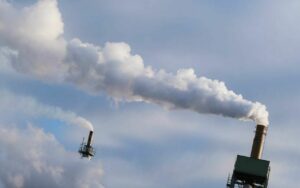
    The second book in the Metamorphoses by the Roman poet Ovid opens with a story that can be read as a climate metaphor. Phaëthon, the hot-headed son of Phoebus, the Sun God, is living on Earth with his mortal mother and feels the god has not acknowledged him as his rightful son. Hoping to prove his parentage, Phaëthon goes up into the sky and asks Phoebus for a sign that the god is indeed his father. “Ask me whatever favor you want,” says Phoebus, “and I’ll bestow it.” The boy responds: “I want to drive the chariot.” The request chills the Sun God to his core.
    ©Heinrich Holtgreve

    View
  • Open Article

    The 24/7 Bed

    Essay

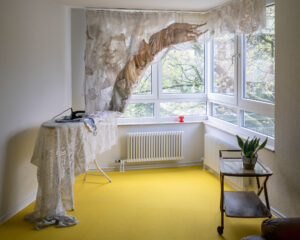
    When John Lennon and Yoko Ono married secretly in Gibraltar on March 20, 1969, the ceremony lasted only three minutes. But these minutes, so elaborately protected, were in fact the end of privacy. They promptly invited a global audience into their honeymoon bed, a weeklong Bed-In for Peace held from March 25 to 31, 9am to 9pm, in room 902 of the Amsterdam Hilton International Hotel. Two of the most public people in the world put themselves in a literal fishbowl, the glass box of the Hilton. But the workday didn’t end at 9pm. John and Yoko repeatedly declared that they wanted to conceive a baby during that week. The bed is both protest site and factory for baby production: a fucktory.
    View
  • Open Article

    Hollow space, Hologram, Holy Earth, Holzwickede, Home office

    Essay

    The Urbane Künste Ruhr magazines #1 to #9, created from 2018 to 2023, form the core of the book at hand. Inspired by the idea of summarising the years past, but also of portraying the processuality of an artistic programme playing out in public space, we decided to create a structural approach to navigating the already existing content – rather than conceiving a whole new publication.
    ©Heinrich Holtgreve
    View

Werne

Begleitet wird die Grand Snail Tour von Künstler*innen aus dem Bereich Literatur, Fotografie und Zeichnung, die zeitgleich zum Aufenthalt des Tourmobils, Eindrücke und Reflexionen aus jeweils derselben Stadt sammeln und diese sie visuell oder literarisch ins Bild setzen. So entsteht ein Paratext zur 3-jährigen Tour, der in Form einer Reisechronik, ein Kaleidoskop an Geschichten, Verbindungen, Momentaufnahmen in den 53 Städten der Region als Gleichzeitigkeiten und Ungleichzeitigkeiten zur Grand Snail Tour sichtbar werden lässt.

Werne von Franziska Klose

Städte sind Cohabitate – artenübergreifende Lebensräume, urbane Biotope. 

In Werne gelten meine Blicke und Bilder der urbanen Flora und ihrer Habitate: Baustellen, Hinterhöfe, Fassadengrün, Blumenkübel, Brachflächen, Wasserläufe, Maisfelder, Blumenampeln, Steingärten und gleich bei meiner Ankunft die „Beete" aus Gleisschotter mit Ruderalpflanzen.

01 Werne Südmauer
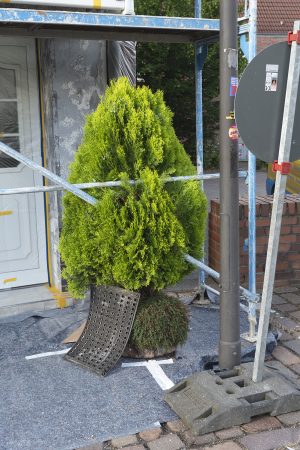
Hauseingang mit Baugerüst, Fußmatte, Straßenschild, Lampenmast und Blümenkübel, darin mit Lebensbaum (Thuja) und Zwergmispel (Cotoneaster)

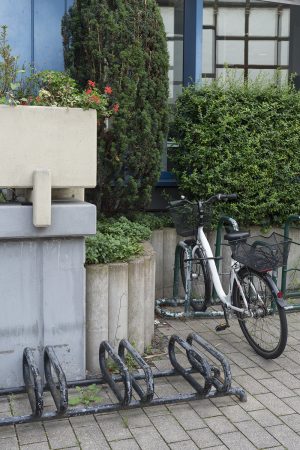
02 Werne Sparkasse
Hausfassade, Fahrradständer und diverse Blumenkübel mit Eibe (Taxus baccata), Pelargonie (Pelargonium), Ysander (Pachysandra), Buchsbaum (Buxus sempervirens) und Efeu (Hedera helix) sowie Gemüse-Gänsedistel (Sonchus oleraceus) und Hornklee (Lotus)

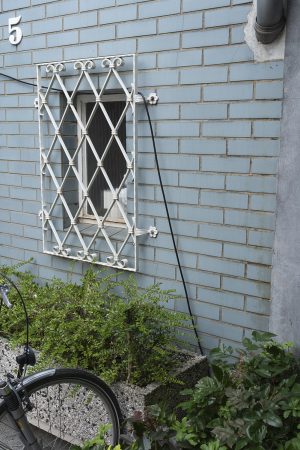
03 Werne Hinterhof
Gekachelte Hauswand, florales Fenstergitter und Blumentrog mit Immergrüner Kriech-Heckenkirsche (Lonicera pileata) und Ilex (Ilex aquifolium)

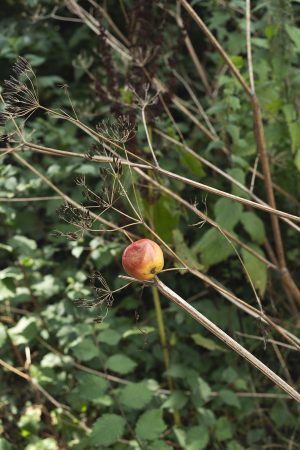
04 Werne Friedhof
Apfel (Malus), aufgespießt auf einem Wiesen-Kerbel (Anthriscus sylvestris), dahinter Ampfer (Rumex), Große Brennnessel (Urtica dioica) und Haselnuss (Corylus avellana)

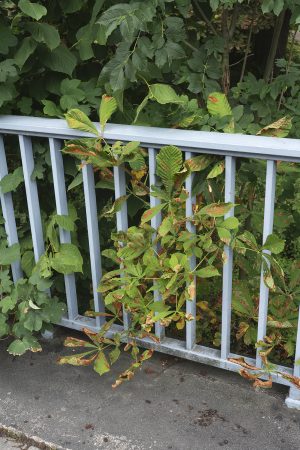
05 Werne Hornebachbrücke
Geländer an der Hornebach-Brücke, Gewöhnliche Kastanie (Aesculus hippocastanum), Sommerlinde (Tilia platyphyllos), Berg-Ahorn (Acer pseudoplatanus) und Esche (Fraxinus excelsior)

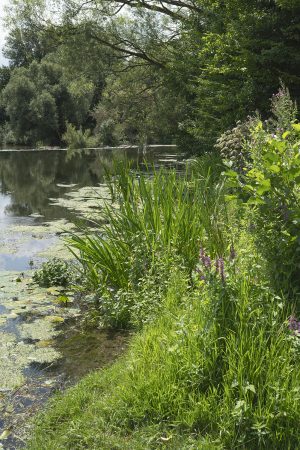
06 Werne Lippewehr
Am Lippe-Ufer, Gräser (Poa), Schwertlilie (Iridaceae), Flatterbinse (Juncus effusus), Wasserminze (Mentha aquatica), Gelbe Teichrose (Nuphar lutea), Ulme (Ulmus), Wiesen-Bärenklau (Heracleum sphondylium), Zottiges Weidenröschen (Epilobium hirsutum), Ackerwinde (Convolvulus arvensis), Weiderich (Lythrum) und Weiden (Salix) in Hintergrund

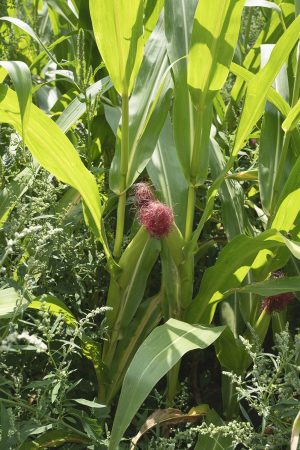
07 Werne MaisFeld
Maisfeld (Zea mays) mit Weißem Gänsefuß (Chenopodium album) und Rauhaarigem Amarant (Amaranthus retroflexus)

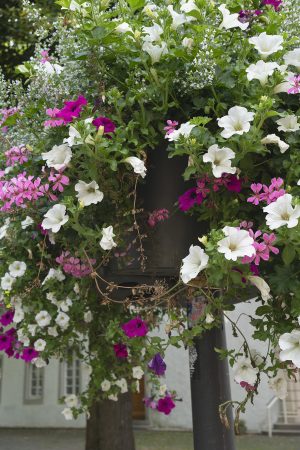
08 Werne Kloster
Blumenampel mit Petunien (Penunia), Pelargonien (Pelargonium) und Kleinblütiger Bergminze (Clinopodium nepeta)

09 Werne Sparkasse
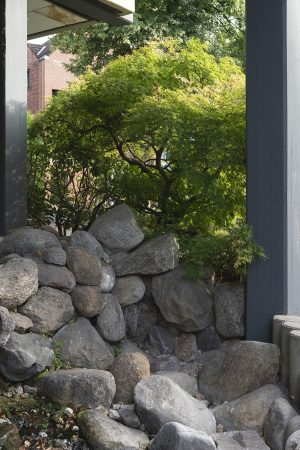
Steingarten mit kleinem Brunnen, Japanischem Ahorn (Acer japonicum), Ilex (Ilex aquifolium), Vogelmiere (Stellaria media), Kanadischer Goldrute (Solidago canadensis) und Moosen

10 Werne Bahnhof
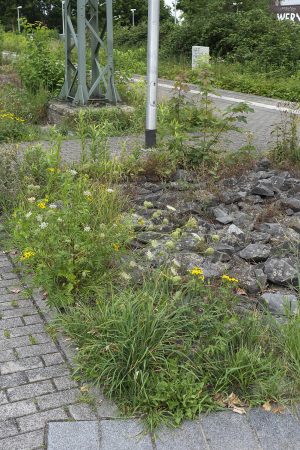
Angelegte Beete am Bahnsteig: Gleisschotter mit typischer Spontanvegetation/Wildwuchs: Rainfarn (Tanacetum vulgare), Wilde Möhre (Daucus carota), Stinkender Storchschnabel (Geranium robertianum), Kompass-Lattich (Lactuca serriola), Löwenzahn (Taraxacum officinale), Mäusegerste (Hordeum murinum), Kriech-Quecke (Elymus repens), Bergahorn (Acer pseudoplatanus), Kanadische Goldrute (Solidago canadensis), Blauer Natternkopf (Echium vulgare), Spitzwegerich (Plantago lanceolata), Vogelmiere (Stellaria media), Wiesen-Knäuelgras (Dactylis glomerata), Wilder Hafer (Avena fatua), Jacobs-Greiskraut (Senecio erucifolius) und Flechten

Stops

Open "Werne"
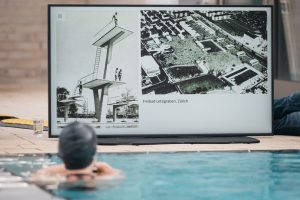
Screen displaying historical images of the Letzigraben outdoor pool in Zurich, viewed from the water.

© Daniel Sadrowski

24.7.25, 16–21 h

Chilling in Werne

Werne

Artist

Open Artsit

© Camilo Pachón

Franziska Klose

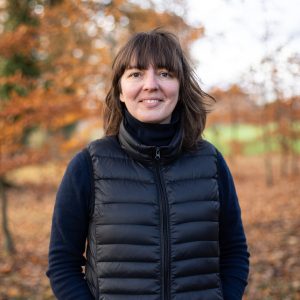
Franziska Klose (* 1977) is an artist and photographer. She has been working on post-industrial landscapes and contemporary nature since 2010. 

View