Breadcrumbs
Grand Snail Tour in ARCH+ Ruhr: From Territory to Space2.7.2026
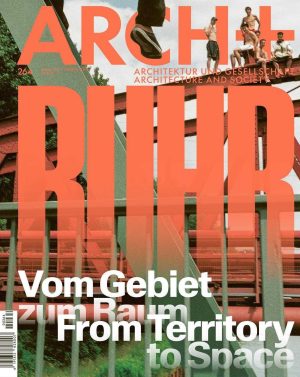
ARCH+ Ruhr: From Territory to Space understands the Ruhr region as an assemblage of different political and cultural spaces, interests, and affiliations. The issue directs its attention to spatial practices based on exchange and negotiation that open up new forms of living together. We are delighted to be part of this research-intensive issue: in the section “Peripheral Centres”, you will find a self-reflective presentation of Britta Peters’ Grand Snail Tour concept.
The issue is published on the occasion of Manifesta 16 Ruhr, in cooperation with Renée Tribble and the Urban Design Processes department at TU Dortmund. View ARCH+ website
Grand Snail Tour
Text: Britta Peters
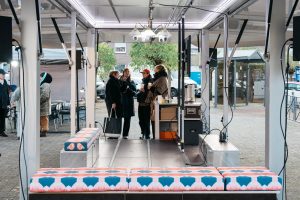
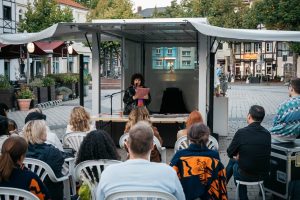
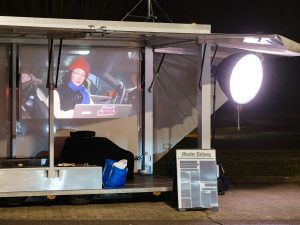
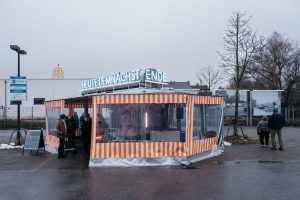
Urbane Künste Ruhr is an institution for contemporary art in public space without a fixed venue. For the Grand Snail Tour, we created a trailer that is a mobile spatial setting moving across the Ruhr region since September 2024. Custom-built by the project team, the trailer offers numerous mounting points both inside and out for installations and transport. Its walls can be opened in various configurations or even function as a roof. The tour itself brings together different elements: a clear conceptual framework, a touch of Fluxus, and ample room for experience.
The Logic of the Series
The Grand Snail Tour is a long-term project with a defined structure that deliberately allows for variation. The idea of visiting all fifty-three cities of the Ruhr region within roughly three years, which grew out of the pandemic, means one or two stops per month, throughout the seasons. To avoid managing too many spatial and temporal options each time, we settled on Thursdays as our regular event day. Occasionally it shifts to a Friday, or extends over several days, as in the summer of 2025 with a stop titled Appreciating in Dortmund. The rhythm provides structure without becoming restrictive.
Traveling the Ruhr Region
Each stop is announced locally through flyers and small posters displayed in bakeries, public libraries, and local banks. Each poster pairs the city’s name with a verb that proposes an activation of public space: Reading in Wesel, Swaying in Schermbeck, Meandering in Holzwickede, Transmitting in Breckerfeld, Raging in Hagen. The Berlin-based graphic design office Studio Yukiko translates these verbs into playful and varied visual motifs. Each verb relates loosely to the program at the respective stop, which is newly developed each time. It functions less as a description than as an invitation to engage.
Assembling Constellations
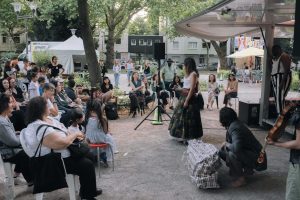
Each stop emerges from a specific constellation. What do we know about the city? Who do we want to collaborate with? Where can public space take shape? In smaller towns, these questions have led us not only to markets and pedestrian zones but also to outdoor swimming pools and parking lots. One particularly memorable moment was a reading by Tunay Önder in Marl, broadcast via FM to car radios during a snowstorm.
The process remains deliberately subjective and intuitive. It resembles a gradual probing of different urban and small-town situations rather than a comprehensive mapping. At times, certain permits are not granted; at others, we encounter constellations we wish we had known about earlier. These missed opportunities also feed into the ongoing planning. The tour is conceived as a process that can be continually recalibrated.
Sharing Continuities
Over the course of three years, we collaborate repeatedly with many artists. The serial format allows them to work with similar settings in different locations, generating comparable experiences. For photographer Rebecca Racine Ramershoven, we built a mobile studio in which, across different cities, she conducts intimate interviews about anger with women and people socialized as women. Mona Schulzek sends messages to extraterrestrials using her own alphabet and a self-built satellite dish, together with local residents and schoolchildren from Xanten, Datteln, and from the highest elevation in the Ruhr region in Breckerfeld.
The Spiral Route
The Ruhr region is not a naturally bounded territory but an administratively defined one, originating in the Siedlungsverband Ruhrkohlenbezirk (Ruhr Coal District Settlement Association). Our route follows a spiral trajectory. From the rural western edges, it moves through the north, south, and east, gradually winding inward toward the more urbanized center of the region, where the tour will conclude in Herne in October 2027. The route connects audiences and institutions across neighboring cities while making regional differences visible. The densely populated north, where the last active coal mine, Prosper-Haniel in Bottrop, closed in 2018, contrasts with the comparatively affluent and picturesque areas to the south along the Ruhr River.
A Chronicle of Journeys
Alongside the tour, a parallel artistic chronicle is taking shape. For each stop, we invite an artist working in photography, drawing, or text to spend the day of our tour stop in the same city. The focus is not on the activities at the trailer but on their individual perception of the place, the journey, and the events of the day. This will result in more than fifty-three distinct perspectives on the cities of the Ruhr region, creating a polyphonic and aesthetically diverse reflection that functions as a paratext to the tour itself.
Social and Ecological Climate
In addition to this subjective chronicle, we also collect empirical data. Since the tour began in Xanten in September 2024, we have recorded weather data and the composition of local political bodies at each stop. We are interested in how the ecological and political climate will shift by 2027. At present, there is little reason for optimism. Against this backdrop, reclaiming public space has been a central motivation from the outset. We aim to show that streets and public squares can be more than sites of fear-driven narratives and consumption.
The Magic of Setup
During the 2024 UEFA European Championship in Germany, it became clear how communicative an outdoor screening can be, even in how it is set up. People gather, watch, ask questions, and start talking. We adopt this principle as a performative context: Curiosity about what is taking shape becomes the most effective icebreaker. As the first stops have shown, our largest audience is often made up of people who simply happen to be there. At the same time, we work with local organizations, schools, and initiatives that host us. Some people even follow the tour across the region. Given the distances within the region’s roughly 4,400 square kilometers, this remains the exception.
A Collection on Board
Like the chronicle, the collection has been integral to the project from the outset. The trailer functions as both a mobile platform for action and an exhibition space. Nearly every element of its interior are contributions by the international artists who participated. Every object is an artwork, and the collection continues to grow. We travel with, among other things, a chandelier by Aram Bartholl, blankets by Anna Haifisch, cushions by Kasia Fudakowski, tables by Nils Norman, a neon sign by Anna Viebrock, and a map of the Ruhr region by Jordi Colomer. Cem A. provided signage and barrier tape, and Stefan Marx contributed curtains and a coloring book. The Duisburg-based author Lütfiye Güzel accompanies each stop with an erasure poem. Drawing on her reading of the local newspaper, she creates fragments in which only a few words remain visible between blacked-out lines. These fragments take on meaning in relation to the place in which they are read.
Forms of Hospitality
The conversations around the trailer also respond to the growing issue of social isolation. The Urbane Künste Ruhr team is present at every stop. Conversations revolve around art, the Ruhr region, local politics, and the prevailing mood in the city. The tour itself offers recurring points of entry. Where have you been? What did you experience? What comes next? A preparatory workshop on how to engage with populist rhetoric helps us navigate difficult conversations and support one another. Over time, this gives rise to an expanding network of relationships and supporters.
Public Space as a Legal Space
As part of its planning, the project contacts municipal administrations with applications for permits to carry out artistic interventions in public space. Although we travel with a conventional market trailer, the legal framework has proved highly complex. In many cases, permits assign full liability for the site to the user, even for a single-day use. This would imply, for example, that a market vendor standing next to the Dresden bridge when it partially collapsed in 2024 would have been held responsible. As a large public institution, we are able to renegotiate these conditions and establish precedents for future users. By the end of the tour, we will have left traces in fifty-three municipal administrations.
What Remains
The question of the material or immaterial legacy of artistic projects has been a standard concern in cultural policy since the late 1990s, yet the response often falls short. The impact of art in public space resists quantification. There are no counters, no metrics, no clicks to record. What remains are situations: encounters that linger in memory, sometimes almost unnoticed. Familiar places appear in a new light, opening up new relations. Site-specific works, such as the live radio project by Ari Benjamin Meyers’s class in the pedestrian zone of Lünen, deepen our understanding of a place’s past and present.
If public space is understood according to not only accessibility but also exchange, it must be produced anew each time. The Grand Snail Tour proposes multiple ways of doing so: through conversations, readings, theater, concerts, an urban mini-golf course, robotic performances, and an electric samovar. Its tightly paced serial practice functions as a kind of loosening exercise, not occupying space but producing it. With each stop, we set out together into the open. Unexpected encounters, actions, and conversations unfold, marked by turns, differences, and tensions that must be sustained. If that succeeds, the project will have already achieved a great deal.