Jump to main content (press Enter)Jump to the footer (press Enter)

Breadcrumbs

  1. Home
  2. Emscherkunstweg
  3. Public Hybrid

Public Hybrid

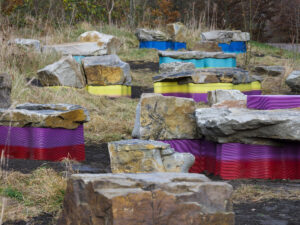
The installation Public Hybrid by David Jablonowski features multiple sandstone and plastic sculptures, their vibrant colors and irregular shapes appearing like artificial rock formations.

© Heinrich Holtgreve

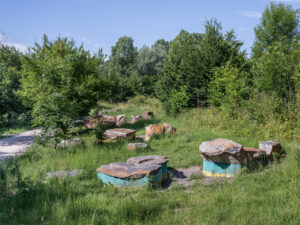
The sculpture Public Hybrid by David Jablonowski stands along the Emscherkunstweg, where layered Ruhr sandstone and 3D-printed plastic elements merge into an abstract landscape.

© Henning Rogge

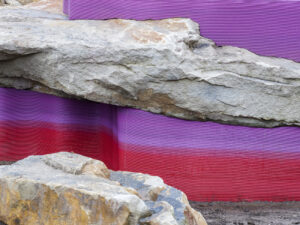
A detailed view of Public Hybrid by David Jablonowski showcases the layered combination of natural sandstone and vividly colored 3D-printed plastic, symbolizing the intersection of nature and technology.

© Heinrich Holtgreve

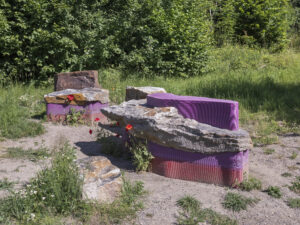
A close-up of Public Hybrid by David Jablonowski shows the colorful, 3D-printed plastic elements blending with natural sandstone, creating a striking contrast.

© Henning Rogge

Address

Emscher-Weg 
Adelenstraße 
44269 Dortmund

Open in Maps

David Jablonowski’s hybrid sculpture is located directly next to the Emscher-Weg bike path in the Schüren district of Dortmund.

In it, the artist, who grew up in Bochum, explores the history and future not only of this particular place, but of the entire Ruhr area as well. At the same time, he has created a contemporary monument that resembles a natural landmark and can be regarded as referring to the ecological improvements that have been made to Emscher River system.

In this multipart installation titled »Public Hybrid«, the artist combines the contrasting materials of sandstone and plastic. 3D printed elements made of recycled plastic and broken sandstone from the Ruhr region are stacked on top of each other like sediments. The resulting amorphous, artificial formations protrude out of the ground in a seemingly random fashion.  

The sandstone comes from the nearby town of Sprockhövel. It was formed about 320 million years ago and is one of the most resistant types of sandstone in Germany. Unlike this raw material that has been used by humans for millennia, the use of recycled plastic elements produced by 3D printing provides a glimpse into a digital, green vision of the future. 3D printing, or additive manufacturing technology, is in principle based on data for computer-aided physical translation. Through 3D printing, Jablonowski implicitly refers to invisible infrastructures that are created by the digital data traffic of public communication. He also juxtaposes waste, which is a material that needs the help of digital technology to become a resource, with geological materials that are quarried in a traditional way. This innovation through the combination of new technologies, nature, and artistic interventions also reflects the project of a generation of restoring the Emscher River.

Artist

Open Artsit

©Frey

David Jablonowski

In his sculptures, David Jablonowski shows the changes in communication and media content, influenced by industrial materials and technologies.
View

Sonne Art Minigolf

Sowatorini Landschaft

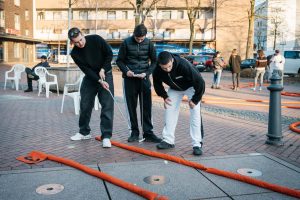
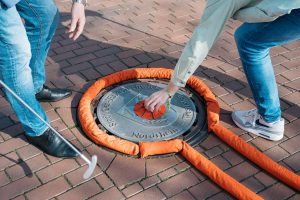
Minigolf ist das demokratische Golf: niedrigschwellig, generationsübergreifend und ohne Dresscode. Das Bochumer Künstlerkollektiv Sowatorini Landschaft — bestehend aus Sebastian Sowa (*1981, Bochum) und Gianluca Torini (*1985, Berlin) — nimmt Minigolf als Volkssport ernst und führt es weiter. Ihr tragbarer Parcour Sonne Art Minigolf verwandelt die jeweilige Stadtoberfläche selbst zur Spielbahn: Pflasterfugen, Bordsteinkanten, Gefälle und Platz-Geometrien ersetzen normierte Kunststoffbahnen. Ausgelegt werden gestopfte Stoffwürsten zu einem weichen, provisorischen und ortsspezifischen Spielfeld. Das Tourmobil wird zum Anmeldepoint und Ausleihstation für alles, was es braucht.

Der Titel ist programmatisch doppeldeutig: Sonne Art klingt im Ruhrgebiet wie „so eine Art“ — Ausdruck einer unprätentiösen Offenheit und des sich selber nicht zu wichtig Nehmens, die zum Geist des Kollektivs gehört. Wer den Parcours meistern will, muss die Topografie lesen lernen: Stadtoberflächen, die sonst als bloßes Durchgangsmedium fungieren, werden zum Handlungsraum und Erkenntnisobjekt — eine Form, die an situationistische Stadtaneignung ebenso anschließt wie an partizipative Kunstpraxen, die den Eigensinn des Alltäglichen produktiv machen.

Sowatorini Landschaft bewegt sich seit ihrer Gründung 2016 an der Schnittstelle von Landschaftsarchitektur und Kunst. Diese besondere Positionierung brachte dem Kollektiv 2023 das renommierte Stipendium der Deutschen Akademie Villa Massimo ein — als erst viertes Landschaftsarchitekturbüro in der über hundertjährigen Geschichte der Fördereinrichtung. Sonne Art Minigolf bleibt im Kern, was es ist: ein einfaches und schönes Spiel, um etwas von der Stadt und den Mitspieler*innen kennenzulernen.

Artist

Open Artsit
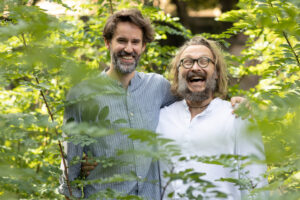
Porträt von SOWATORINI Landschaft

© Alberto Novelli

Sowatorini Landschaft

Sebastian Sowa and Gianluca Torini work as Sowatorini Landschaft between garden, landscape and art.

View