Jump to main content (press Enter)Jump to the footer (press Enter)

Breadcrumbs

  1. Home
  2. Emscherkunstweg
  3. Public Hybrid

Public Hybrid

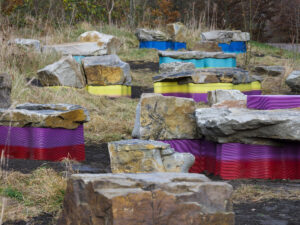
The installation Public Hybrid by David Jablonowski features multiple sandstone and plastic sculptures, their vibrant colors and irregular shapes appearing like artificial rock formations.

© Heinrich Holtgreve

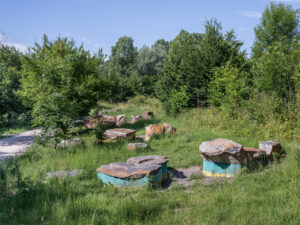
The sculpture Public Hybrid by David Jablonowski stands along the Emscherkunstweg, where layered Ruhr sandstone and 3D-printed plastic elements merge into an abstract landscape.

© Henning Rogge

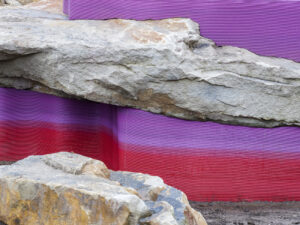
A detailed view of Public Hybrid by David Jablonowski showcases the layered combination of natural sandstone and vividly colored 3D-printed plastic, symbolizing the intersection of nature and technology.

© Heinrich Holtgreve

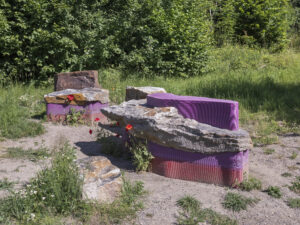
A close-up of Public Hybrid by David Jablonowski shows the colorful, 3D-printed plastic elements blending with natural sandstone, creating a striking contrast.

© Henning Rogge

Address

Emscher-Weg 
Adelenstraße 
44269 Dortmund

Open in Maps

David Jablonowski’s hybrid sculpture is located directly next to the Emscher-Weg bike path in the Schüren district of Dortmund.

In it, the artist, who grew up in Bochum, explores the history and future not only of this particular place, but of the entire Ruhr area as well. At the same time, he has created a contemporary monument that resembles a natural landmark and can be regarded as referring to the ecological improvements that have been made to Emscher River system.

In this multipart installation titled »Public Hybrid«, the artist combines the contrasting materials of sandstone and plastic. 3D printed elements made of recycled plastic and broken sandstone from the Ruhr region are stacked on top of each other like sediments. The resulting amorphous, artificial formations protrude out of the ground in a seemingly random fashion.  

The sandstone comes from the nearby town of Sprockhövel. It was formed about 320 million years ago and is one of the most resistant types of sandstone in Germany. Unlike this raw material that has been used by humans for millennia, the use of recycled plastic elements produced by 3D printing provides a glimpse into a digital, green vision of the future. 3D printing, or additive manufacturing technology, is in principle based on data for computer-aided physical translation. Through 3D printing, Jablonowski implicitly refers to invisible infrastructures that are created by the digital data traffic of public communication. He also juxtaposes waste, which is a material that needs the help of digital technology to become a resource, with geological materials that are quarried in a traditional way. This innovation through the combination of new technologies, nature, and artistic interventions also reflects the project of a generation of restoring the Emscher River.

Artist

Open Artsit

©Frey

David Jablonowski

In his sculptures, David Jablonowski shows the changes in communication and media content, influenced by industrial materials and technologies.
View

Local Blackouts

Lütfiye Güzel

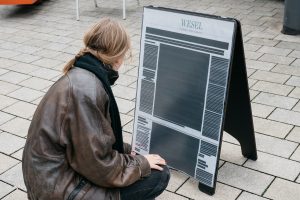
A person in a brown leather jacket looks at a large printed newspaper on a stand with the heading 'Wesel'.

© Daniel Sadrowski

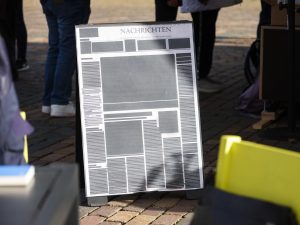
A sign with the word 'NACHRICHTEN' with an abstract newspaper layout with little text.

© Heinrich Holtgreve

Ausgangsmaterial ist ein besonders kurzweiliges Format aus dem Alltag: die Tageszeitung. Lütfiye Güzel, Poetin aus Duisburg und Vertreterin eines konsequent selbstverlegten, körpernahen Schreibens, lässt sich für die Grand Snail Tour von Projektpartner*innen und Passant*innen Lokalzeitungen und -beilagen aus den zu bereisenden Städten zusenden. Aus diesen Dokumenten erzeugt Güzel durch gezieltes Ausstreichen und Schwärzen von Textpassagen insgesamt 53 Gedichte — Local Blackouts —, die auf Aufstellern an jeder Station veröffentlicht werden.

Die Methode der Blackout Poetry ist eine Form der Found Poetry und wird bei Güzel zum politischen Akt. Das Schwärzen zitiert die Logik der Zensur, kehrt sie aber um, denn das unkenntlich Machen hat nicht Unterdrückung, sondern Verdichtung zum Ziel: Was bleibt, wenn der redaktionelle Lärm verschwindet? Lyrische Miniaturen, die in ihrer Knappheit dem Haiku ähnlich ist. Güzels Entscheidung, diese Textarbeiten im öffentlichen Raum zu zeigen, stellt zudem implizit die Frage: Für wen werden solche Texte geschrieben, und wer kommt darin vor?

Lokalzeitungen sind ein ambivalentes Medium. Sie fördern und informieren Nachbarschaften jenseits von Social Media — doch die Sprache und Nachrichtenauswahl ist häufig hetzerisch und vereinfachend. Tatsache ist, dass Lokalzeitungen an Bedeutung und finanzielle Unterstützung verlieren. Güzels Aneignung bewahrt und befragt dieses Erbe zugleich. Präsentiert auf herkömmlichen Presseaufstellern verleiht ihre Arbeit der Grand Snail Tour ein vertrautes Erscheinungsbild von regionaler Kultur und überführt diese gleichzeitig in die poetische Abstraktion.

Artist

Open Artsit

©Ben Knabe

Lütfiye Güzel

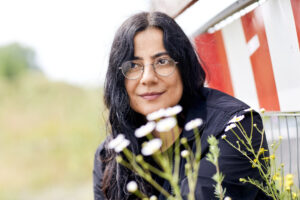
Lütfiye Güzel is a poet and has been publishing poems under her own label go-güzel-publishing since 2014.

View