Jump to main content (press Enter)Jump to the footer (press Enter)

Breadcrumbs

  1. Home
  2. Emscherkunstweg
  3. Public Hybrid

Public Hybrid

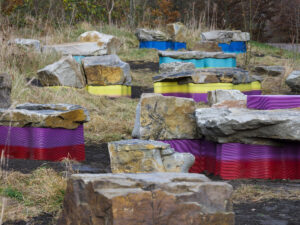
The installation Public Hybrid by David Jablonowski features multiple sandstone and plastic sculptures, their vibrant colors and irregular shapes appearing like artificial rock formations.

© Heinrich Holtgreve

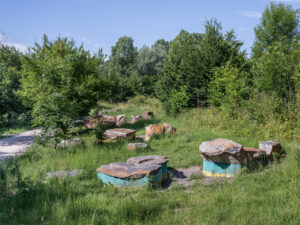
The sculpture Public Hybrid by David Jablonowski stands along the Emscherkunstweg, where layered Ruhr sandstone and 3D-printed plastic elements merge into an abstract landscape.

© Henning Rogge

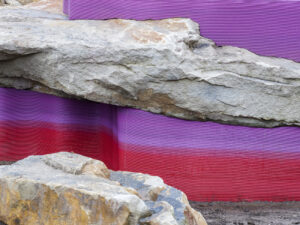
A detailed view of Public Hybrid by David Jablonowski showcases the layered combination of natural sandstone and vividly colored 3D-printed plastic, symbolizing the intersection of nature and technology.

© Heinrich Holtgreve

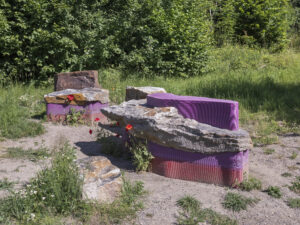
A close-up of Public Hybrid by David Jablonowski shows the colorful, 3D-printed plastic elements blending with natural sandstone, creating a striking contrast.

© Henning Rogge

Address

Emscher-Weg 
Adelenstraße 
44269 Dortmund

Open in Maps

David Jablonowski’s hybrid sculpture is located directly next to the Emscher-Weg bike path in the Schüren district of Dortmund.

In it, the artist, who grew up in Bochum, explores the history and future not only of this particular place, but of the entire Ruhr area as well. At the same time, he has created a contemporary monument that resembles a natural landmark and can be regarded as referring to the ecological improvements that have been made to Emscher River system.

In this multipart installation titled »Public Hybrid«, the artist combines the contrasting materials of sandstone and plastic. 3D printed elements made of recycled plastic and broken sandstone from the Ruhr region are stacked on top of each other like sediments. The resulting amorphous, artificial formations protrude out of the ground in a seemingly random fashion.  

The sandstone comes from the nearby town of Sprockhövel. It was formed about 320 million years ago and is one of the most resistant types of sandstone in Germany. Unlike this raw material that has been used by humans for millennia, the use of recycled plastic elements produced by 3D printing provides a glimpse into a digital, green vision of the future. 3D printing, or additive manufacturing technology, is in principle based on data for computer-aided physical translation. Through 3D printing, Jablonowski implicitly refers to invisible infrastructures that are created by the digital data traffic of public communication. He also juxtaposes waste, which is a material that needs the help of digital technology to become a resource, with geological materials that are quarried in a traditional way. This innovation through the combination of new technologies, nature, and artistic interventions also reflects the project of a generation of restoring the Emscher River.

Artist

Open Artsit

©Frey

David Jablonowski

In his sculptures, David Jablonowski shows the changes in communication and media content, influenced by industrial materials and technologies.

View

Kleine orange Schnecke

Anna Haifisch

© Daniel Sadrowski 

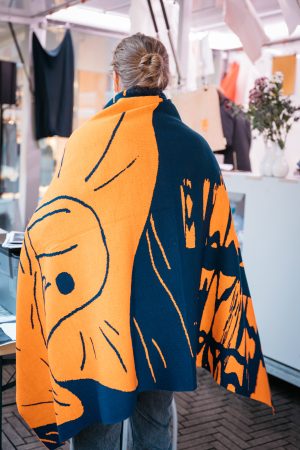
A person with tied-up hair wears an orange-blue blanket with a snail motif over their shoulders.

© Daniel Sadrowski

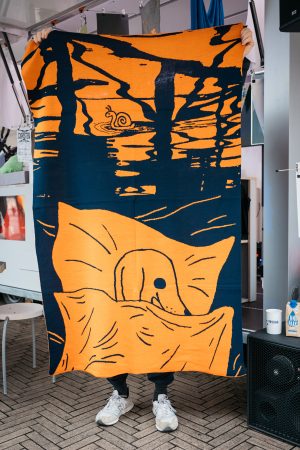
A person holds up a large orange-blue blanket with a drawing of a snail and a dog on it.

© Daniel Sadrowski

Anna Haifisch (*1986 in Zwenkau) ist Zeichnerin und Künstlerin, deren Arbeiten im Museum sowie in Zeitungen und Zeitschriften gleichermaßen zu sehen sind, ihre Comics wie The Artist erscheinen in mehreren Sprachen. Ob das vogelartige Wesen, das davon träumt, Künstler*in zu werden, oder Schappi — ihre Figuren sind vom Tierreich inspiriert und interessieren sich auf eigensinnige Art für die Kunstwelt. Allerdings ist der Humor zutiefst menschlich, mit dem Haifisch ein erzählerisches Universum entwickelt, das den Betrieb, seine Sehnsüchte und Absurditäten durchleuchtet. Dafür verbindet sie visuelle und erzählerische Elemente aus Design, Comic- und Kunstgeschichte. 

Die für die Grand Snail Tour gestaltete Decke Kleine orange Schnecke zeigt einen hundeartigen Charakter, der von einer Schnecke träumt. Dass die Decke erstmals für die Veranstaltung mit Anna Haifisch am Museum für Fotokopie in Dorsten im Grand Snail Trailer reiste, ist kein Zufall: Das Museum widmet sich einem Reproduktionsmedium, das Hochkultur und Alltagsgebrauch, Original und Vervielfältigung unauflöslich verknüpft – ein Spannungsfeld, das auch die Zeichnungen der Künstlerin bestimmt. Das textile Objekt gehört seither zur reisenden Sammlung der Grand Snail Tour: An kalten Tagen spendet sie als Decke Wärme, an warmen kann sie überall und jederzeit im Freien ausgebreitet werden und erinnert dann daran, dass auch die langsamste Reise Pausen braucht.

Artist

Open Artsit
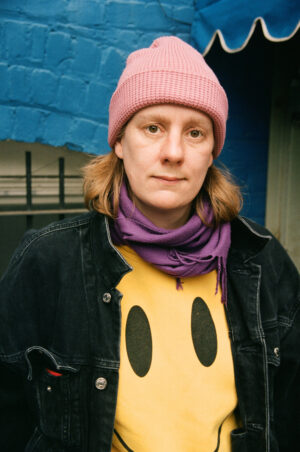
Portrait of artist Anna Haifisch, known for her comics and illustrations, wearing a pink beanie and a smiley sweater in front of a blue wall.

© Matthew James Wilson

Anna Haifisch

Anna Haifisch writes and draws comics, works as an illustrator for national and international media and designs print series, posters and design products.

View