Jump to main content (press Enter)Jump to the footer (press Enter)

Breadcrumbs

  1. Home
  2. Emscherkunstweg
  3. Public Hybrid

Public Hybrid

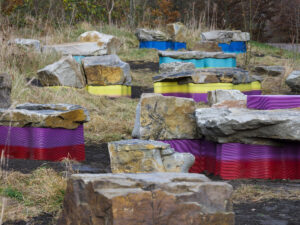
The installation Public Hybrid by David Jablonowski features multiple sandstone and plastic sculptures, their vibrant colors and irregular shapes appearing like artificial rock formations.

© Heinrich Holtgreve

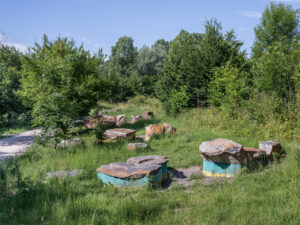
The sculpture Public Hybrid by David Jablonowski stands along the Emscherkunstweg, where layered Ruhr sandstone and 3D-printed plastic elements merge into an abstract landscape.

© Henning Rogge

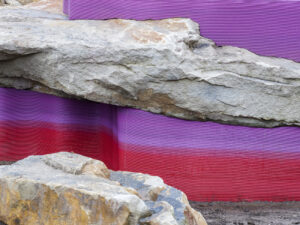
A detailed view of Public Hybrid by David Jablonowski showcases the layered combination of natural sandstone and vividly colored 3D-printed plastic, symbolizing the intersection of nature and technology.

© Heinrich Holtgreve

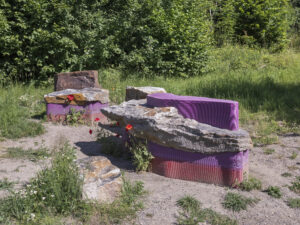
A close-up of Public Hybrid by David Jablonowski shows the colorful, 3D-printed plastic elements blending with natural sandstone, creating a striking contrast.

© Henning Rogge

Address

Emscher-Weg 
Adelenstraße 
44269 Dortmund

Open in Maps

David Jablonowski’s hybrid sculpture is located directly next to the Emscher-Weg bike path in the Schüren district of Dortmund.

In it, the artist, who grew up in Bochum, explores the history and future not only of this particular place, but of the entire Ruhr area as well. At the same time, he has created a contemporary monument that resembles a natural landmark and can be regarded as referring to the ecological improvements that have been made to Emscher River system.

In this multipart installation titled »Public Hybrid«, the artist combines the contrasting materials of sandstone and plastic. 3D printed elements made of recycled plastic and broken sandstone from the Ruhr region are stacked on top of each other like sediments. The resulting amorphous, artificial formations protrude out of the ground in a seemingly random fashion.  

The sandstone comes from the nearby town of Sprockhövel. It was formed about 320 million years ago and is one of the most resistant types of sandstone in Germany. Unlike this raw material that has been used by humans for millennia, the use of recycled plastic elements produced by 3D printing provides a glimpse into a digital, green vision of the future. 3D printing, or additive manufacturing technology, is in principle based on data for computer-aided physical translation. Through 3D printing, Jablonowski implicitly refers to invisible infrastructures that are created by the digital data traffic of public communication. He also juxtaposes waste, which is a material that needs the help of digital technology to become a resource, with geological materials that are quarried in a traditional way. This innovation through the combination of new technologies, nature, and artistic interventions also reflects the project of a generation of restoring the Emscher River.

Artist

Open Artsit

©Frey

David Jablonowski

In his sculptures, David Jablonowski shows the changes in communication and media content, influenced by industrial materials and technologies.
View

Choir of Missed Connections

Aram Bartholl

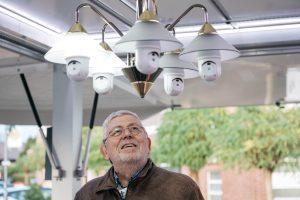
A man looks at a futuristic lamp with integrated surveillance cameras.

© Daniel Sadrowski

© Daniel Sadrowski

Wir stehen unter einem Kronleuchter, der statt Kerzen fünf 360°-Kameras in Glühbirnenform trägt. Diese suchen pausenlos nach einer Internetverbindung, aus der Audioschleife von Verbindungsaufbau und Reset – „Entering peering mode“ und „Power on!" – wird ein Chor aus Fehlermeldungen, der uns im Grand Snail Tour Trailer umgibt.

Aram Bartholl – Medienkünstler, Aktivist und Professor – stellt seit Dekaden unser Medienverhalten und die Ökonomien sozialer Netzwerke zur Diskussion. Im heutigen Internet sieht er die zentralen Probleme im Rückzug in private und kommerzielle Nutzung, in Überwachung, Manipulation und den endlosen Datenfluten. Dabei ist Kontrolle durch Licht kein neues Phänomen: Straßenbeleuchtung dienten nicht zuletzt dazu, Sichtbarkeit im öffentlichen Raum herzustellen, um längere Arbeitszeiten zu ermöglichen, Bewegungen zu erfassen, Menschen zu kontrollieren. Geprägt von seiner Nähe zum Chaos Computer Club, überführt Bartholl Lücken und Absurditäten des digitalen Alltags in Objekte und Interventionen. Mit Dead Drops (seit 2010) zementierte er USB-Sticks in Mauerwerke – Speicher für einen anonyme Datenaustausch ohne Cloud, ohne Algorithmus, ohne Konzern. Für Skulptur Projekte Münster entwickelte Bartholl 2017 thermoelektrische Installationen an historischen Orten der Stadt, die das Feuer als ursprüngliches Kommunikationsmedium in Energie umwandelten: Ein ofenbeheizter Offline-Router am Fernmeldeturm, lagerfeuergespeiste Ladestationen für Mobiltelefone am Pumpenhaus – und einen Kronleuchter aus teelichtbetriebenen LED-Lampen in der Schlossunterführung. 

Choir of Missed Connections zieht nun als Soundskulptur durch abgelegene Kleinstädte, sucht Verbindungen – und wird im kommunikativen Sinne vielleicht auf unerwartete Weise fündig.

Artist

Open Artsit

©Friso Gentsch

Aram Bartholl

In his sculptural works and workshops, Aram Bartholl explores digital media, surveillance and platform capitalism in public space.

View