Jump to main content (press Enter)Jump to the footer (press Enter)

Breadcrumbs

  1. Home
  2. Emscherkunstweg
  3. Public Hybrid

Public Hybrid

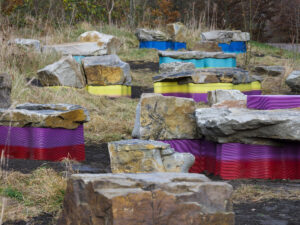
The installation Public Hybrid by David Jablonowski features multiple sandstone and plastic sculptures, their vibrant colors and irregular shapes appearing like artificial rock formations.

© Heinrich Holtgreve

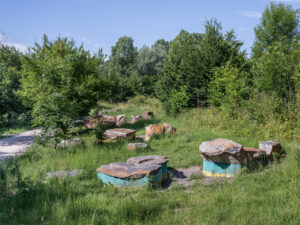
The sculpture Public Hybrid by David Jablonowski stands along the Emscherkunstweg, where layered Ruhr sandstone and 3D-printed plastic elements merge into an abstract landscape.

© Henning Rogge

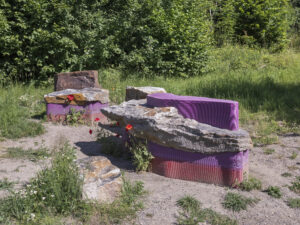
A detailed view of Public Hybrid by David Jablonowski showcases the layered combination of natural sandstone and vividly colored 3D-printed plastic, symbolizing the intersection of nature and technology.

© Heinrich Holtgreve

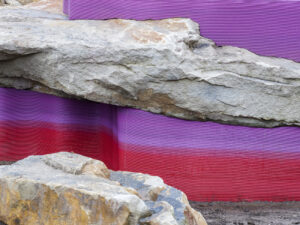
A close-up of Public Hybrid by David Jablonowski shows the colorful, 3D-printed plastic elements blending with natural sandstone, creating a striking contrast.

© Henning Rogge

Address

Emscher-Weg 
Adelenstraße 
44269 Dortmund

Open in Maps

David Jablonowski’s hybrid sculpture is located directly next to the Emscher-Weg bike path in the Schüren district of Dortmund.

In it, the artist, who grew up in Bochum, explores the history and future not only of this particular place, but of the entire Ruhr area as well. At the same time, he has created a contemporary monument that resembles a natural landmark and can be regarded as referring to the ecological improvements that have been made to Emscher River system.

In this multipart installation titled »Public Hybrid«, the artist combines the contrasting materials of sandstone and plastic. 3D printed elements made of recycled plastic and broken sandstone from the Ruhr region are stacked on top of each other like sediments. The resulting amorphous, artificial formations protrude out of the ground in a seemingly random fashion.  

The sandstone comes from the nearby town of Sprockhövel. It was formed about 320 million years ago and is one of the most resistant types of sandstone in Germany. Unlike this raw material that has been used by humans for millennia, the use of recycled plastic elements produced by 3D printing provides a glimpse into a digital, green vision of the future. 3D printing, or additive manufacturing technology, is in principle based on data for computer-aided physical translation. Through 3D printing, Jablonowski implicitly refers to invisible infrastructures that are created by the digital data traffic of public communication. He also juxtaposes waste, which is a material that needs the help of digital technology to become a resource, with geological materials that are quarried in a traditional way. This innovation through the combination of new technologies, nature, and artistic interventions also reflects the project of a generation of restoring the Emscher River.

Artist

Open Artsit

©Frey

David Jablonowski

In his sculptures, David Jablonowski shows the changes in communication and media content, influenced by industrial materials and technologies.
View

7000 Palmen

Cosima von Bonin

© Daniel Sadrowski 

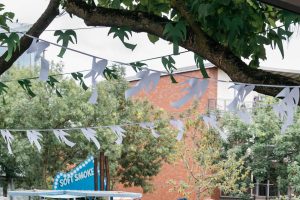
Die Palme ist Siegeszeichen und Strandbar-Logo, zentrales Motiv in der Bibel sowie der Urlaubswerbung, Wappenpflanze unzähliger Nationalflaggen und vielseitig genutzter/vielfach verschickter Emoji. Cosima von Bonin arbeitet mit dem populären Symbol als stilisierte Konturform. Sie nimmt dabei offensichtlich Bezug auf Beuys soziale Plastik 7000 Eichen - Stadtverwaldung statt Stadtverwaltung, für die er 1982 für die documenta 7 auf dem Vorplatz des Fridericianum in Kassel 7000 Basaltstelen aufschüttete, die mit jeder in der Stadt neu gepflanzten Eiche abgetragen wurden: Je mehr Bäume in Kassel gepflanzt wurden, desto kleiner wurde die Plastik. Noch heute sind die „Beuys-Eichen“ durch die jeweils daneben eingelassenen Stelen gut zu erkennen.  

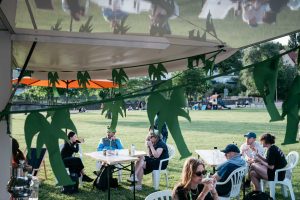
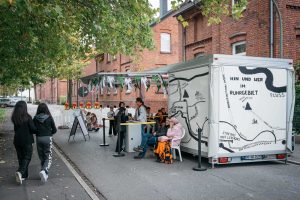
Die Künstlerin vervielfältigte die Pflanze 7000-fach als luftige Girlande in grün und weiß. Die Besitzer*innen der kostenlosen Edition – ob Museum, Schule oder Sportverein – können damit öffentliche Räume markieren. Die Methode der Vereinfachung ist uns auch aus anderen künstlerischen Arbeiten von Bonins bekannt: Sie fragmentiert, abstrahiert und erzeugt damit eine Anziehungskraft zwischen Wiedererkennung und Verfremdung. Generell ist Textil ein zentrales Material, beispielweise als collagierte Stoffbilder, übergroße Kleidungsstücke, Wandteppiche oder Skulpturen, die nach dem Vorbild bekannter Comicfiguren entstehen, oder Plüschtiere abbilden. 

Von Bonin wurde international und mit Einzelausstellungen im Museum Ludwig Köln, im MUMOK Wien, im SculptureCenter New York und zuletzt im Mudam Luxemburg gewürdigt und nahm 2007 an der documenta 12 sowie 2022 an der Biennale di Venezia teil. Als fester Bestandteil der Sammlung betont 7000 Palmen den öffentlichen Charakter der Grand Snail Trailer und schmückt den Trailer als willkommen heißenden Ort zwischen Marktstand, Vereinsheim und Kunstprojekt. 

Artist

Open Artsit

© Simone Junker

Cosima von Bonin

Cosima von Bonin is one of the most influential artists of her generation. She participated in documenta 12 in 2007 and the Venice Biennale in 2022.

View