Jump to main content (press Enter)Jump to the footer (press Enter)

Breadcrumbs

  1. Home
  2. Emscherkunstweg
  3. Public Hybrid

Public Hybrid

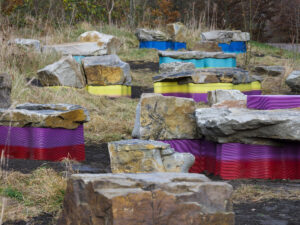
The installation Public Hybrid by David Jablonowski features multiple sandstone and plastic sculptures, their vibrant colors and irregular shapes appearing like artificial rock formations.

© Heinrich Holtgreve

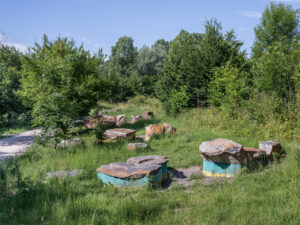
The sculpture Public Hybrid by David Jablonowski stands along the Emscherkunstweg, where layered Ruhr sandstone and 3D-printed plastic elements merge into an abstract landscape.

© Henning Rogge

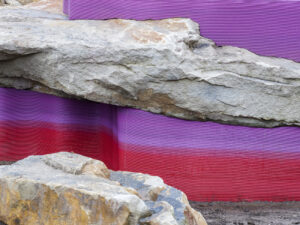
A detailed view of Public Hybrid by David Jablonowski showcases the layered combination of natural sandstone and vividly colored 3D-printed plastic, symbolizing the intersection of nature and technology.

© Heinrich Holtgreve

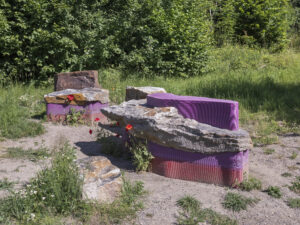
A close-up of Public Hybrid by David Jablonowski shows the colorful, 3D-printed plastic elements blending with natural sandstone, creating a striking contrast.

© Henning Rogge

Address

Emscher-Weg 
Adelenstraße 
44269 Dortmund

Open in Maps

David Jablonowski’s hybrid sculpture is located directly next to the Emscher-Weg bike path in the Schüren district of Dortmund.

In it, the artist, who grew up in Bochum, explores the history and future not only of this particular place, but of the entire Ruhr area as well. At the same time, he has created a contemporary monument that resembles a natural landmark and can be regarded as referring to the ecological improvements that have been made to Emscher River system.

In this multipart installation titled »Public Hybrid«, the artist combines the contrasting materials of sandstone and plastic. 3D printed elements made of recycled plastic and broken sandstone from the Ruhr region are stacked on top of each other like sediments. The resulting amorphous, artificial formations protrude out of the ground in a seemingly random fashion.  

The sandstone comes from the nearby town of Sprockhövel. It was formed about 320 million years ago and is one of the most resistant types of sandstone in Germany. Unlike this raw material that has been used by humans for millennia, the use of recycled plastic elements produced by 3D printing provides a glimpse into a digital, green vision of the future. 3D printing, or additive manufacturing technology, is in principle based on data for computer-aided physical translation. Through 3D printing, Jablonowski implicitly refers to invisible infrastructures that are created by the digital data traffic of public communication. He also juxtaposes waste, which is a material that needs the help of digital technology to become a resource, with geological materials that are quarried in a traditional way. This innovation through the combination of new technologies, nature, and artistic interventions also reflects the project of a generation of restoring the Emscher River.

Artist

Open Artsit

©Frey

David Jablonowski

In his sculptures, David Jablonowski shows the changes in communication and media content, influenced by industrial materials and technologies.

View

Marl

The Grand Snail Tour will be accompanied by literary, photographic and illustrative artists, who will collect impressions and reflections from the same city at the same time as the Trailer is there and put them into visual or literary form. The result is a paratext on the three-year tour, a travel chronicle in the form of a kaleidoscope of stories, connections and snapshots in the 53 cities of the region, revealing the simultaneities and non-simultaneities of the Grand Snail Tour.

Marl von Nikita Teryoshin

An older woman in a pink outfit with heart motifs leans against a white tiled wall. Behind her, a poster with red heart balloons is visible.

© Nikita Teryoshin

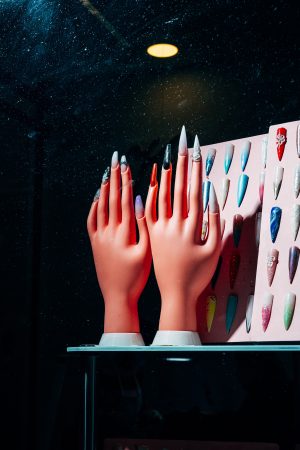
Two artificial hands with long, decorated nails stand in a store window. Next to them, a color palette displays various nail designs.

© Nikita Teryoshin

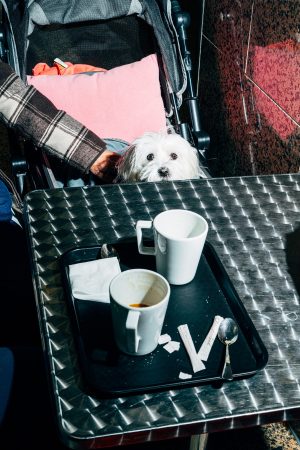
A small white dog looks out from a stroller behind a metal table with empty coffee cups. The scene is lit with strong lighting.

© Nikita Teryoshin

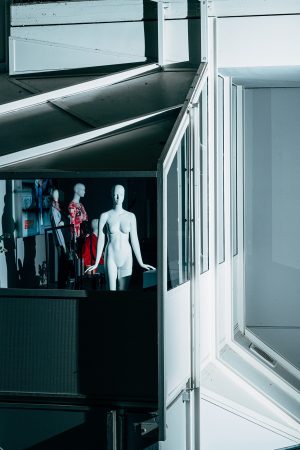
A mannequin in a store window with cold lighting. Additional mannequins and a reflection are visible in the background.

© Nikita Teryoshin

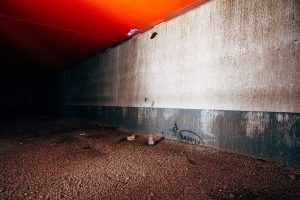
A dark underpass with a red-lit ceiling and a stained concrete wall. A graffiti tag reading "Banksy" is visible on the wall.

© Nikita Teryoshin

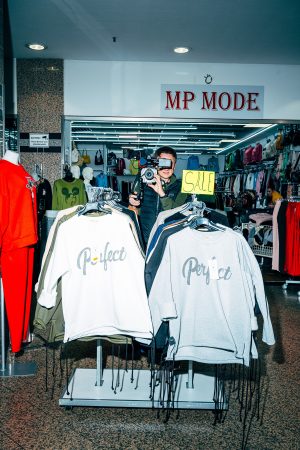
A man with a camera stands inside a clothing store with a SALE sign. In front of him, sweatshirts with the word "Perfect" are displayed.

© Nikita Teryoshin

A tray with two cups of coffee and pastries, held by a person wearing a white winter jacket. The pastries include a powdered sugar donut and a glazed fried ring.

© Nikita Teryoshin

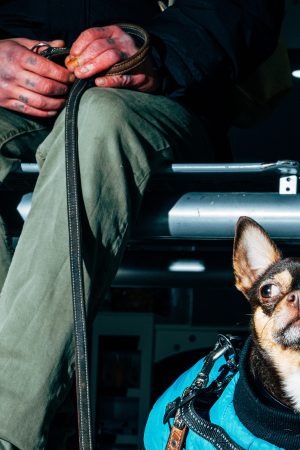
Close-up of a tattooed man holding a dog leash. Beside him, a Chihuahua wearing a blue jacket sits attentively.

© Nikita Teryoshin

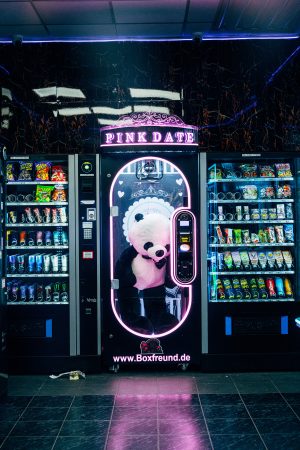
A vending machine labeled "Pink Date" in neon lights, surrounded by snack and drink dispensers. Inside the machine is an oversized plush panda costume.

© Nikita Teryoshin

Artist

Open Artsit

©Nikita Teryoshin

Nikita Teryoshin

Nikita Teryoshin, photographs defense exhibitions worldwide. His award-winning book “Nothing Personal” was published in 2024.

View