Jump to main content (press Enter)Jump to the footer (press Enter)

Breadcrumbs

  1. Home
  2. Emscherkunstweg
  3. Public Hybrid

Public Hybrid

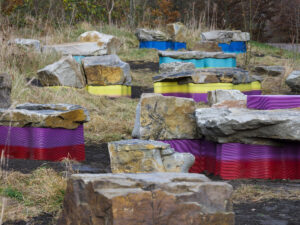
The installation Public Hybrid by David Jablonowski features multiple sandstone and plastic sculptures, their vibrant colors and irregular shapes appearing like artificial rock formations.

© Heinrich Holtgreve

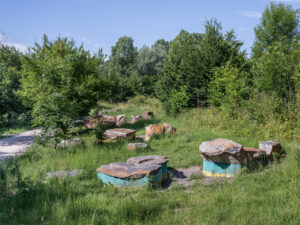
The sculpture Public Hybrid by David Jablonowski stands along the Emscherkunstweg, where layered Ruhr sandstone and 3D-printed plastic elements merge into an abstract landscape.

© Henning Rogge

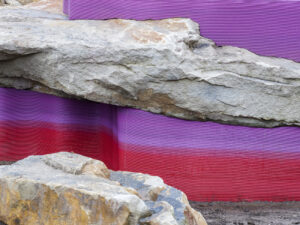
A detailed view of Public Hybrid by David Jablonowski showcases the layered combination of natural sandstone and vividly colored 3D-printed plastic, symbolizing the intersection of nature and technology.

© Heinrich Holtgreve

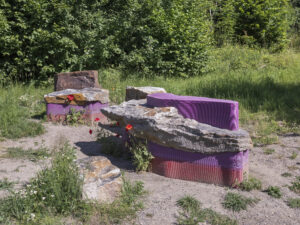
A close-up of Public Hybrid by David Jablonowski shows the colorful, 3D-printed plastic elements blending with natural sandstone, creating a striking contrast.

© Henning Rogge

Address

Emscher-Weg 
Adelenstraße 
44269 Dortmund

Open in Maps

David Jablonowski’s hybrid sculpture is located directly next to the Emscher-Weg bike path in the Schüren district of Dortmund.

In it, the artist, who grew up in Bochum, explores the history and future not only of this particular place, but of the entire Ruhr area as well. At the same time, he has created a contemporary monument that resembles a natural landmark and can be regarded as referring to the ecological improvements that have been made to Emscher River system.

In this multipart installation titled »Public Hybrid«, the artist combines the contrasting materials of sandstone and plastic. 3D printed elements made of recycled plastic and broken sandstone from the Ruhr region are stacked on top of each other like sediments. The resulting amorphous, artificial formations protrude out of the ground in a seemingly random fashion.  

The sandstone comes from the nearby town of Sprockhövel. It was formed about 320 million years ago and is one of the most resistant types of sandstone in Germany. Unlike this raw material that has been used by humans for millennia, the use of recycled plastic elements produced by 3D printing provides a glimpse into a digital, green vision of the future. 3D printing, or additive manufacturing technology, is in principle based on data for computer-aided physical translation. Through 3D printing, Jablonowski implicitly refers to invisible infrastructures that are created by the digital data traffic of public communication. He also juxtaposes waste, which is a material that needs the help of digital technology to become a resource, with geological materials that are quarried in a traditional way. This innovation through the combination of new technologies, nature, and artistic interventions also reflects the project of a generation of restoring the Emscher River.

Artist

Open Artsit

©Frey

David Jablonowski

In his sculptures, David Jablonowski shows the changes in communication and media content, influenced by industrial materials and technologies.
View

Werne

Begleitet wird die Grand Snail Tour von Künstler*innen aus dem Bereich Literatur, Fotografie und Zeichnung, die zeitgleich zum Aufenthalt des Tourmobils, Eindrücke und Reflexionen aus jeweils derselben Stadt sammeln und diese sie visuell oder literarisch ins Bild setzen. So entsteht ein Paratext zur 3-jährigen Tour, der in Form einer Reisechronik, ein Kaleidoskop an Geschichten, Verbindungen, Momentaufnahmen in den 53 Städten der Region als Gleichzeitigkeiten und Ungleichzeitigkeiten zur Grand Snail Tour sichtbar werden lässt.

Werne von Franziska Klose

Städte sind Cohabitate – artenübergreifende Lebensräume, urbane Biotope. 

In Werne gelten meine Blicke und Bilder der urbanen Flora und ihrer Habitate: Baustellen, Hinterhöfe, Fassadengrün, Blumenkübel, Brachflächen, Wasserläufe, Maisfelder, Blumenampeln, Steingärten und gleich bei meiner Ankunft die „Beete" aus Gleisschotter mit Ruderalpflanzen.

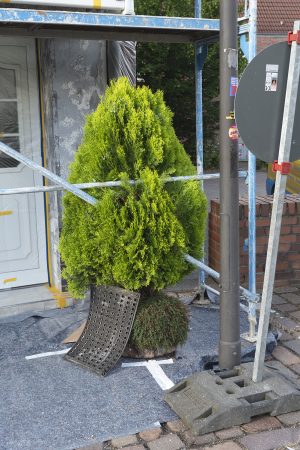
01 Werne Südmauer
Hauseingang mit Baugerüst, Fußmatte, Straßenschild, Lampenmast und Blümenkübel, darin mit Lebensbaum (Thuja) und Zwergmispel (Cotoneaster)

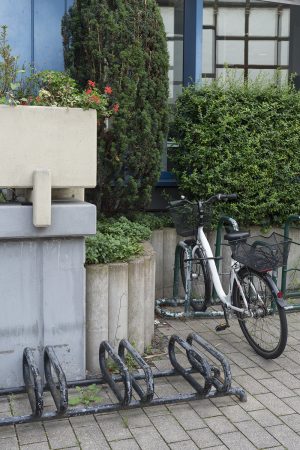
02 Werne Sparkasse
Hausfassade, Fahrradständer und diverse Blumenkübel mit Eibe (Taxus baccata), Pelargonie (Pelargonium), Ysander (Pachysandra), Buchsbaum (Buxus sempervirens) und Efeu (Hedera helix) sowie Gemüse-Gänsedistel (Sonchus oleraceus) und Hornklee (Lotus)

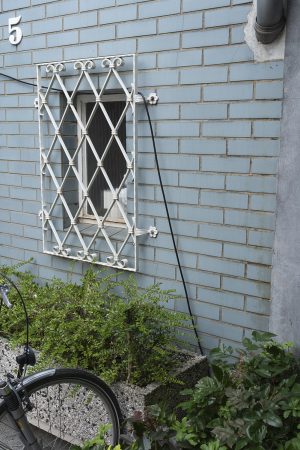
03 Werne Hinterhof
Gekachelte Hauswand, florales Fenstergitter und Blumentrog mit Immergrüner Kriech-Heckenkirsche (Lonicera pileata) und Ilex (Ilex aquifolium)

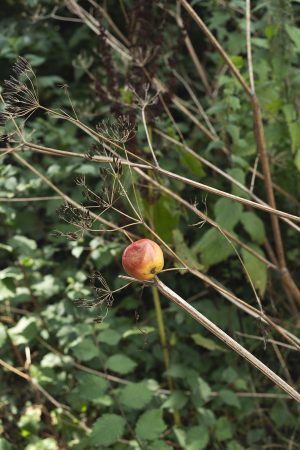
04 Werne Friedhof
Apfel (Malus), aufgespießt auf einem Wiesen-Kerbel (Anthriscus sylvestris), dahinter Ampfer (Rumex), Große Brennnessel (Urtica dioica) und Haselnuss (Corylus avellana)

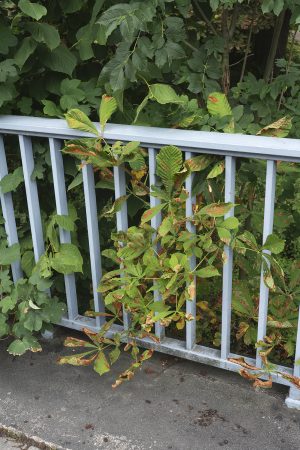
05 Werne Hornebachbrücke
Geländer an der Hornebach-Brücke, Gewöhnliche Kastanie (Aesculus hippocastanum), Sommerlinde (Tilia platyphyllos), Berg-Ahorn (Acer pseudoplatanus) und Esche (Fraxinus excelsior)

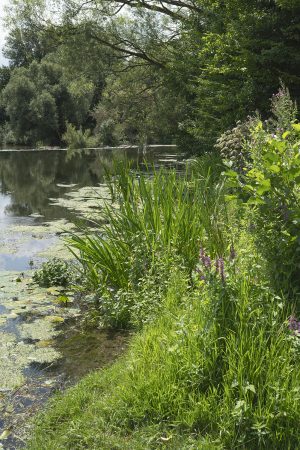
06 Werne Lippewehr
Am Lippe-Ufer, Gräser (Poa), Schwertlilie (Iridaceae), Flatterbinse (Juncus effusus), Wasserminze (Mentha aquatica), Gelbe Teichrose (Nuphar lutea), Ulme (Ulmus), Wiesen-Bärenklau (Heracleum sphondylium), Zottiges Weidenröschen (Epilobium hirsutum), Ackerwinde (Convolvulus arvensis), Weiderich (Lythrum) und Weiden (Salix) in Hintergrund

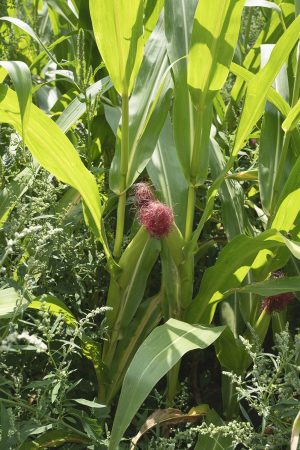
07 Werne MaisFeld
Maisfeld (Zea mays) mit Weißem Gänsefuß (Chenopodium album) und Rauhaarigem Amarant (Amaranthus retroflexus)

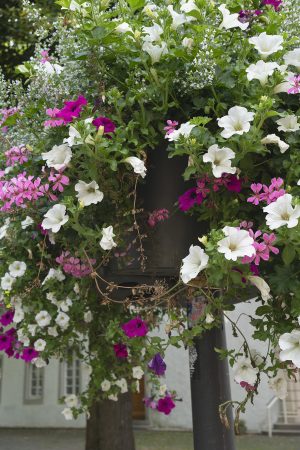
08 Werne Kloster
Blumenampel mit Petunien (Penunia), Pelargonien (Pelargonium) und Kleinblütiger Bergminze (Clinopodium nepeta)

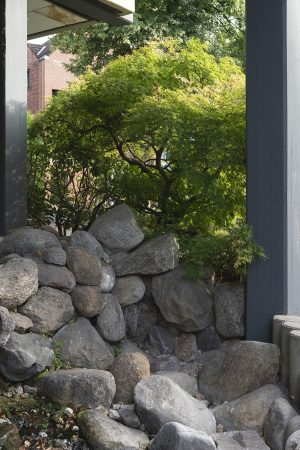
09 Werne Sparkasse
Steingarten mit kleinem Brunnen, Japanischem Ahorn (Acer japonicum), Ilex (Ilex aquifolium), Vogelmiere (Stellaria media), Kanadischer Goldrute (Solidago canadensis) und Moosen

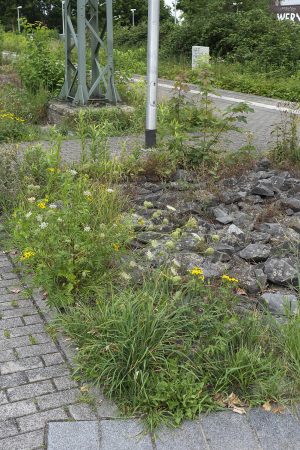
10 Werne Bahnhof
Angelegte Beete am Bahnsteig: Gleisschotter mit typischer Spontanvegetation/Wildwuchs: Rainfarn (Tanacetum vulgare), Wilde Möhre (Daucus carota), Stinkender Storchschnabel (Geranium robertianum), Kompass-Lattich (Lactuca serriola), Löwenzahn (Taraxacum officinale), Mäusegerste (Hordeum murinum), Kriech-Quecke (Elymus repens), Bergahorn (Acer pseudoplatanus), Kanadische Goldrute (Solidago canadensis), Blauer Natternkopf (Echium vulgare), Spitzwegerich (Plantago lanceolata), Vogelmiere (Stellaria media), Wiesen-Knäuelgras (Dactylis glomerata), Wilder Hafer (Avena fatua), Jacobs-Greiskraut (Senecio erucifolius) und Flechten

Stops

Open "Werne"
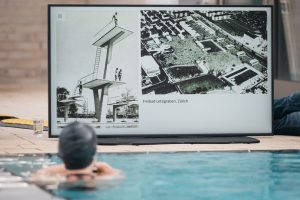
Screen displaying historical images of the Letzigraben outdoor pool in Zurich, viewed from the water.

© Daniel Sadrowski

24.7.25, 16–21 h

Chilling in Werne

Werne

Artist

Open Artsit

© Camilo Pachón

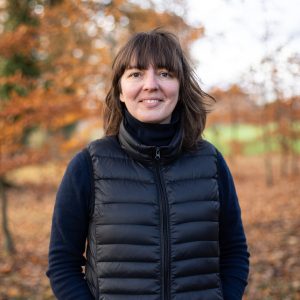
Franziska Klose

Franziska Klose (* 1977) is an artist and photographer. She has been working on post-industrial landscapes and contemporary nature since 2010. 

View