Jump to main content (press Enter)Jump to the footer (press Enter)

Breadcrumbs

  1. Home
  2. Emscherkunstweg
  3. Pool Lines

Pool Lines

The sculpture Pool Lines by Sofía Táboas consists of two large triangular structures covered in shimmering green mosaic tiles, blending into the surrounding landscape.

© Henning Rogge

Address

Gartenverein Im Massbruch e. V. 
Gevelsbergstraße 120 
44287 Dortmund

Open in Maps

Two large triangles together constitute a third triangular form. Their waist-high walls are about one metre thick; they both taper and flatten towards the ground.

The sculpture Pool Lines by Mexican artist Sofía Táboas is clad with shimmering green mosaic tiles. Are these the archaeological remains of a swimming pool from times when the Emscher was still a meandering river? Have we been projected into a mythical Bermuda Triangle, bordered by a strictly geometric greenstone mosaic? 

Or are these preparations for some future landing site? Facing each other, both triangles are open and encompass the section of a meadow that lies between an industrial estate and allotment gardens in the Dortmund district of Schüren. In the background flows the Emscher, which along this stretch has already been completely renaturated. While blending into its surroundings, the sculpture’s configuration remains an alien body as attractive as it is mysterious, a play between landscape and architecture. The interior space described by its walls is of the same nature as the exterior space around it. It both reflects and transforms the site of the installation: the scarcely cultivated green strip has become a garden whose velvet green walls invite us to linger a while.

Artist

Open Artsit

©Daniel Sadrowski

Sofía Táboas

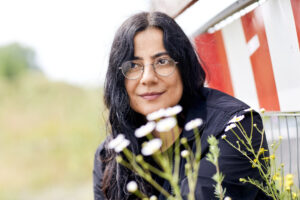
In her sculptures and installations, Sofía Táboas (*1968) explores how man-made and natural space is perceived and reshaped.
View

Local Blackouts

Lütfiye Güzel

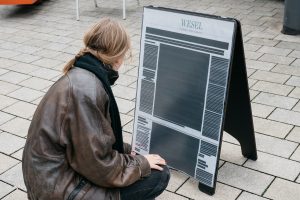
A person in a brown leather jacket looks at a large printed newspaper on a stand with the heading 'Wesel'.

© Daniel Sadrowski

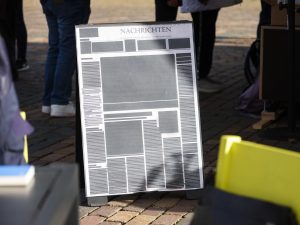
A sign with the word 'NACHRICHTEN' with an abstract newspaper layout with little text.

© Heinrich Holtgreve

Ausgangsmaterial ist ein besonders kurzweiliges Format aus dem Alltag: die Tageszeitung. Lütfiye Güzel, Poetin aus Duisburg und Vertreterin eines konsequent selbstverlegten, körpernahen Schreibens, lässt sich für die Grand Snail Tour von Projektpartner*innen und Passant*innen Lokalzeitungen und -beilagen aus den zu bereisenden Städten zusenden. Aus diesen Dokumenten erzeugt Güzel durch gezieltes Ausstreichen und Schwärzen von Textpassagen insgesamt 53 Gedichte — Local Blackouts —, die auf Aufstellern an jeder Station veröffentlicht werden.

Die Methode der Blackout Poetry ist eine Form der Found Poetry und wird bei Güzel zum politischen Akt. Das Schwärzen zitiert die Logik der Zensur, kehrt sie aber um, denn das unkenntlich Machen hat nicht Unterdrückung, sondern Verdichtung zum Ziel: Was bleibt, wenn der redaktionelle Lärm verschwindet? Lyrische Miniaturen, die in ihrer Knappheit dem Haiku ähnlich ist. Güzels Entscheidung, diese Textarbeiten im öffentlichen Raum zu zeigen, stellt zudem implizit die Frage: Für wen werden solche Texte geschrieben, und wer kommt darin vor?

Lokalzeitungen sind ein ambivalentes Medium. Sie fördern und informieren Nachbarschaften jenseits von Social Media — doch die Sprache und Nachrichtenauswahl ist häufig hetzerisch und vereinfachend. Tatsache ist, dass Lokalzeitungen an Bedeutung und finanzielle Unterstützung verlieren. Güzels Aneignung bewahrt und befragt dieses Erbe zugleich. Präsentiert auf herkömmlichen Presseaufstellern verleiht ihre Arbeit der Grand Snail Tour ein vertrautes Erscheinungsbild von regionaler Kultur und überführt diese gleichzeitig in die poetische Abstraktion.

Artist

Open Artsit

©Ben Knabe

Lütfiye Güzel

Lütfiye Güzel is a poet and has been publishing poems under her own label go-güzel-publishing since 2014.

View